













Ginowan, Oct 5 – For decades, residents of Japan’s Okinawa have strongly opposed the US military bases that dot the region but a subtle shift is under way, driven by Chinese sabre-rattling and economic challenges.
The bases are often seen as a disproportionate burden for Japan’s sub-tropical southernmost region.
Okinawa comprises 0.6 percent of the Japanese archipelago’s territory but contains 70 percent of the land used for US bases, and over half the 50,000-strong troop presence.
Base-related crime, accidents and pollution are potent irritants for Okinawa’s 1.5 million residents.
But with Okinawa now a front line in the burgeoning confrontation between China and regional US allies, the bases are increasingly important for American and Japanese defence strategies.
“Okinawa has been given an excessive burden,” said 39-year-old Ryo Matayoshi, a municipal councillor in the Okinawan city of Ginowan.
But “if we think about the security of Japan and of east Asia, the presence of bases on Okinawa is inevitable in a way,” he told AFP.
“A lot of people of our generation recognise that reality.”
Japan has long been wary of China’s growing military, but the stakes have risen as Beijing hardens its rhetoric on Taiwan and riles Tokyo with incursions around disputed islands.
In August, Chinese drills in response to US House Speaker Nancy Pelosi’s trip to Taiwan spotlighted the issue, with several missiles landing in waters near Okinawa.
“China’s reaction to the Pelosi visit and the Russian invasion of Ukraine… have elevated the threat perception,” said Yoichiro Sato, a professor and foreign affairs expert at Ritsumeikan Asia Pacific University.
– Crime, noise, pollution –
Anti-base opposition is deeply rooted in Okinawa, which was an independent kingdom before Japanese annexation in the 19th century.
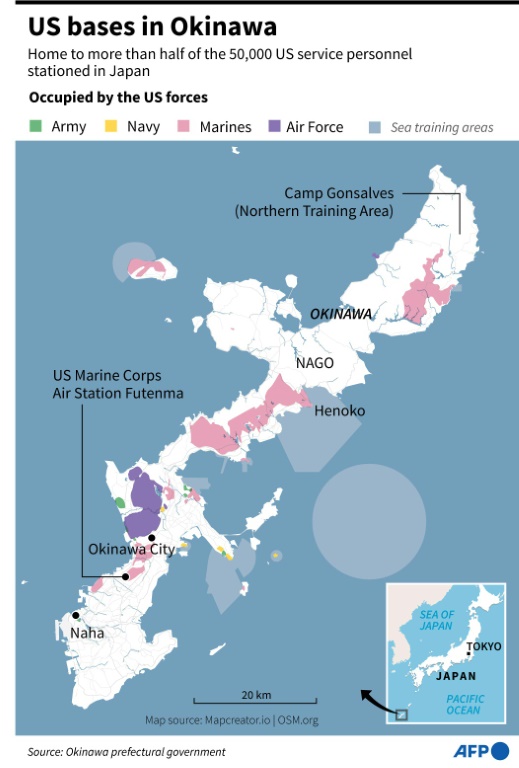
Map showing US military bases in Japan’s Okinawa. © AFP
Tokyo used it as a buffer to slow US forces during World War II and over a quarter of the population died in the 1945 Battle of Okinawa.
US occupation only ended in 1972, under a mutual treaty that left American bases in place.
And persistent flight noise, pollution and crime have kept anti-base sentiment strong, according to 82-year-old politician and peace activist Suzuyo Takazato.
Between 1972 and 2020, Okinawa’s government recorded 582 violent crimes involving base residents, and the kidnap and rape of a 12-year-old girl by three US soldiers in 1995 drew more than 80,000 protesters.
The treaty governing US forces limits Japanese legal oversight — a persistent sore point, said Takazato.
“When a helicopter crashed in the Okinawa International University, US soldiers surrounded it and wouldn’t allow any inspection,” she said.
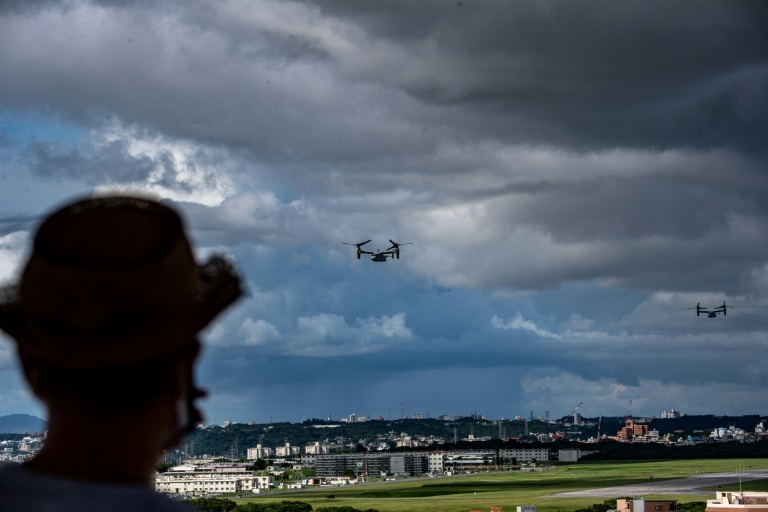
In recent years, opposition has crystallised around the planned relocation of Futenma air base in Ginowan, sometimes called the world’s most dangerous base because of its proximity to homes.
The government wants it shifted north to the less-populated Henoko, but base opponents want it removed altogether.
That is the position of governor Denny Tamaki, a prominent anti-base politician who was recently re-elected.
But at the local level, candidates backed by the pro-base Liberal Democratic Party, Japan’s ruling party, are gaining ground, including in the areas where Futenma and Henoko are located.
– ‘Economic realities’ –
The shift reflects security concerns, but also financial challenges, said councillor Matayoshi.
“More than just focusing on the question of the bases… people are concentrating on economic realities.”
Okinawa is Japan’s poorest prefecture and its tourist-dependent economy was hit hard by the pandemic.
Polling before Tamaki’s re-election found the economy was most voters’ top concern, and the share calling the bases their main priority went from 45 percent in 2014 to 32 percent this year.
The bases contributed just six percent to Okinawa’s GDP in 2017 but they bring lucrative government subsidies.
Conservatives woo Okinawan voters by telling them the LDP “brings those benefits from the mainland,” Sato said.
Politician Takazato points out that “three generations have grown up” with the US presence, which is now so established that some think “they have no choice but to accept it”.
But Matayoshi sees real ties being built, thanks to US military outreach and friendships between Okinawans and troops.
“We are becoming good neighbours,” he said.
Traditional anti-base sentiment makes it “hard in Okinawa to say publicly that you accept their presence”.
But “I think the opposition is gradually fading”.