


















NAIROBI, Kenya Feb 18 – The National Treasury has projected that Kenya could earn up to Sh371 billion in oil revenues over the life of the proposed Field Development Plan (FDP) for Blocks T6 and T7, as Parliament scrutinizes the fiscal implications of the long-awaited upstream project.
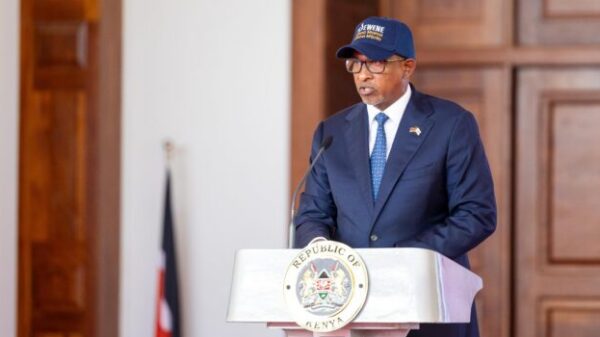
Appearing before the joint committees of the National Assembly Committee on Energy and the Senate Committee on Energy, Cabinet Secretary for the National Treasury, John Mbadi, assured lawmakers that the proposed development will not saddle the country with public debt.
“The FDP does not create any explicit or implicit public debt obligation for the Government. Financing of exploration, development, and production remains solely the responsibility of the contractor under the Production Sharing Contract framework,” Mbadi said.
Revenue Projections
According to Treasury estimates, Kenya stands to earn between USD 1.05 billion (Sh136 billion) at an average oil price of $60 per barrel and USD 2.9 billion (Sh371 billion) at $70 per barrel over the project’s lifespan.
Direct revenues will accrue from profit oil splits and government participation, while indirect benefits are expected across key State agencies and the wider economy.
The Kenya Pipeline Company (through Kenya Pipeline Refinery Limited) is projected to generate Sh42.3 billion in storage and handling fees. Meanwhile, the Kenya Ports Authority is expected to earn Sh41.9 billion from operations at the New Kipevu Oil Jetty.
Treasury further projects the creation of more than 3,000 direct, indirect and induced jobs, boosting Pay-As-You-Earn (PAYE) collections and social security contributions.
“Oil revenues are expected to positively contribute to GDP growth through upstream, midstream and associated economic activities,” Mbadi told legislators.
Fiscal Concessions
However, contractors have sought fiscal concessions totaling USD 1.331 billion (Sh173 billion) under the Project Specific Fiscal Terms (PSFTs), a request now under review.
Treasury analysis shows that at a base oil price of $60 per barrel, the Government’s net cash flow would decline from USD 3.485 billion under existing Production Sharing Contract (PSC) terms to USD 1.047 billion if all tax concessions and harmonisation adjustments were granted.
Conversely, the contractor’s net free cash flow would shift from negative territory to a projected USD 497 million, improving the project’s bankability.
Mbadi cautioned that any tax relief must comply with constitutional safeguards.
“Article 210 of the Constitution provides that no tax or licensing fee may be waived, varied or exempted except as provided by legislation,” he noted.
Under Kenya’s PSC regime, contractors recover petroleum costs subject to approved ceilings and regulatory oversight. Treasury defended the framework as globally competitive, noting that exploration and development remain high-risk, capital-intensive ventures fully financed by contractors.
“Robust safeguards are in place, including approval of annual work programmes and budgets, audit rights, ring-fencing of costs and phased development tied to commercial viability,” Mbadi said.
No Automatic Debt Exposure
Treasury clarified that the FDP does not automatically increase Kenya’s public debt burden. Exploration and development costs remain the contractor’s responsibility.
However, should the Government exercise its 20 percent back-in rights, it would be required to contribute approximately USD 1.228 billion, subject to the normal approval process.
Government-funded enabling infrastructure including land acquisition, power, water, roads and crude oil handling facilities, is estimated at USD 433.4 million (Sh56.3 billion).
Treasury indicated that these projects are either already budgeted for or at various stages of planning and feasibility assessment. Services such as power and crude handling will be provided at commercial tariffs regulated by relevant authorities.
Sensitivity to Oil Prices
Treasury acknowledged that projected revenues remain highly sensitive to global oil prices.
At $50 per barrel, Government earnings would fall to USD 411 million. At $70 per barrel, revenues would rise sharply to USD 2.856 billion.
Mitigation measures include conservative pricing assumptions and continuous market monitoring.
On crude transportation, Treasury endorsed a phased approach: initial trucking to minimise upfront capital costs, followed by a transition to rail transport as production scales up.
“This phased approach ensures logistics arrangements are matched to production levels while protecting Kenya’s share of oil revenue from excessive transportation costs,” Mbadi said.
Decommissioning and Oversight
The projected decommissioning cost of USD 331.8 million, plus associated interest, will be financed through a Decommissioning Fund established under the Petroleum Act. Contractors will progressively provide financial guarantees to ensure liabilities do not revert to the State.
“This approach aligns with international best practice and ensures adequate resources are set aside to meet end-of-life obligations,” the CS said.
Reflecting on the Early Oil Pilot Scheme (EOPS), which generated USD 28.3 million in revenue against USD 62.7 million in expenditure, Treasury maintained the initiative was never intended as a commercial venture but as a proof-of-concept exercise.
“The key lesson learnt is that Government should have a strong monitoring and oversight framework,” Mbadi said.
Under Section 57(2) of the Petroleum Act, oil revenues accruing to the State will be classified as non-tax revenue and deposited into a dedicated petroleum fund managed in accordance with the Public Finance Management Act.