







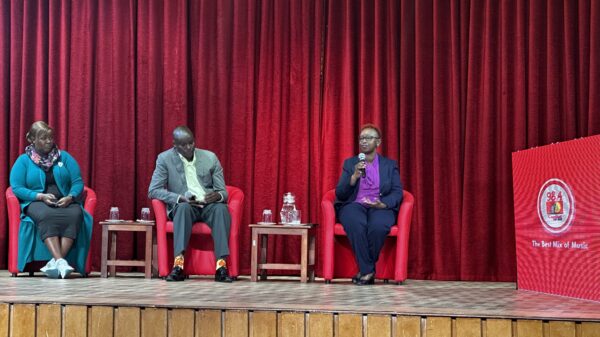








NAIROBI, Kenya Jun 11 – East African Community Affairs Principal Secretary Caroline Karugu has called on the National Assembly to expedite the amendment of national tax laws to align with community frameworks and avert an impending trade war with neighboring states.
Appearing before the National Assembly’s Departmental Committee on Finance and National Planning, Karugu cautioned that some provisions in the proposed Finance Bill, 2026 risk undermining regional treaties and triggering heavy trade retaliation against Kenyan exports.
At the heart of the Department ‘s submission was the critical push to redefine how goods moving within the bloc are classified. Under Kenya’s current Excise Duty Act, any goods brought into the country from a foreign country, special economic zone, or export processing zone are labeled as imports.
However, this directly contradicts the EAC Customs Management Act of 2004, which defines an import strictly as goods coming from a foreign country outside the bloc, while classifying the movement of goods between partner states as a transfer.
According to the Principal Secretary, labeling EAC goods as imports under Kenya’s tax laws allows them to be subjected to higher excise duty rates than domestic products. This practice has been flagged as discriminatory and a significant contributor to Non-Tariff Barriers (NTBs) within the region.
“Article 8(4) of the Treaty for the establishment of the EAC explicitly provides that Community laws take precedence over national laws on matters of implementation,” she explained to the lawmakers urging the Committee to adopt the regional definition.
PS Karugu raised concern over the omission of this redefinition in the Finance Bill, 2026, stating it places Kenyan market access at extreme risk of reciprocal punitive measures by partner states.
“The EAC market accounts for more than 29 per cent of Kenya’s total annual exports. Partner states are reportedly considering retaliatory measures if Kenya continues to impose discriminatory duties”, PS Karugu noted.
In her submissions, the PS highlighted several key sectors where proposed rollbacks on excise duty exemptions for EAC-originating goods could spark severe diplomatic and economic fallout.
She called on the Committee to align the Excise Duty Act with the EAC Treaty by reclassifying goods arriving from partner states as “transfers” rather than “imports.”
The distinction, the PS argued, carries significant commercial consequences for the Port of Mombasa. She noted that Dar es Salaam’s port is gaining approximately seven percent in annual regional market share while Kenya’s Northern Corridor is shedding around ten percent.
“Without the reclassification, Kenyan importers face excise exposure that incentivises routing cargo through Tanzania instead. Kenya will be the country that loses because we are the greatest beneficiaries of the East African community,” the PS told the Committee.
Weighing into the matter, the Members led by the Chairperson Kuria Kimani expressed concerns that Kenya’s liniency had not been reciprocated.
“Recently we had an engagement with the Kenya Association of Manufacturers on the Finance Bill and they noted that Kenya has been too linient with our EAC partners without reciprocation from them. There’s also the issue of stay applications which remains unresolved,” Kimani noted.
The meeting also deliberated a number of issues relating to the elimination of trade barriers and the need to sensitize all officials involved in facilitating free movement of people and goods across the region.
The Committee resolved to hold joint visits with other relevant House Committees to border points on a fact finding mission.