











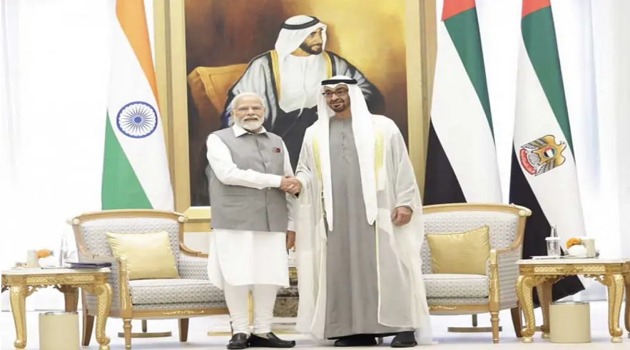

June 10 – As India pursues its Vision 2047 development agenda, the United Arab Emirates has emerged as a key strategic partner, with cooperation expanding across trade, energy, logistics, technology and infrastructure.
The growing relationship reflects New Delhi’s broader efforts to strengthen economic partnerships, secure critical supply chains and enhance connectivity with key global markets.
At the heart of the partnership is the UAE’s role as a major gateway linking Asia, the Middle East and Europe. India views the Gulf nation as a critical logistics and transportation hub, particularly within the framework of the proposed India-Middle East-Europe Economic Corridor (IMEC), which aims to create new trade routes connecting the three regions.
The partnership gained further momentum in May 2026 when the two countries signed a strategic cooperation agreement covering advanced technology, innovation, industrial development, maritime security and information sharing. The agreement is expected to unlock new investment opportunities and strengthen collaboration in sectors considered vital to future economic growth.
Energy security remains a central pillar of the relationship. India continues to work closely with the UAE on strategic petroleum storage and energy infrastructure, with the Fujairah energy hub playing an increasingly important role in supporting India’s long-term energy needs.
Located outside the Strait of Hormuz, Fujairah provides India with additional storage capacity and greater resilience against supply disruptions arising from market volatility or geopolitical tensions.
Beyond bilateral cooperation, the partnership aligns with wider regional initiatives such as the I2U2 grouping, which brings together India, the UAE, Israel and the United States to promote collaboration in technology, infrastructure, logistics, food security and investment.
Analysts say the relationship represents a modern model of economic cooperation built on investment, trade and sector-specific collaboration rather than traditional alliance structures. This flexibility allows both countries to pursue shared economic interests while maintaining broader international partnerships.
With global supply chains undergoing significant transformation and countries seeking greater economic resilience, the India-UAE partnership is expected to play an increasingly important role in shaping trade, energy and connectivity across South Asia and the Middle East.
As projects such as IMEC advance and cooperation deepens in strategic sectors, both nations are positioning themselves at the centre of emerging regional economic networks that could influence global commerce for decades to come.