














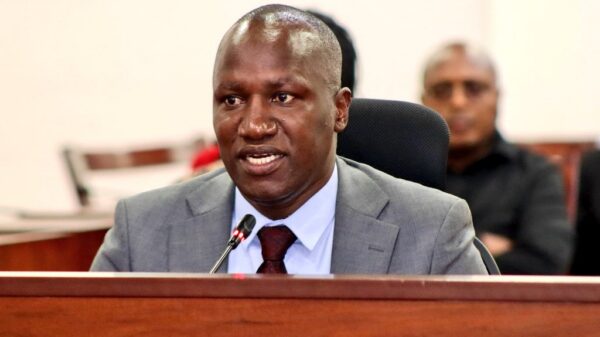


NAIROBI, Kenya Mar 5 – Israel’s Ambassador to Kenya Gideon Behar has defended the recent military strikes on Iran, saying the operation targeted critical military and nuclear infrastructure and was necessary to prevent Tehran from acquiring capabilities that could threaten Israel and destabilize the wider region.
Speaking during an interview with Capital in the Morning Thursday, Behar said the strikes, carried out jointly with the United States, were aimed at halting Iran’s nuclear and ballistic missile programmes, which he said were being developed with the intention of destroying Israel and expanding Tehran’s influence across the Middle East.
“The Iranian regime’s strategy is to develop atomic weapons and thousands of ballistic missiles to launch at Israel and to destabilize the region. We took a pre-emptive strike with the United States to stop the Iranian regime from acquiring these capabilities,” he said.
The US and Israel have bombed targets across Iran for days now as President Donald Trump declared that the country’s air defences, air force, navy, and leadership were “gone”.
The Israeli military said it had struck Iran’s presidential office, a covert nuclear compound, and a Revolutionary Guards commander in Tehran, while the US military said it had destroyed command facilities, missile launch sites and airfields.
Iranian authorities did not comment. But explosions were reported across Iran, where the Red Crescent has said 780 people have been killed since Saturday.
Iran has responded to the strikes by launching deadly missile and drone attacks on Israel and Gulf states hosting US bases.
The Israel Ambassador to Kenya said the Iranian government lacks legitimacy both domestically and internationally, insisting that many Iranians oppose the ruling regime.
“There is a big difference between the Iranian people and the Iranian regime,” Behar said. “The Iranian people are peaceful and modern, but the regime is destructive and terroristic. It has no legitimacy among its own people and no legitimacy internationally.”
He cited ongoing protests in Iran and alleged human rights abuses by security forces as evidence of widespread discontent within the country.
The envoy further argued that Iran’s military expansion has come at the expense of its citizens, accusing the government of diverting resources from public services to fund weapons programmes and support militant groups abroad.
“Billions of dollars are being spent on missiles and proxies while ordinary Iranians struggle with inflation, lack of electricity and water, and economic hardship,” he said.
Behar also warned that Iran’s activities have extended beyond the Middle East, claiming Tehran has supported armed groups that operate in parts of Africa, including the Horn of Africa.
He said weakening Iran’s ability to finance such networks could help reduce the operational capacity of extremist groups in the region.
“If the Iranian support to these organizations stops, their ability to cooperate with other terrorist groups will be dramatically reduced,” he said.
According to the envoy, Israel acted at a critical moment when Iran was allegedly moving parts of its nuclear and missile programmes into underground facilities to shield them from potential attacks.
“We knew that once these capabilities were buried underground it would be almost impossible to stop them from acquiring an atomic bomb,” he said.
Behar argued that Israel had “no choice but to act” to defend itself, pointing to what he described as repeated threats by Iranian leaders against Israel.
The ambassador also accused Iran of backing militant groups across the region, including Hezbollah, Hamas and the Houthis, saying Tehran has been financing and training proxy organizations that have carried out attacks in the Middle East.
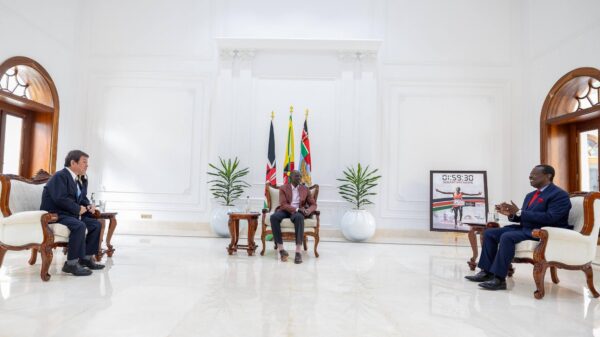
On Kenya’s position, the ambassador emphasized the long-standing relationship between Nairobi and Tel Aviv, describing the two countries as close partners.
“Israel sees Kenya as a close friend. Our relationship is based on mutual respect, shared values and a long history of cooperation,” he said.
Behar expressed confidence that the outcome of the conflict would lead to a more stable Middle East, arguing that removing what he described as a destabilizing influence in the region could open the door for greater economic cooperation and security.