













It is now becoming increasingly embarrassing to watch the campaign trail. I mean, is it that these politicians on the campaign trails are easily excitable or their communication strategists are just not up to scratch.
You see, there are things that Kenyans have accepted and probably some of these politicians looking for high office should understand and move on. Telling a mobilised crowd that rival aspirants are state projects or thieves or traitors and all that seems to be doing just the opposite – popularizing the very people they intend to denigrate.
Silently it is a ‘known secret’ that at the end of the day, it is never about the excellent choice, but the most prudent choice given the current circumstances and different elections have different dynamics and it is naïve and simplistic to use the past as the only benchmark for what the outcome of an election will be. The dynamics of what some politicians call state projects today are totally different from what prevailed in 2002. That probably explains why Baba as a state project today is turning out to be the very spark that most Kenyans who had given up hope of ever voting again needed to come out in large numbers and make Baba the fifth. Twenty years ago, it was probably a stark reminder that voting President Uhuru Kenyatta then would have been giving president Moi power to rule via proxies.
One thing that is clear is that the very people who are now crying foul were themselves angling to be state projects. How can a man who has struggled for generations for multi-party democracy and most recently devolution be a state project? Word has it that for all his efforts, as the project of the people all these years, the “state” if there is such a voting block has decided to collude with the people to pave way for the people’s president to ascend to the topmost leadership.
Granted, in Deputy President William Ruto, Baba has a formidable opponent and what the Kenya Kwanza team does not understand is that going around talking about Baba as a state project essentially galvanises his supporters, most of who probably believe that the final jigsaw for surmounting what has been a stumbling block to Baba’s presidency is now the stepping stone to the presidency. Just this belief alone has spurred many to come out and rally others to register as voters and probably will spur many more to come out and vote. And all these has been occasioned by negative campaigns, which are increasingly turning out to favour the very people they are intended to disfavour.
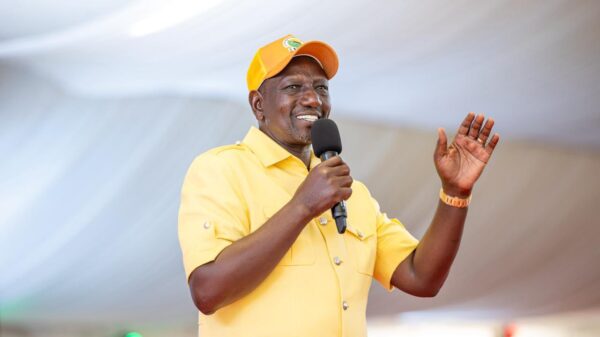
A colleague of mine and I decided to do a recording of the political news stories from all the major TV stations and it’s interesting what we found. Since the earthquake, for instance, all the soundbites from the two major political formations have predominantly been about the other formations. The campaigns in the last few days for instance, has seen Azimio la Umoja team either defend themselves from accusations of Baba being a state project or attack the hustler coalition. In Kisii, the Deputy President and his potential running mate Musalia Mudavadi exchanged close to three minutes of prime time talking about Raila Odinga and attacking president Uhuru Kenyatta. Interesting, the leaders behind them looked as uninspired by their political speak as the crowd in front.
One could see the shock on their faces when Musalia Mudavadi talked of President Uhuru Kenyatta using a remote control to control Baba and his DP when he becomes the president. But that is not my point. I know politicians get excited by crowds and we should never doubt the effect of a crowd on a politician who cannot pull any.
Nevertheless, it does seem like Deputy President William Ruto and Baba have locked this to a two-horse race. Azimio la Umoja seems to be whipping the Kenya Kwanza, hot on the heels of two principals having joined the DP. That tells you that with the Kenya Kwanza stuttering in areas they ought to have gained ground, there is no chance that another force would imagine going it alone. The distributed campaign by Azimio that seems to be everywhere and drumming up support for Baba is just is poised to be much for the rivals. And with the eminent reinvigoration of the coalition by the entry of Jubilee, it is likely to be interesting.
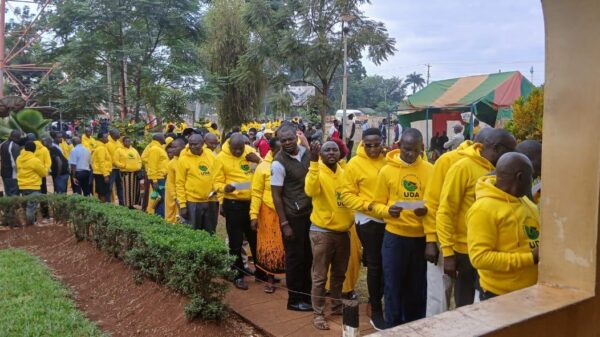
There is a sense in which keeping the electorate energised and keeping the campaign going with a presidential candidate constantly in the public domain is a likely clincher here. It is the reason the DP was way ahead when Tanga Tanga was everywhere rallying Kenyans and outwitting Baba in terms of number of campaign meetings. That is in the past now and the distributed campaigns strategy by Azimio la Umoja is changing the narrative. In politics, there is nothing bigger in terms of impact as what the Azimio heavyweights are doing for baba – pulling crowds and passing the Azimio la Umoja message even in Baba’s absence. One wonders whether the Kenya Kwanza principals can even pull crowds in the absence of the Chief Hustler! It will take something out of this world to beat this distributed campaign strategy and with pseudo principals, in Kenya Kwanza it will take a toll on the Deputy President, who has to probably organise and finance and be in all Kenya Kwanza rallies.
But for both formations the gap in terms of messaging and audience segmentation is glaring. There are four levels of strategic communication in a campaign. First is the public communication and here is where the primary audience is and you would expect messages to be tailored to the specific publics where these leaders are campaigning. This level is exciting, is prone to goofs and if not well planned may render the second level of mass communication, especially for a presidential candidate unsuccessful. In a public rally, you can only reach so many people and you have the advantage of passing the message in its entirety.
However, a critical communication strategy should be deployed here because the media at the second level will only pick a slice of what is said in the public rally for the all-important and populous mass audience. Suffice to note, it is what the mass media picks that sets the tone and give as many Kenyans as you can guess a frame of thought. Sadly, our political communication strategists in these two camps are oblivious of strategies that would help their candidates leverage on soundbites to purvey their main agenda. The media likes the rebuttals, especially when they are outrageous and spark retaliatory outbursts; they make for interesting soundbites and capture more eyeballs. Critics will say that politicians have to excite the crowd, but then a critique will opine that the circus means our political communication strategists are failing to make the most significant of their agenda the most interesting and exciting to the crowds in public rallies. Consequently, they are failing to speak issues to the composed mass audience at home or are exposed to soundbites that carry very little of the substantive agenda.
The centrality of what the media purveys and the reason why communication strategists in these political formations need to up their game is in the third level of interpersonal and group communication. You see, we always talk of that which the media captures as the most important issues of the day and when communication strategists fail to package the most important issues for soundbites, then the public ends up talking of the frivolous and the salacious. The last level is the behaviour change level, it is influenced by the awareness created by the mass media, the conversations propagated at the interpersonal and group communication and ultimately the vote cast. Simply put, what politicians say and do in public rallies should not just be assumed to be about the public in those rallies. There is a big audience out here and responsive and dynamic political communication strategists win elections by having robust talking points that will be blown big as broadcast soundbites and quotable quotes; filter through interpersonal and group communications and lead in a favourable voter behaviour.
The author is a PhD Candidate in Media Studies and Political communication.