












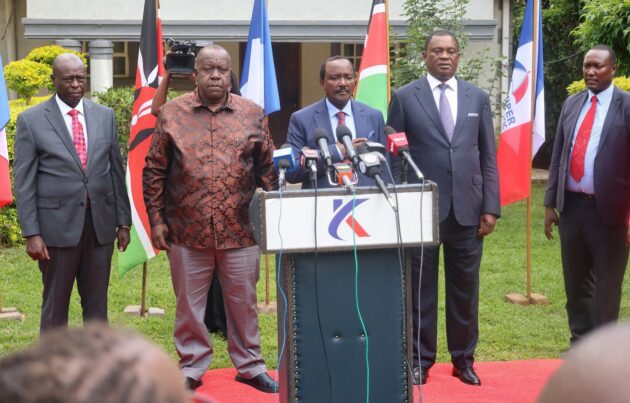

NAIROBI, Kenya, June 11 — Kenya’s opposition coalition under the United Alternative Government banner has sharply criticised President William Ruto’s administration ahead of the presentation of the 2026/2027 national budget, accusing the government of pursuing policies that are deepening the country’s debt crisis and worsening the burden on ordinary citizens.
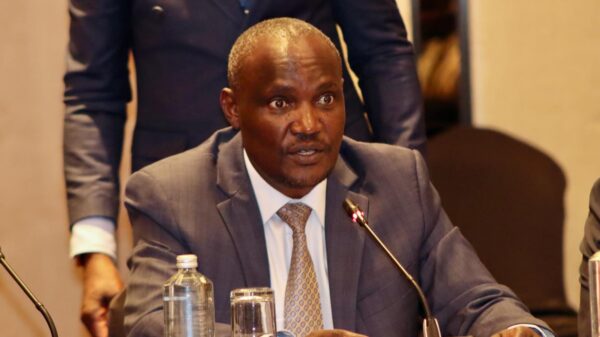
Speaking during a joint opposition address on Wednesday, Wiper Party leader Kalonzo Musyoka unveiled what the coalition described as a “People’s Budget” — an alternative economic plan aimed at reducing the cost of living, improving public services and cutting reliance on borrowing.
Kalonzo said the government’s proposed Ksh4.82 trillion budget reflects misplaced priorities and excessive expenditure at a time when many Kenyans are struggling with unemployment, high food prices and rising taxes.
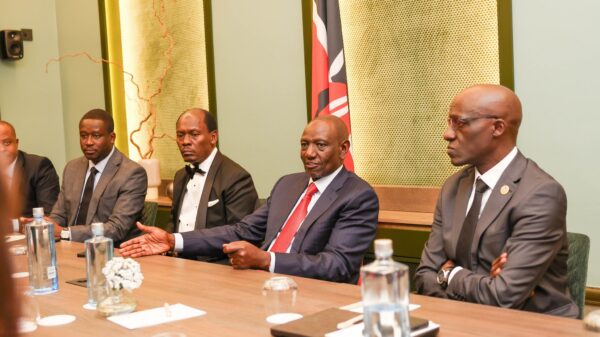
The opposition leader was joined by Democracy for Citizens Party (DCP) leader Rigathi Gachagua, Democratic Party leader Justin Muturi and Jubilee Deputy Party Leader Fred Matiang’i.
According to the coalition, the government’s projected revenue of Sh3.63 trillion falls significantly short of planned expenditure, leaving a budget deficit of more than Sh1 trillion that will have to be financed through additional borrowing.
Kalonzo warned that the growing debt burden risks placing future generations under severe financial pressure.
“The country is borrowing beyond its means while essential sectors continue to suffer from underfunding,” he said.
The coalition particularly criticised the government’s allocation towards debt repayment, arguing that the amount set aside for servicing loans now rivals or exceeds spending on critical sectors such as education.
Opposition leaders accused the government of failing to adequately finance free education programmes, claiming parents are increasingly being forced to cover costs that should be met by the State.
They pointed to funding shortfalls in Free Primary Education, Junior Secondary School and Free Day Secondary Education, insisting that access to education should remain fully supported by government funding.
The coalition also linked recent unrest and fire incidents in schools to what it described as neglect of student welfare, mental health services and safety infrastructure in learning institutions.
On healthcare, the opposition renewed attacks on the Social Health Authority (SHA), claiming the programme has failed to deliver efficient healthcare services despite mandatory contributions by citizens.
Kalonzo described SHA as an expensive system that continues to face operational challenges while public hospitals struggle with shortages of medicines, equipment and personnel.
The coalition further questioned the government’s continued investment in technology contracts linked to SHA, saying the funds would be better directed towards frontline healthcare services.
The opposition also criticised several proposals contained in the Finance Bill 2026, especially taxes targeting digital financial services and mobile phone users.
Among the measures opposed by the coalition are the proposed 16 percent VAT on mobile money transaction fees and a 25 percent excise duty on mobile phones upon activation.
The leaders argued that such measures would disproportionately affect low-income Kenyans who rely heavily on mobile money platforms for daily transactions and small businesses.
The coalition additionally raised concerns over plans to grant the Kenya Revenue Authority expanded access to taxpayer information, warning that the move could expose citizens to intrusive monitoring and excessive taxation.
Opposition leaders also opposed any attempts to privatise or dispose of strategic national assets, including the Kenya Ports Authority and the government’s stake in Safaricom, saying such decisions should involve public participation and parliamentary scrutiny.
As an alternative, the United Alternative Government proposed a Ksh4.32 trillion “People’s Budget,” which it says would significantly reduce the fiscal deficit through improved efficiency, tighter expenditure controls and better revenue collection rather than imposing new taxes.
The coalition’s proposals include increased funding for education and healthcare, restoration of programmes such as Linda Mama and Edu Afya, creation of an Ksh80 billion youth employment programme and removal of taxes proposed on mobile money services and mobile phones.
It also pledged to abolish the Affordable Housing Levy and reduce spending at State House and the National Intelligence Service (NIS), redirecting some of the savings towards irrigation and food security programmes.
The opposition further proposed the introduction of a Single Treasury Account to curb corruption, eliminate duplicate payments and address pending bills flagged in Auditor General reports.
Kalonzo also faulted the government for failing to allocate compensation funds for victims of the June 2024 anti-government protests, including those affected by alleged police brutality and human rights violations.
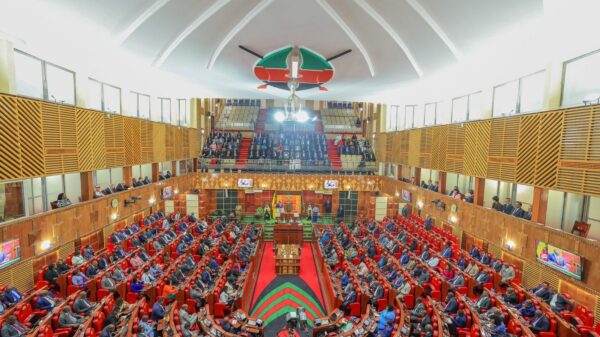
Addressing Members of Parliament ahead of debate on the budget and Finance Bill 2026, the opposition urged legislators to reject proposals they described as punitive to ordinary Kenyans.
The coalition maintained that its alternative budget framework is designed to restore accountability in public spending while easing economic pressure on households and businesses across the country.