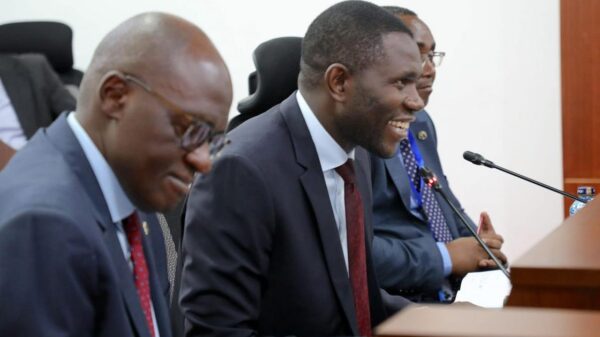














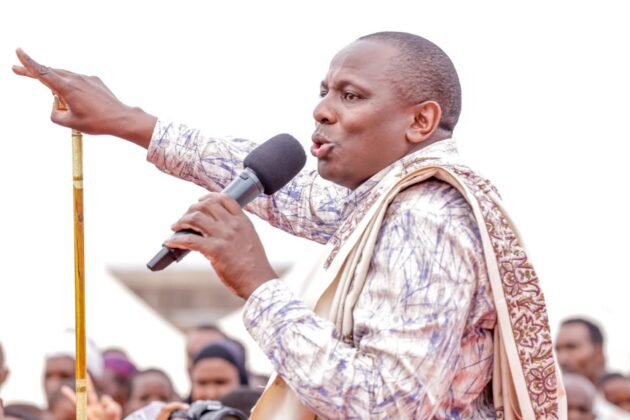

NAIROBI, Kenya Feb 19 – National Assembly Majority Leader Kimani Ichung’wah has lifted the lid on what he termed a deeply disturbing network of rogue state officials allegedly colluding with human trafficking syndicates to recruit and transport Kenyans to fight in the Russia–Ukraine war.
Addressing the House, the Kikuyu MP disclosed that a joint investigation by the National Intelligence Service and the Directorate of Criminal Investigations had uncovered collusion involving officers drawn from immigration, security agencies and even Kenya’s foreign missions.
“There has been collusion between officers from the Directorate of Criminal Investigations, the Directorate of Immigration Services and the National Employment Authority,” Ichung’wah told MPs.
Ichung’wah told the House that more than 1,000 Kenyans have reportedly been recruited and trafficked to Russia since the war with Ukraine began, many lured by promises of lucrative salaries, hefty bonuses and foreign citizenship.
According to the investigation, rogue recruitment agencies have targeted former military and police officers as well as unemployed civilians aged between their mid-20s and 50s. Recruits are allegedly promised monthly pay of up to Sh350,000 and bonuses ranging from Sh900,000 to Sh1.2 million.
However, upon arrival, many reportedly find themselves deployed to front-line combat roles after minimal military training.
“They are told you are going to work as a guard… only to get there and you are taken to military camps,” Ichung’wah said.
“You’ve only trained for three weeks. They are basically just giving you a gun to go and die.”
He directed the ministries concerned to identify the officers involved and ensure swift accountability warning that those implicated would face the full force of the law.
“Government offices are not to be used for criminal activities,” he said.
The Majority Leader singled out Kenya’s embassy in Moscow, demanding internal accountability.
“Our ambassador in Moscow must be able to identify the officers within the embassy that may have colluded with these criminals. Our embassy must be beyond reproach. It must be the place where Kenyans can seek refuge, not exploitation,” he said.
Casualties and Missing Persons
The House was told that the human cost of the scheme is mounting. As of February 2026, 39 Kenyans are hospitalised, 30 have been repatriated, 28 are missing in action, 89 remain on the front line, one is detained, and another has completed his contract.
At least one Kenyan has died, while several others have returned home injured or traumatised.
Initially, recruits are said to have departed through Jomo Kenyatta International Airport using tourist visas, transiting through Turkey and the United Arab Emirates.
But with increased surveillance at JKIA, traffickers allegedly shifted tactics, routing victims through South Africa, Uganda and other neighbouring countries to evade detection.
“When JKIA is closely monitored, you hear now they have moved through South Africa, Uganda and other neighbouring countries,” Ichung’wah said.
Immediate Crackdown
The revelations drew sharp reactions from lawmakers across the aisle who urged the NIS and DCI to act with speed against rogue agencies.
Baringo North MP Joseph Makilap described the matter as chilling, warning that Kenya’s vulnerability to trafficking networks had reached alarming levels.
“I am extremely shocked by the manner in which Kenyans can be taken to Moscow to fight another sovereign country, Ukraine. This is a chilling matter,” he said
Taita Taveta Woman Representative Lydia Haika called for a coordinated, whole-of-government response, noting that complaints about exploitative recruitment agencies frequently reach parliamentary committees.
“The problem of rogue agencies that continue to exploit Kenyans persists daily. This is one of the most serious cases, but there are many more Kenyans suffering out there,” she said.
The disclosures are likely to intensify scrutiny of Kenya’s labour migration oversight framework and the integrity of public offices tasked with safeguarding citizens.
Ichung’wah insisted that the crackdown would not spare any official, regardless of rank.
“This House must send a clear message no public officer will be allowed to aid criminal syndicates that trade in the lives of our people,” he said.