






NAIROBI, Kenya, Jan 17 — President Donald Trump has proposed that Ethiopia could “give or sell” electricity generated from the Grand Ethiopian Renaissance Dam (GERD) to Egypt and Sudan as part of a renewed American push to break the long-running deadlock over the Nile waters.
In a letter dated January 16, addressed to Egyptian President Abdel Fattah el-Sisi, Trump said Washington was ready to restart mediation between Egypt and Ethiopia to “responsibly resolve” the question of Nile water sharing “once and for all.”
He said a successful deal would guarantee “predictable water releases during droughts and prolonged dry years for Egypt and the Sudan,” while allowing Ethiopia to generate “very substantial amounts of electricity, perhaps some of which can be given, or sold, to Egypt and/or the Sudan.”
Trump said the United States believed “no state in this region should unilaterally control the precious resources of the Nile, and disadvantage its neighbors in the process.”
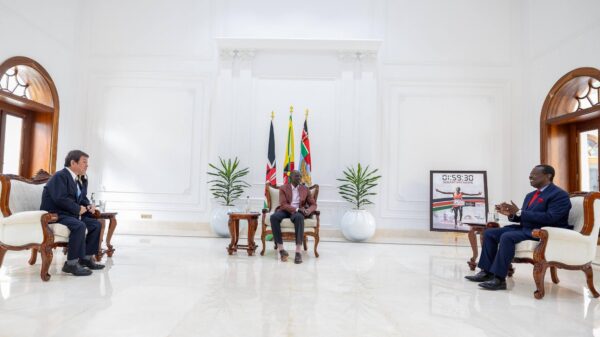
His proposal comes months following the inauguration of the $5 billion GERD in September 2025 — a ceremony attended by several African leaders, including President William Ruto, who served as chief guest and hailed the dam as a “monumental achievement” for African self-reliance.
Ruto announced Kenya’s readiness to expand electricity imports from Ethiopia beyond the 200 megawatts supplied under the existing1,045-kilometre Ethiopia–Kenya interconnector, saying Nairobi was ready to sign a new power purchase agreement to tap additional output from the dam.
Ethiopian Prime Minister Abiy Ahmed said the dam, which will eventually generate about 5,150 megawatts, was built not only to meet domestic demand but also to supply surplus electricity to the region — a vision that now aligns with Trump’s proposal to pair water guarantees with regional power trade.
But Cairo reacted furiously to the inauguration.
In a letter to the UN Security Council dated September 10, 2025, Egypt condemned Ethiopia’s move as a “unilateral action” that violates international law and undermines the rights of downstream states.
Egypt’s Foreign Minister Badr Abdel Aati said the dam “remains a unilateral measure that violates international law and norms”.
He accused Addis Ababa of pursuing “intransigent positions” and using the project as a political tool to mobilise domestic opinion “against an imaginary enemy,” while reiterating Cairo’s rejection of any filling or operation of the dam in the absence of a binding agreement with Egypt and Sudan.
Egypt, which depends on the Nile for about 90 per cent of its water needs, has warned repeatedly that it will not compromise its “existential interests” and that its reserves the right to take “all measures guaranteed by international law and the UN Charter” to defend its interests.
Construction of the GERD began in 2011. Four turbines are already in operation, producing about 1,550 megawatts, with output set to rise gradually to the full 5,150-megawatt capacity.
In his letter to Sisi, Trump acknowledged the “deep significance” of the Nile to Egypt and praised the Egyptian leader for what he described as Cairo’s role in mediating a ceasefire between Israel and Hamas, saying the strain of regional crises since October 7, 2023 had weighed heavily on Egypt and its people.
He said resolving tensions around the GERD was now “at the very top of my agenda” as part of his push for “lasting peace in the Middle East and Africa.”
“I very much hope that this truly understandable dispute over the GERD (DAM!) will not lead to major military conflict between Egypt and Ethiopia,” Trump wrote.
He copied Saudi Crown Prince Mohammed bin Salman, UAE President Sheikh Mohammed bin Zayed, Ethiopian President Taye Atske Selassie and Sudan’s military leader Abdel Fattah al-Burhan in the letter.