







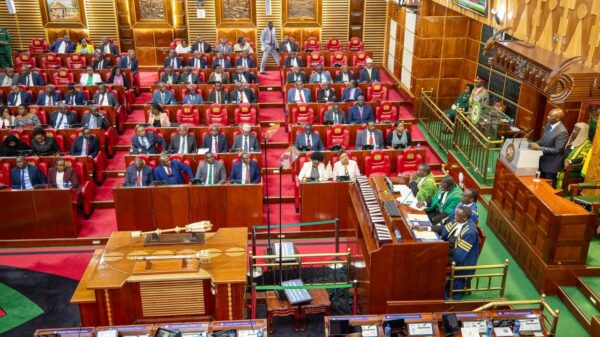








NAIROBI, Kenya Jul 28 -The National Assembly has called on the public to submit their views and memoranda on the Division of Revenue (Amendment) Bill, 2024.
Samuel Njoroge, Clerk of the National Assembly, announced that submissions can be emailed or hand-delivered to Parliament, with the deadline set for Thursday, August 1.
The Bill, introduced by Ndindi Nyoro, Chairperson of the Budget and Appropriations Committee, addresses a significant reduction in national revenues for the Financial Year 2024/25, amounting to Sh346 billion.
This includes a 326 billion Shilling decrease in allocation to the National Government and a 20 billion Shilling reduction for County Governments.
The Bill further proposes an allocation of Sh7.8 billion to the Equalization Fund, representing 0.5 percent of the most recent audited revenue, as approved by the National Assembly.
The public’s input is sought to ensure a comprehensive and inclusive approach to the changes in revenue distribution.
The call for public input comes in the wake of recent nationwide protests against the Finance Bill, which had proposed new taxation measures to raise additional revenue. The Finance Bill faced widespread opposition due to concerns over its potential impact on the cost of living and economic inequality.
Protesters, including civil society organizations, political leaders, and citizens, argued that the proposed taxes would disproportionately affect lower and middle-income households, exacerbating existing economic challenges.
The protests turned violent in several parts of the country, leading to clashes between demonstrators and law enforcement officers. Tragically, these incidents resulted in the deaths of more than 60 people, highlighting the deep-seated frustrations and anger among the populace.
The violence also underscored the public’s demand for greater transparency and accountability in the government’s fiscal policies.
Amid the unrest, the government decided to withdraw the Finance Bill for further review. However, this withdrawal left a significant budgetary gap, prompting the introduction of the Division of Revenue (Amendment) Bill as a measure to manage the reduced revenue expectations. The proposed cuts in allocations to both the National and County Governments are part of a broader strategy to address the fiscal shortfall.
The reduction in the National Government’s allocation will impact various ministries and departments, potentially leading to cuts in planned expenditures. Similarly, County Governments, which rely heavily on transfers from the national exchequer, may face challenges in maintaining service delivery and development projects.
The proposed allocation to the Equalization Fund, aimed at addressing disparities in marginalized areas, totals Sh7.8 billion. While this allocation represents 0.5 percent of the most recent audited revenue, some view it as insufficient to adequately address the needs of these regions.
The public consultation on the Division of Revenue (Amendment) Bill is a critical step in the legislative process, allowing stakeholders, including civil society organizations, business groups, and citizens, to voice their opinions and concerns. This input is vital to ensure that the final legislation aligns with the public’s needs and aspirations.
The outcome of this consultation process will have significant implications for Kenya’s fiscal policy and economic planning. The government faces the dual challenge of fiscal consolidation and meeting public demands for services and development. The decision to cut allocations is part of a broader effort to manage the country’s debt levels and ensure fiscal sustainability.
As the August 1 deadline for public submissions approaches, the National Assembly urges all interested parties to participate actively in the consultation process. This engagement is essential for maintaining transparency, accountability, and inclusiveness in the legislative process and for building public trust in the government’s fiscal management.
The public’s response, alongside parliamentary debates, will play a crucial role in shaping the future of Kenya’s budgetary allocations and economic policy. The government, parliament, and other stakeholders must navigate these complex issues with sensitivity, balancing the need for economic stability with the public’s demand for a more equitable and prosperous society.
The Division of Revenue (Amendment) Bill, 2024, thus stands at a critical juncture in Kenya’s fiscal landscape, reflecting broader economic challenges and political dynamics. The coming weeks will be decisive in determining the direction of the country’s financial and economic future, as the public and government work together to find a sustainable path forward.