
















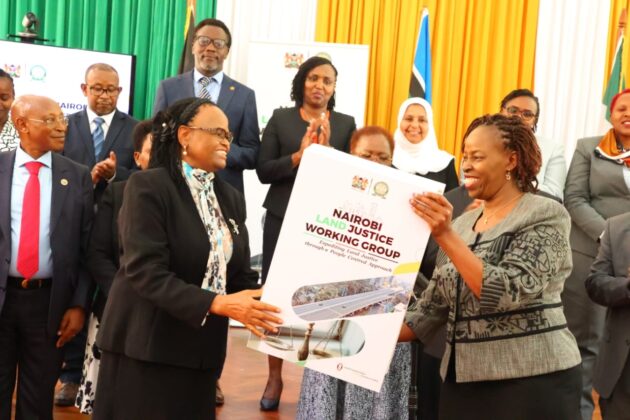

NAIROBI, Kenya, Feb 5 – Chief Justice Martha Koome has commissioned a multi-agency team that will be responsible for expeditious and sustainable resolution of land disputes in Nairobi.
The Nairobi Land Justice Working Group that comprises of all key players in the land justice sector is tasked with identifying the root causes and address systemic and endemic challenges in the administration of land justice.
The group is also expected to engage with the public and stakeholders to secure lasting solutions to land disputes and foster a prosperous and harmonious future.
The Working Group will be expected to recommend appropriate interventions; formulate guidelines to be implemented to expedite land justice through adoption of innovative and effective approaches to justice including Alternative Justice Systems and Court Annexed Mediation.
The CJ who presided over the unveiling said the initiative will directly be aligned with the goals of the Social Transformation through Access to Justice (STAJ) blueprint, particularly its target that no case should stay in court for more than three years.
“This initiative goes beyond the conventional boundaries, seeking to foster an inclusive, participatory, accountable, and responsive justice system that truly serves the aspirations of our people, including the most marginalized and vulnerable among us,” she said.
She said the group will examine root causes of delays, streamline case management processes and adopt innovative justice delivery mechanisms. This, she noted, will significantly expedite resolution of land cases, reduce backlog and bring lasting solution to land justice challenges.
She added that the establishment of the Land Justice Working Group is a testament to the commitment of the Environment and Land Court, aimed at expediting land justice in Nairobi.
Nairobi is plagued with issues of double allocation, encroachment of public land, mix-up during survey, adverse possession claims, lack of zoning and enforcement, informal settlements, renewal of leases and fraud hence creating a complex web of land injustice which is difficult to navigate outside a multi-sectoral collaborative approach.
Lauding ELC’s novel initiative to securing land justice, Deputy Chief Justice Philomena Mwilu said she will be paying keen attention to the outcomes of the Working Group not only because they will be transformative but, importantly, they could form the benchmark for its expansion to other counties and to other jurisdictional areas and courts.
She urged the team to embed a system of performance measurement and management that will enable them to track and improve their performance and achieve tangible results.
Cabinet Secretary for Lands, Public Works Housing and Urban Development Alice Wahome pledged the support of her ministry to ensure that the goals of the working group are met and land justice is achieved to save people, especially the elderly from suffering injustice.
The Working Group which is a brainchild of the Nairobi ELC Court Users Committee (CUC) draws its membership from ELC, Nairobi City County, Ministry of Lands, Attorney General, the National Land Commission and Ministry of Interior and National Administration among others.
Present in the launch was Cabinet Secretary Ministry of Lands, Public Works, Housing, and Urban Development Hon Alice Wahome who said that they are planning to geo reference 40 percent of all land parcels in the country by 2025.
Wahome also said that the ministry will develop a cabinet memo and policy to guide a national multipurpose cadaster problem especially in the coastal region.
She also informed Kenyans that the ministry is obligated to deliver 250,000 affordable houses per year.
She termed the Nairobi justice Land working group as a trialblazer initiative that will improve land tenure and justice.
Taking over her predecessor’s plan to issue out 420,000 title deeds by end of next year, she said that she will see to it that it is achieved.
According to the Presiding Judge of the Environmental and Land Court- Justice Oscar Ngote, land disputes in Nairobi are being caused by urbanization, population growth and unavailability of land.
He further stated that according to 2022/2023 case load in Milimani land vision, there are approximately 3,500 cases and 800 of those cases are more than 10 years old.
He said this working group will act as a mechanism to speed up justice and the 800 cases will be given priority.