
























NAIROBI, Kenya, Feb 8 — Nairobi carries a rare global badge of honour. It is the only city in the Global South to host a United Nations headquarters, home to the United Nations Environment Programme (UNEP) and UN-Habitat.
From climate negotiations to biodiversity frameworks, the Kenyan capital is often described as the “environmental capital of the world.”
World leaders, scientists and negotiators regularly converge in Gigiri to shape global environmental policy.
Just two months ago, nearly 6,000 delegates gathered for the Seventh Session of the United Nations Environment Assembly (UNEA-7), reaffirming Nairobi’s central role in climate diplomacy.
Yet beyond the conference halls, a more uncomfortable reality persists.
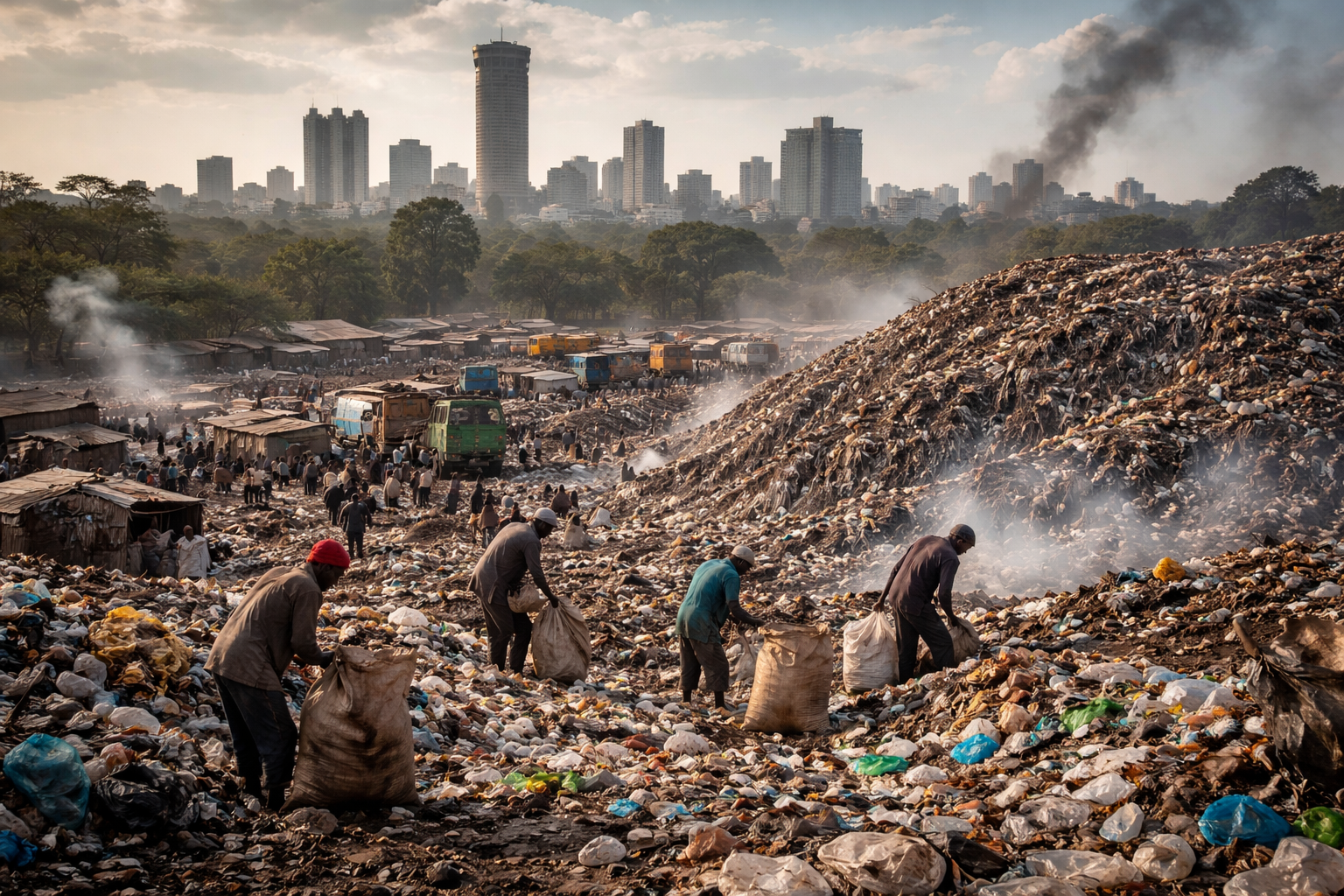
Plastic-clogged rivers, toxic air pollution, illegal logging, encroached forests and recurring garbage crises tell a different story — one where global prestige has not translated into consistent domestic enforcement.
This contrast exposes a central question: Why does a country at the heart of global climate diplomacy still struggle to enforce environmental accountability at home?
Kenya has built a strong international reputation as a climate leader. More than 90 percent of its electricity generation comes from renewable sources — largely geothermal, hydropower, wind and solar.
The country banned single-use plastic carrier bags in 2017 and has committed to reducing greenhouse gas emissions by 32 per cent by 2030 under its updated Nationally Determined Contribution (NDC).
Waste management gap
On paper, the ambition is clear but practice, enforcement often lags.
Nairobi generates between 2,000 and 2,500 tonnes of waste daily, with less than half formally collected.
Organic waste accounts for up to 80 per cent, while plastics make up roughly 20 percent.
Recycling and recovery rates remain below national targets, and significant volumes still end up in open dumping sites.
County officials acknowledge the gap. Nairobi City County, in partnership with the Kenya Climate Innovation Centre (KCIC) and the Kenya Industrial Research and Development Institute (KIRDI), is conducting a State of Circularity Study to map waste flows and identify practical circular economy solutions.
“Nairobi City County has prioritised solid waste management and evidence-based decision-making as key pillars in building a clean, healthy and sustainable city,” said Christine Kivuva, Assistant Director for Environmental Monitoring, Compliance and Enforcement.
But strategies and policy frameworks do not automatically guarantee compliance.
Dandora dumpsite — holding an estimated 1.8 million tonnes of waste — remains the clearest symbol of enforcement failure.
Despite multiple court directives ordering its closure and the clean-up of the Nairobi River, waste continues to flow into the site.
In February, a court ordered Nairobi City County and the National Environmental Management Authority (NEMA) to pay over Sh25 million in damages to waste pickers after finding authorities had failed to monitor air pollution and rehabilitate the dumpsite.
The ruling underscored a recurring pattern in Kenya’s environmental governance; one of strong judicial pronouncements and weak execution.
Forest enchroachment
Protected forests such as Karura and Ngong have faced repeated encroachment attempts, often linked to politically connected developers.
Civil society and the courts have frequently stepped in to halt illegal developments, highlighting reactive rather than proactive enforcement.
In Kajiado and Machakos, unregulated sand harvesting continues to degrade rivers and farmland, with communities alleging that political pressure and corruption blunt regulatory action.
According to Amos Wemanya, Senior Climate Advisor at Power Shift Africa, the disconnect stems from how Kenya frames climate action.
“Kenya’s climate leadership has largely been outward-facing,” Wemanya said.
“Internationally, the country positions itself as a champion. Domestically, commitments are not treated as binding governance obligations.”
The contradiction is visible in flagship policies. While the government promotes its plan to plant 15 billion trees by 2032, it simultaneously lifted a six-year logging ban — a move critics say weakens conservation credibility.
Kenya continues to lose tens of thousands of hectares of forest annually, with severe economic losses tied to degraded ecosystem services, including water insecurity and increased vulnerability to floods and droughts.
“When forests are treated as expendable assets rather than national infrastructure, accountability inevitably weakens,” Wemanya said, warning that policy inconsistency erodes public trust.
“Globally, Kenya speaks the language of ambition. Locally, policies are often shaped by short-term economic and political pressures.”
For many Nairobi residents, UNEP’s presence feels distant from daily environmental challenges.
“We hear about big climate meetings, but in my area drainage is still blocked and garbage piles up every day,” said Mwangi John, a boda boda rider in Pipeline.
Accountability gap
Abdullahi, a shopkeeper in Eastleigh, said hosting UNEP has brought prestige and employment opportunities but limited change in local enforcement.
“Garbage is still a problem because enforcement is weak,” he said.
UNEP provides science, policy frameworks and technical guidance, but enforcement remains the sovereign responsibility of national and county governments.
The accountability gap, analysts say, is rooted less in the absence of laws and more in structural weaknesses: fragmented coordination between national and county agencies, chronic underfunding of regulators, political interference in environmentally sensitive sectors and penalties that often fail to deter powerful violators.
Systemic constraints dilute oversight and make consistent enforcement difficult.
Recent global legal developments could begin to narrow that gap. The International Court of Justice advisory opinion affirming states’ obligations to address climate change strengthens the legal foundation for climate litigation and expands avenues for citizens to challenge inaction as violations of constitutional rights to life, health, food, water and a clean environment.
“That leverage only holds if Kenya aligns its domestic enforcement with the standards it champions internationally,” Wemanya said.
Countries such as Finland demonstrate that environmental credibility depends not only on ambition but on institutional discipline.
Finland’s Ambassador to Kenya, Riina-Riikka Heikka, attributes her country’s sustainability performance to a practical, solution-oriented mindset embedded in governance structures.
“It’s not about talking things; we are really looking for solutions,” she said. “That mindset guides us when we talk about sustainability — domestically and internationally.”
Hosting UNEP gives Kenya global visibility and diplomatic influence. But prestige alone cannot rehabilitate rivers, protect forests or halt illegal extraction.
Real climate leadership is measured not in conference halls, but in court compliance, regulatory consistency and institutional independence.
Until global ambition is matched by domestic enforcement discipline, Nairobi may remain the headquarters of environmental diplomacy — but not yet its strongest example.