













In the 1950s and 60s, Wole Soyinka emerged as a sharp critic of the Negritude movement’s over-romanticisation and performative assertion of Black identity without corresponding action. He famously observed, “A tiger does not proclaim its tigritude; it pounces.”
Today, our president presents a curious duality: a tiger proclaiming its tigritude while also attempting to pounce. Critics focus heavily on the performative assertions, and understandably so. He relishes rhetoric and possesses a gift for it. Yet beneath the spectacle, something else is unfolding. The pouncing, however imperfect, is taking root. And therein lies an awakening that many politicians appear ill-prepared to confront.
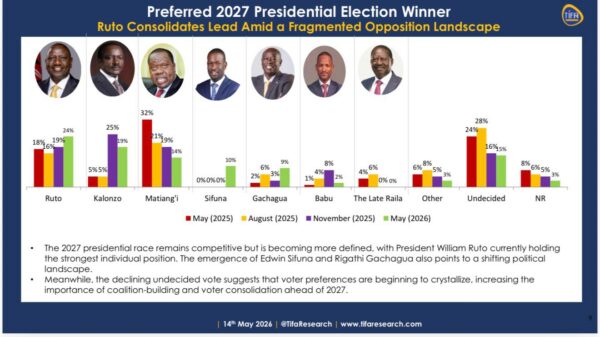
There is a shift underway in Kenya. It is grounded less in proclamations and more in whether the pounce delivers. That distinction may prove decisive in the coming elections.
A politician who has served two or three terms now faces an electorate whose lived experience over the last decade has been sobering. For many families, years of political loyalty have yielded little beyond episodic handouts. Livelihoods remain fragile. Intergenerational mobility remains elusive. Structural transformation has been promised repeatedly but rarely realised.
In an era of information abundance, that reality is increasingly difficult to obscure. The disruptions of the past three years have been painful. The Kenya Kwanza administration has been consequentially disruptive, with clear pain points and undeniable political excesses. Yet there are also pockets of tangible material intervention, and programmes like Nyota are embedding impact at the grassroots in ways that are beginning to reshape expectations.
This growing consciousness, particularly among young people, is deeply unsettling for traditional political actors. The Gen Z–led protests were not simply an eruption of anger; they were an inflection point. Kenyan politics is shifting from symbolic mobilisation toward a more instrumental logic. Citizens increasingly expect politics to produce measurable outcomes. Yet many politicians continue to misread this moment, clinging to ethnic arithmetic and spectacle as though nothing fundamental has changed.
It is within this context that the controversy around the Nyota Fund must be understood. The opposition is correct in noting that Nyota is supported by World Bank financing and that its politicisation deserves scrutiny. But governments exist precisely to mobilise resources, forge partnerships and create enabling environments for socio-economic development. If, in the aftermath of a youth awakening, the state responds with a programme directly targeting the youth bulge and structural vulnerabilities, it is not unreasonable for the government to communicate that intervention widely. Democratic accountability demands critique, but it also demands clarity about what the state is doing in the public interest.
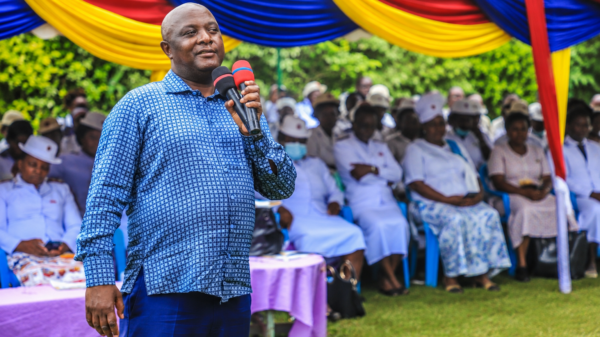
What is often missed is that participation in Nyota events, dancing beside the president or sharing a podium, does not automatically translate into political loyalty. Young people will not vote on the basis of proximity to power or performative inclusion. They will vote on whether their lives have changed.
A non-repayable start-up grant of KSh 50,000, combined with entrepreneurship training, financial literacy, mentorship and structured business support, has material consequences. On-the-job placements, Recognition of Prior Learning certification for artisans and incentives that embed a savings culture through the NSSF Haba Haba scheme can alter life trajectories in ways handouts never could. These are not abstract promises; they are interventions that affect balance sheets, household stability and future planning.
I have disagreed with many actions of the current regime and have said so publicly, even at moments when friends expressed concern for my safety, particularly during periods marked by abductions and violence. Those concerns remain legitimate. But even the staunchest critics concede that the 2027 election will be shaped less by rhetoric than by lived experience.
Despite the high cost of living, political repression and governance excesses, the cumulative judgement of voters will turn on a central question: has this regime, particularly since the advent of the Broad-Based Government, expanded opportunity and reduced precarity for the majority of young people? Youth now constitute the decisive voting bloc. Ethnic mobilisation alone may no longer blunt their collective power.
This is also where the opposition appears strategically thin. It is entirely legitimate to question the political framing of Nyota. It is analytically weak, however, to do so without articulating credible alternatives. Political parties exist to aggregate interests and translate social demands into competing policy visions. If the ruling coalition has rallied youth aspirations around a concrete livelihood programme, the opposition’s task is not merely to dismiss it but to present a more compelling design. How would they do it differently? At what scale? With what financing model? With what institutional credibility?
To say that Nyota is World Bank money and should not be used politically is one argument. But development financing of this magnitude does not deploy itself. It requires negotiation, institutional coherence and implementation capacity. Governments are in the business of building enabling environments for socio-economic transformation. If that environment, emerging from a period of youth unrest, addresses the youth bulge with structured interventions, it is politically rational for the administration to foreground it.
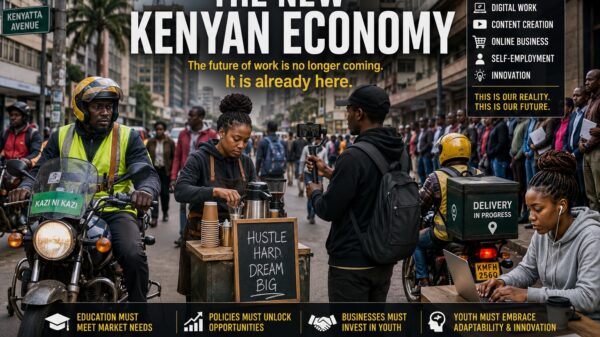
Given Nyota’s grassroots footprint, touching young people across nearly every county, Kenyan youth are unlikely to be persuaded solely by ethnic appeals divorced from material realities. They may still accept campaign handouts. Tribal rhetoric will persist. But voting behaviour is increasingly being anchored in outcomes: businesses started, incomes stabilised, skills recognised and credentialised, savings accumulated and futures rendered plausible.
Parents who witness their sons and daughters launch enterprises, formalise skills and build financial discipline through structured schemes may begin to rethink inherited political loyalties. To imagine that 2027 will be decided purely by spectacle and arithmetic, as elections once were, would be profoundly naïve.
The tiger may proclaim its tigritude. But in this political season, only the pounce will count.