















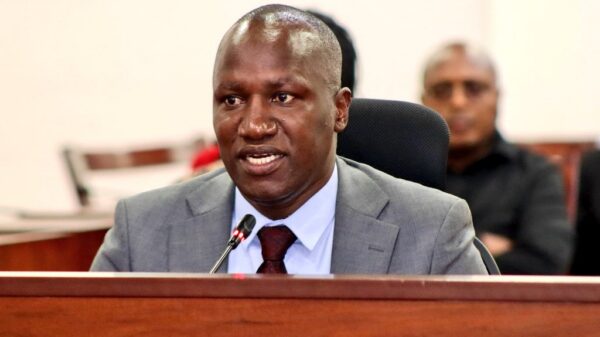





NAIROBI, Kenya, Oct 7 – Nyandarua Senator John Methu has petitioned the Senate Justice and Legal Affairs Committee (JLAC) to effect the Supreme Court ruling that recommended the introduction of legislation that will seal existing loopholes in the electoral process.
This follows the fiasco that unfolded in the commission where four Independent Electoral and Boundaries Commission (IEBC) commissioners contested the results announced by Chairman Wafula Chebukati terming them ‘opaque’.
In a notice of motion that is yet to be tabled before the house, Methu urged JLAC to policy framework on the relationship between the commissioners and secretariat within the electoral body.
In its full judgment, the Supreme Court directed the roles of the commission’s chairperson, commissioners, and the Chief Executive Officer (CEO), other staff and third parties should be clearly set out in both the legislative and administrative edicts.
“Now therefore, the Senate -urges the Standing Committee on Justice Legal Affairs and Human Rights to study the Supreme Court ruling and introduce legislation including the manner of appointment of future IEBC Commissioners and enhance the statutory and regulatory framework on the separate policy and administrative remit of IEBC,” Methu stated in the motion.
The Nyandarua Senator recommended that the Senate condemn the actions of the quartet commissioners namely Juliana Cherera, Irene Massit, Justus Nyang’aya and Francis Wanderi for denouncing the verification and tallying processes conducted by IEBC without valid proof.
“Observing their actions were expressions of impunity and concerted effort to subvert the sovereign will of the people through the sabotage of the constitutional mandates of the Commission to conduct. free, fair, transparent and verifiable elections, which go against their official calling and the oaths of office they swore to undertake,” Methu petitioned in his motion.
Methu asserted that the actions of four dissenting commissioners risked plunging the country into a State of disquiet and uncertainty yet they did not provide information or evidence to substantiate their accusations that the Chairperson of the commission Wafula Chebukati usurped the will of the people.
Therefore, he urged the Senators to effect the legal, policy, and institutional reforms recommended by the Supreme Court ruling on the Presidential Petition No. E005 for 2022.
“The four Commissioners attempted to defeat the sovereign will of the people of Kenya espoused in Article 138(10) of the Constitution on the basis of what was described in the Supreme Court ruling on the Presidential Petition No. E005 for 2022 as a “last minute boardroom rupture (the details of which remain scanty and contradictory),” Methu stated.
In its full judgement,the seven-judge bench led by Chief Justice Martha Koome noted that the separation of electoral processes from IEBC’s internal affairs would safeguard the commission from suits that may arise for breaches of third-party agreements which maybe violated during scrutiny of elections.
“IEBC should ensure that the servers supporting the elections and those serving their internal administrative work are distinct and separate. This would then allow the Court, should the need arise, to carry out forensic imaging of the same without compromising and/or infringing any third-party agreements,” the judges pointed out.
Koome (President), Deputy Chief Justice Philomena Mwilu (Deputy President), Justices Mohamed Ibrahim, Smokin Wanjala, Njoki Ndung’u, Isaac Lenaola and William Ouko also recommended governance reforms to further strengthen IEBC’s institutional framework and create a distinction between policy and administrative functions.
“Parliament should consider enhancing the statutory and regulatory framework on the separate policy and administrative remit of IEBC,” the judgement read in part.
The Court also urged IEBC to institutionalize the separation of functions under the two domains.
“IEBC ought to effect formal internal guidelines that clearly delineate the policy, strategy, and oversight responsibility of the Chairperson and the Commissioners; and develop institutionalized guidelines on how to manage the separation of administrative and policy domains,” the Supreme Court advised.
The Court added that a similar distinction must be made on key roles including that of the Chairperson, Commissioners, Chief Executive Officer, other staff and third parties.