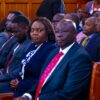






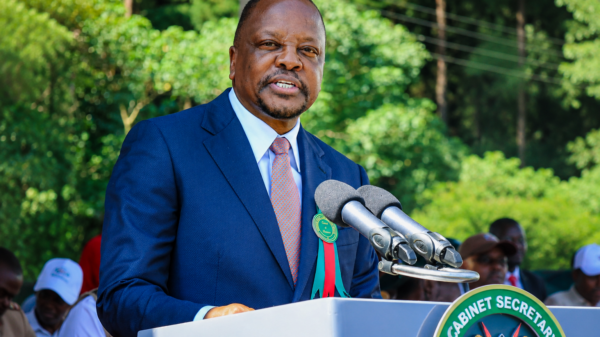








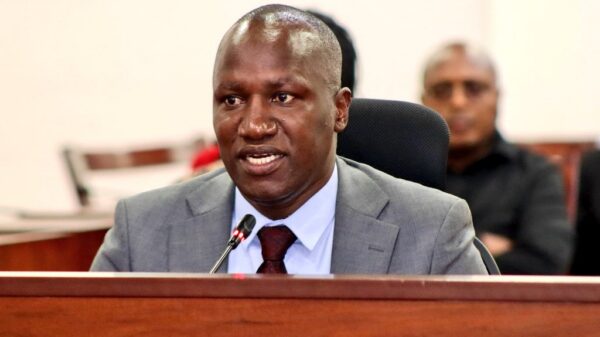


NAIROBI, March 11 – Education Cabinet Secretary Julius Ogamba has defended the government’s decision to host Junior Schools within primary institutions and dismissed claims of irregularities in the 2025 junior school assessment results during a session before the Senate.
Appearing before the plenary, Ogamba responded to questions from Edwin Sifuna (Nairobi) and Tom Ojienda (Kisumu) on the management structure of Junior Schools, the credibility of the 2025 Kenya Junior School Education Assessment (KJSEA) results and the implementation of government-backed talent development programmes.
Addressing concerns about the placement of Junior Schools within primary institutions, the CS said the arrangement followed recommendations of the Presidential Working Party on Education Reform after wide public consultations.
He told senators that 93 per cent of stakeholders supported hosting Junior Schools within existing primary schools, while only a small proportion proposed placing them in secondary schools or running them as independent institutions.
“Primary and Junior Schools operate under one Head of Institution and one Board of Management to ensure effective governance, coordination and smooth transition for learners,” Ogamba told the Senate.
The CS explained that the decision was guided by psychosocial, logistical and financial considerations, noting that younger learners could face integration challenges if placed in secondary school environments.
He added that using existing infrastructure in primary schools particularly classrooms previously occupied by Standard Seven and Eight learners was also more cost-effective than constructing new facilities nationwide.
On financial management, Ogamba clarified that the existence of separate accounts for Junior School funds does not imply administrative independence.
Instead, he said the separation reflects different capitation allocations, with primary school learners receiving Sh1,420 per year while Junior School learners receive Sh15,042 annually, requiring separate accounting structures for transparency and planning.
The CS also told senators that teachers deployed to Junior Schools are graduate teachers trained to deliver the secondary-level curriculum under the Competency-Based Education (CBE) system and fall under the secondary school career progression framework developed by the Teachers Service Commission.
KJSEA Results Manipulations
Responding to concerns raised by Sen. Ojienda about alleged manipulation of the 2025 KJSEA results, Ogamba said the ministry was not aware of any cases of misreporting.
“The results released by the Kenya National Examinations Council are accurate and were used to guide learner placement into Grade 10,” he said, referring to the Kenya National Examinations Council.
He explained that the KJSEA is a competency-based summative assessment conducted at the end of Grade Nine to identify learners’ abilities, interests and strengths rather than rank them through traditional aggregate scores.
Under the assessment framework, learner performance is graded into categories such as Exceeding Expectations, Meeting Expectations, Approaching Expectations and Below Expectations, with further bands to provide detailed evaluation.
Ogamba told senators that several quality assurance measures are in place to safeguard the credibility of national examinations, including pilot testing of assessment tools, automated scoring systems, supervision during examinations and verification of results before their release.
The CS also highlighted progress in co-curricular and talent development programmes in Kisumu County, saying 617 public primary schools and 232 secondary schools participate annually in organised activities.
These include competitions coordinated through the Kenya Secondary Schools Sports Association, the Kenya Primary and Junior Schools Sports Association and the Kenya Music Festival, alongside national science, sports and drama contests.
According to the CS, more than 500 student-athletes from Kisumu have participated in regional training camps organised by the Kenya Academy of Sports between 2022 and 2025, with some advancing to national and East African competitions.
However, Ogamba acknowledged challenges including inadequate sports infrastructure, limited access to opportunities in remote schools and coordination gaps between schools, county governments and sports federations.
To address integrity concerns in school competitions, he said the ministry has introduced a digital athlete registration system integrated with the Kenya Education Management Information System (KEMIS) to improve transparency.
The CS said the government remains committed to strengthening inclusive talent development programmes to ensure learners across the country have opportunities to nurture their abilities and compete on national and international platforms.