

















The greatest mistake Kenya’s opposition can make ahead of the 2027 General Election is to assume that numbers alone are enough to send President William Ruto home.
Kenyan politics has never been purely about arithmetic. Elections are won through perception, symbolism, emotional connection, coalition-building and the ability to transform public frustration into a compelling national movement. That is what the NARC coalition achieved in 2002. It is also what William Ruto successfully managed in 2022.
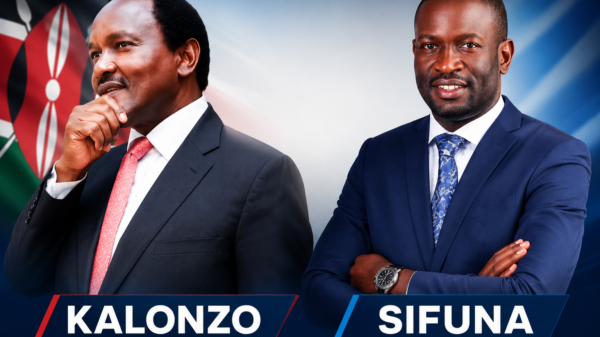
This is why the emerging possibility of an Edwin Sifuna and Kalonzo Musyoka ticket is increasingly attracting political attention.
Not because it guarantees victory, but because it potentially addresses one of the opposition’s biggest longstanding weaknesses — the inability to balance generational energy with political reassurance. More importantly, it could excite a new category of voters increasingly shaping Kenya’s political future.
There is little doubt that public discontent against the current administration is visible across the country. Rising living costs, unemployment anxieties, frustrations over taxation, concerns around abductions and extrajudicial killings, and perceptions of a government disconnected from everyday struggles have all created fertile ground for political change.
But dissatisfaction alone has never automatically translated into electoral victory.
Kenya’s opposition politics has historically struggled to convert collective anger into a coherent national vision. In 1992, opposition disunity allowed the incumbent to retain power with barely a third of the vote. Even today, many opposition formations still appear united more by shared opposition to the government than by a shared vision for the country.
That is not enough.
Kenyans are increasingly tired of elite coalitions whose only ideological glue is the pursuit of power. The electorate is younger, more politically aware and less emotionally attached to traditional political loyalties than in previous decades.
Many Gen Z and younger millennial voters are not necessarily searching for political saviours. They are looking for political meaning.
And this is where Edwin Sifuna becomes politically consequential.
Whether admired or criticised, Sifuna possesses qualities that are becoming increasingly rare in Kenyan politics. He is articulate, media-savvy, combative and deeply connected to the frustrations of younger voters. He communicates with sharpness, spontaneity and confidence, particularly on digital platforms where political influence is increasingly shaped.
A Sifuna candidacy would likely energise urban youth, first-time voters and a generation that consumes politics through social media clips, podcasts, online debates and issue-based conversations rather than traditional rallies alone.
But politics is not sustained by excitement alone.
While youthful energy mobilises support, experience calms anxieties.
That is where Kalonzo Musyoka enters the equation.
Kalonzo offers what many moderate and older voters often seek during periods of uncertainty — stability, predictability and institutional experience. To many Kenyans, he represents a safe pair of hands within an increasingly polarised political environment.
His longstanding loyalty to Raila Odinga has also earned him goodwill among sections of ODM supporters who view him as one of the few opposition figures who remained consistently aligned with Raila during difficult political moments.
A Sifuna–Kalonzo arrangement would therefore symbolise more than regional arithmetic. It would represent an intergenerational political handshake.
If such a ticket managed to attract sections of Raila’s support base, combine that with the Ukambani vote, parts of Mt Kenya mobilised by Rigathi Gachagua, and backing from figures such as Fred Matiang’i, Eugene Wamalwa and George Natembeya, then the opposition would not merely be assembling numbers.
It would be constructing a coalition with multiple centres of legitimacy.
More importantly, Sifuna could become the bridge connecting older opposition structures with younger, digitally engaged voters who increasingly feel politically homeless.
Yet even that may still not be sufficient.
The slogan “Ruto Must Go” cannot sustain a serious national campaign for the next two years.
Kenyans are already familiar with complaints about taxation, governance failures, economic hardship and police excesses. Repeating outrage without presenting solutions risks exhausting voters instead of inspiring them.
The opposition must now shift from protest politics to proposition politics.
The central political question is no longer simply why this government should leave. The far more important question is what comes next.
Any coalition serious about 2027 must begin articulating a coherent national agenda capable of appealing across class, ethnic and generational divides.
How exactly will it lower the cost of living?
What economic model will it pursue?
How will it create sustainable jobs for young people beyond empowerment slogans?
What reforms will it introduce in education, healthcare and agriculture?
How will it address public debt, rebuild trust in institutions and tackle corruption within its own ranks?
What is its vision for Kenya’s digital economy and innovation future?
These are the conversations that will ultimately shape the next election.
Equally important is the tone of opposition politics.
Perpetual bitterness, ethnic undertones and aggressive rhetoric may energise core supporters but risk alienating undecided voters searching for stability and hope.
Sifuna and a younger generation of politicians around him must therefore move beyond outrage and begin building belief.
Winning elections is ultimately about convincing ordinary citizens that a political movement genuinely understands their frustrations and offers a credible path forward.
That belief only emerges when politics stops sounding like revenge and starts sounding like renewal.
Whether it is Sifuna–Kalonzo, Kalonzo–Sifuna or another coalition altogether, the greatest challenge ahead is not simply assembling politicians.
It is constructing hope.