







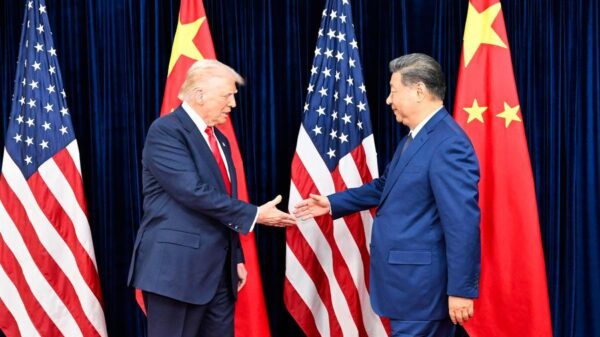





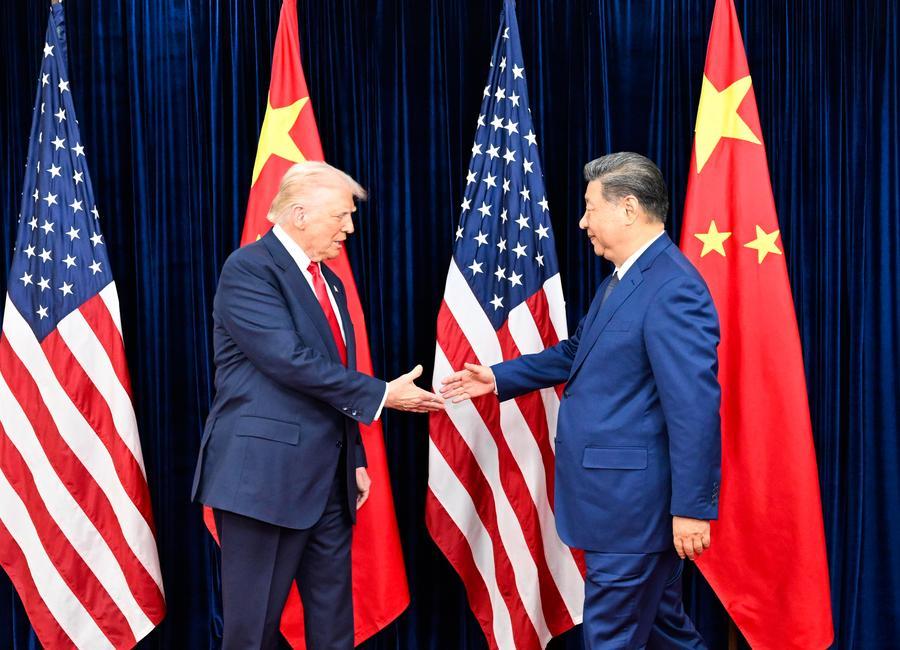

BEIJING, China, May 11 — The Chinese capital will soon become the setting for one of the most closely watched, high-stakes diplomatic encounters of the year, as the leaders of the world’s two largest economies prepare to meet face-to-face.
This will be US President Donald Trump’s first state visit to China since his re-election, and the second time Chinese President Xi Jinping has hosted him in the country — their last such meeting in the country took place nearly a decade ago.
Against the backdrop of a complex international landscape and shared global challenges, expectations are running high: How can President Xi and President Trump manage differences between the two sides? How can they navigate the world’s most consequential bilateral relationship?
AT THE HELM OF A GIANT SHIP
“You and I are at the helm of China-US relations,” Xi told Trump during their latest vis-a-vis talks held in Busan, South Korea, in October 2025. Lasting more than 100 minutes, the meeting marked another moment of direct engagement between the two leaders as they sought to steer China-US relations through uncertainty.
Using a maritime metaphor that has become a recurring theme in his remarks, Xi asked the US president to help keep the “giant ship” of bilateral ties sailing steadily forward.
Over the years, head-of-state diplomacy has anchored China-US relations, serving as a stabilizing force amid shifting global currents. Since Trump’s re-election, Xi has spoken with him by phone five times, maintaining close communication on ties and global hotspot issues.
The two presidents first met in 2017, a year marked by an exchange of state visits that set the tone for their interactions. In April that year, Xi and his wife, Peng Liyuan, visited Trump’s Mar-a-Lago estate in the US state of Florida, where the two presidents dined together and Xi met Trump’s family, including his grandchildren.

It was during that visit that Xi delivered a line often recalled in discussions of bilateral ties: “There are a thousand reasons to make the China-US relationship a success, but not a single reason to break it.”
Several months later, in November, Trump traveled to Beijing, where Xi hosted him during a series of special events. The two leaders and their spouses toured the Forbidden City along its central axis, visiting the Hall of Supreme Harmony, the Hall of Central Harmony and the Hall of Preserving Harmony — an experience imbued with the Chinese cultural ideal of “harmony” reflected in the names of the three grand halls.
Walking inside the ancient royal palace, Xi told Trump that China’s history can be traced back more than 5,000 years, or even earlier, and its culture has been passed down in an unbroken continuum.
During a chat over tea on that trip, Trump showed Xi a video of his granddaughter, Arabella Kushner, singing and reciting classical poems in Mandarin. Xi said her performance deserved an A-plus. The clip quickly resonated with Chinese netizens and went viral online.

Those early exchanges were widely seen as helping to build a personal rapport between the two leaders, offering a channel to understand each other, manage differences and prevent the relationship from sliding into outright confrontation. “I have a lot of respect for President Xi,” Trump has often said.
The past years have seen Xi’s meetings with US leaders using this approach — from the Mar-a-Lago summit and the Yingtai evening talks in the Zhongnanhai compound to the long conversation by China’s West Lake — often remembered as defining moments in bilateral ties.
The upcoming meeting is expected to continue the tradition of high-level engagement. “The real significance of this meeting may not lie in any grand deal,” said Denis Simon, a senior fellow at the Quincy Institute. “Instead, it will test whether the United States and China can establish an equilibrium.”
Earlier this year, on Feb 4 — “Lichun,” the traditional Chinese marker for the beginning of spring — Xi spoke with Trump by phone for the first time in 2026, returning to the metaphor that has come to define his messages on bilateral ties.
“In the year ahead,” Xi said, “I look forward to working with you to steer the giant ship of China-US relations through winds and waves, keep it on a steady course, and achieve more major and positive outcomes.”
AVOIDING MISCALCULATIONS
In recent years, China-US relations have experienced twists and turns. Some observers fear that China and the United States may repeat the historical pattern of major-power rivalry known as the “Thucydides Trap.” Yet, Xi has rejected this notion: “There is no such thing as a ‘Thucydides Trap’ in the world. But repeated strategic miscalculations between major countries could create one for themselves.”
Avoiding such miscalculations, therefore, has become a critical task for China and the United States, which requires both sides to engage in candid dialogue on several key issues.
Foremost is the Taiwan question. President Xi has repeatedly and unequivocally conveyed China’s fundamental stance to the US side. In the Feb 4 phone conversation with Trump, Xi once again stressed that the Taiwan question is the most important and sensitive issue in China-US relations, urging the US side to handle arms sales to Taiwan with utmost prudence.
Trade is another critical issue. In the face of unilateral US tariff offensives, China, under Xi’s leadership, has taken resolute countermeasures.

At the same time, Beijing has kept channels of engagement open. Xi has dispatched economic and trade teams that have held six rounds of talks with the US side, seeking to narrow differences step by step while expanding common ground. Currently, trade ties between the two countries remain roughly steady. The two sides will hold a new round of trade talks in South Korea from May 12 to 13.
During their Busan meeting, Xi underscored the broader perspective needed to manage such frictions. “Both sides should take a broader and longer-term view,” Xi told Trump, “focusing on the lasting benefits of cooperation instead of falling into a vicious cycle of retaliation.” Trump described Xi as a great leader and a firm negotiator.
How, then, does Xi envision the direction of bilateral ties leading into the future? In a speech delivered in San Francisco in 2023, he posed what he described as the number-one question: “Are we adversaries, or partners?”

“If one sees the other side as a primary competitor, the most consequential geopolitical challenge and a pacing threat,” he warned, “it will only lead to misinformed policy making, misguided actions, and unwanted results.”
Xi also stressed that China has no intention of challenging or unseating the United States. “China never bets against the United States,” he said. “Likewise, the United States should not bet against China.”
Drawing on the experience of China-US relations, Xi has outlined three principles — mutual respect, peaceful coexistence and win-win cooperation — as the right path forward for the two countries.
“SMALL BALL MOVES BIG GLOBE”
This April, Xi sent a congratulatory letter to an event commemorating the 55th anniversary of China-US Ping-Pong Diplomacy, recalling the historic 1971 episode often described as “a small ball moving the big globe.”

In 1971, a US table tennis team visited Beijing, a breakthrough that thawed more than two decades of estrangement, and helped pave the way for then US President Richard Nixon’s landmark visit to China in 1972, and later the establishment of diplomatic ties between the two countries in 1979. Its impact extended far beyond the bilateral sphere, profoundly reshaping the global landscape.
More than half a century on, Xi referred to the story not merely as a historical memory, but as a reminder of the profound influence stable China-US relations can have on the wider world.
In a 2024 meeting with Antony Blinken, former US Secretary of State, Xi invoked a concept inspired by traditional Chinese culture — “tong qiu gong ji” (“working together for the common good on the same planet”).
“Planet Earth is only this big, and humanity is faced with so many common challenges,” Xi said. “As an old Chinese saying goes, ‘Passengers in the same boat should help each other.’ Today, as I see it, ‘dwellers of the same planet should help each other’.”
During their meeting in Busan, Trump also acknowledged the importance of cooperation between the two countries, saying that China and the United States can get many great things done for the world and have many years of success.
“There is no geopolitical relationship more important than the China-U. bilateral relationship … with by far the largest impact on global affairs,” said Robert Lawrence Kuhn, chairman of the Kuhn Foundation.
For both countries, a stable China-US relationship helps remove obstacles to domestic development. More broadly, it carries profound significance for global stability and prosperity, according to Kuhn.
The timing adds further weight to the relationship. In 2026, China is embarking on its 15th Five-Year Plan (2026-2030), while the United States marks the 250th anniversary of its founding. The two countries will respectively host major global gatherings, the APEC Economic Leaders’ Meeting in Shenzhen and the G20 Leaders’ Summit in Miami, which will place them at the center of the international agenda.

Beyond red-line and trade issues, observers also point to several areas where cooperation remains vital for both sides, including climate change, counternarcotics and artificial intelligence.
For Xi, it is precisely these countless small acts of cooperation that carry lasting significance.
He once reminded Trump that for China and the United States, “it is always right to do a good thing, however small, and always wrong to do a bad thing, however small.”
Just as the Chinese leader has noted on many occasions, China and the United States, as two major countries, can shoulder their responsibilities and work together to accomplish more great and concrete things for the good of both countries and the whole world.
For more visit China Daily
For subscriptions on news from China Daily, or inquiries, please contact China Daily Africa Ltd on +254 20 6920900 or write to enquiries@chinadailyafrica.com