
















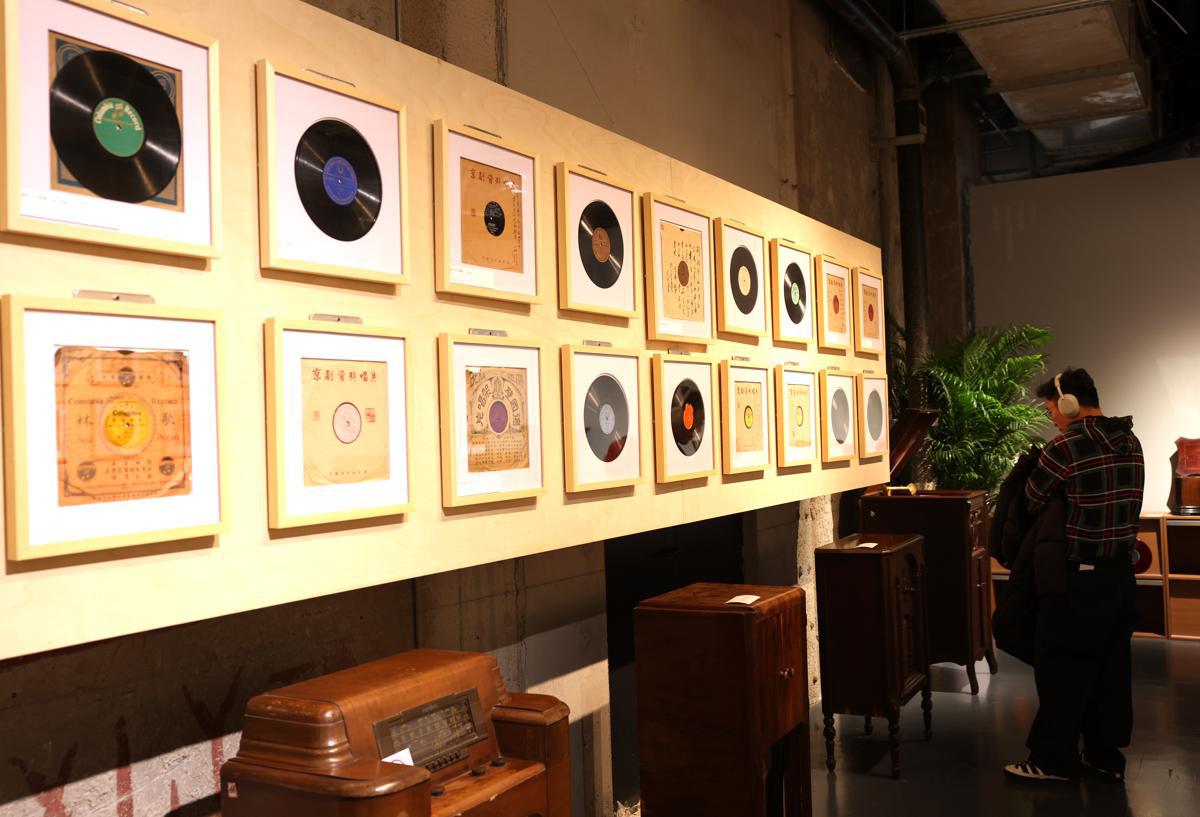

BEIJING, China, Jan 14 — The warmth of a crackling record, its familiar hum reverberating through time, is the essence of Looking Back, a centennial exhibition that brings the past to life in vibrant detail.
Curated by renowned jazz pianist and collector Luo Ning, the exhibition, which opened on Dec 31 and will run through Jan 31 at Beijing’s The Box Young Power Center, offers visitors a deeply immersive exploration of China’s musical history, through a meticulously selected collection of over 160 vinyl and shellac records.
Spanning nearly a century, from the late Qing Dynasty (1644-1911) to the 1980s, the exhibition sheds light on a time when music was both an art form and a cultural artifact.
“It’s like opening these sleeping time capsules,” said Luo, adding that the exhibition is an invitation for people, especially the younger generations, to rediscover the sounds and stories that shaped a century of music.
Luo, who has amassed more than 10,000 vinyl records over the past two decades, said that his collection is a labor of love, carefully sourced from around the world. His passion goes beyond the music itself, as Luo noted that the covers of albums released after 1949 are considered to be an essential part of cultural expression.
Early Chinese pop songs
One of the key pieces in the exhibition is a 1902 Cantonese Opera recording titled Dadong Jiebai, created by Chinese workers in the United States. Produced by Victor Talking Machine Co, the early recording was made for homesick overseas Chinese.
“Sound, just like food, stirs memories of home,” said Luo. More than a century later, the recording stands as a vibrant piece of cultural history, providing insight into the lives of Chinese laborers abroad at the time.
Another notable piece is Mai Ma, or Selling Horse, performed by Tan Xinpei (1847-1917), one of the leading figures in Peking Opera. Released by Pathe Records in 1911, the record holds historical significance beyond its artistic value. Tan’s Mai Ma was a favorite of Empress Dowager Cixi, who was an avid patron of Peking Opera.
Another featured recording is Mao Mao Yu, or Drizzle, often regarded as one of the earliest Chinese pop songs. Released in 1927 and performed by singer Li Minghui, the song marks an important moment in Chinese music history, as it was one of the first to embrace a more Westernized, light and popular style.
“What fascinates me the most is how these records reflect the changing urban culture and musical evolution of China,” Luo said.
Historical recordings
Luo, who was born and raised in Northwest China’s Xinjiang Uygur autonomous region, began classical piano studies at the age of 4. He later furthered his musical education at the University of Arts in Cuba, studying under the legendary Cuban pianist Chucho Valdes, the winner of multiple Grammy and Latin Grammy awards.
The exhibition also includes a selection of important historical recordings, such as March of the Volunteers, which is the Chinese national anthem, recorded at different times, including 1949, 1951 and 1959, and a complete set of Peking in Melody, released by China Record Corp in 1964 to commemorate the 15th anniversary of the founding of the People’s Republic of China.
“We want to ensure these fragile pieces of history are not lost to time,” said Wu Yiming, co-curator of the exhibition. “Through this exhibition, we hope to reconnect people with a past that still resonates today.”
The exhibition also features a collection of antique record players, Swiss-made music boxes, radios and other devices that Wu described as “time machines that have allowed the voices of history to live on”.
He added that vinyl “is becoming more popular with younger audiences, with a greater variety of content and styles”.
For more visit China Daily
For subscriptions on news from China Daily, or inquiries, please contact China Daily Africa Ltd on +254 20 6920900 or write to enquiries@chinadailyafrica.com