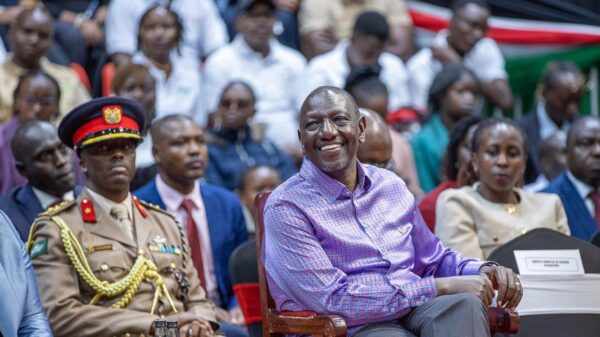












NAIROBI, Kenya, Dec 12 – The Kenya Army’s elite 20th Parachute Battalion (20 Para) took centre stage at Nyayo Stadium on Friday as President William Ruto presided over the Trooping of the Colours, the highlight of the 62nd Jamhuri Day celebrations.
The ceremony opened with the President inspecting a Guard of Honour mounted by a joint parade of the Kenya Army, Kenya Air Force, and Kenya Navy, accompanied by the KDF Band and senior military leadership, including Chief of Defence Forces General Charles Kahariri.
Based at Kenyatta Barracks, Gilgil, the 20th Parachute Battalion is one of the Kenya Army’s most specialized airborne and high-risk operations units within the Army Special Operations Brigade.
Formed in 1983, the battalion has executed key counter-terrorism, counter-insurgency, and high-intensity missions both inside and outside Kenya.
US backing
Its elite D Company, created with US assistance after the 9/11 attacks, has significantly enhanced Kenya’s rapid-response and special operations capabilities.
Friday’s event reaffirmed the battalion’s symbolic place in national defence tradition as it led the Trooping of the Presidential and Regimental Colours—ceremonial flags representing a unit’s honour, identity, and distinguished service.
Kenya’s airborne capability traces back to 14 October 1962, when the first batch of 40 Kenyan officers and men were sent to the UK for parachute training.
Subsequent cohorts led to the formation of the 1st Independent Parachute Company on 24 April 1965 at Napier Camp, Gilgil, later evolving into the 1st Parachute Company, first commanded by Major Galgham, with Major (now Retired Lt Gen) Opande becoming the first African Officer Commanding. By 1968, Kenya trained its own Parachute Jumping Instructors, enabling full local airborne training.
The establishment of the 20th Parachute Battalion on 17 March 1983 consolidated Kenya’s airborne forces.
During the battalion’s 20th anniversary that year, it formally adopted its current name and received both Presidential and Regimental Colours on 12 December 1990—a rare honour in military tradition.
Military Colours are symbolic emblems of sovereignty and distinguished service. Their consecration and presentation mark the final milestone in a unit’s formation.
Presidential Colours are trooped during national ceremonies graced by the Commander-in-Chief or visiting Heads of State, while Regimental Colours are displayed during ceremonies involving General Officers.
In keeping with tradition, both were escorted by a commissioned officer and two armed senior non-commissioned officers.
Tourism-themed Jamhuri Day
This year’s celebrations also mark the full adoption of the government’s new themed-holidays model, with Tourism, Wildlife, and MICE (Meetings, Incentives, Conferences, and Exhibitions) forming the 2025 focus.
Tourism and Wildlife Cabinet Secretary Rebecca Miano said President Ruto is expected to unveil reforms aimed at positioning Kenya as a global destination for tourism and business events.
These reforms align with the Magical Kenya brand refresh, launched in September under the guidance of the 23-member Brand Kenya Task Force chaired by Mary-Ann Musangi.
The strategy seeks to unify all of Kenya’s tourism marketing efforts under a single, modern brand aligned with Vision 2030 and the Bottom-Up Economic Transformation Agenda (BETA).
The celebrations were further boosted by the presence of Ghanaian President John Dramani Mahama Adama, who arrived Thursday evening and was received by Prime Cabinet Secretary Musalia Mudavadi and Defence Cabinet Secretary Aden Duale. Crowds filled Nyayo Stadium as performances, military displays, and cultural presentations brought the national celebrations to life.
President Ruto is expected to highlight Kenya’s economic priorities, internal reforms, and growing international profile during his annual Jamhuri Day address.