



















NAIROBI, Kenya May 13 – Members of Parliament have raised sharp concerns over continued government spending on leased office space and refurbishment costs, even as the State Department for Parliamentary Affairs struggles with budget cuts threatening key digitisation programmes in the 2026/2027 financial year.
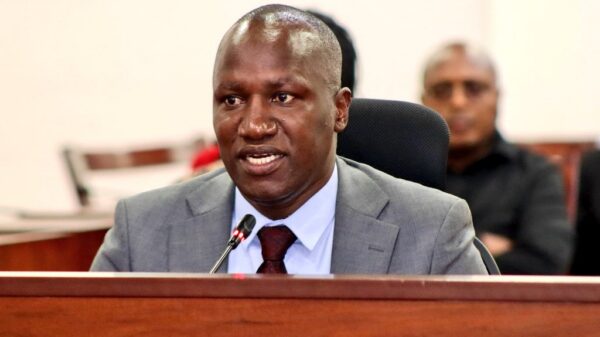
The concerns emerged during a session of the National Assembly Committee on National Administration and Internal Security, where the Principal Secretary for the State Department for Parliamentary Affairs, Aurelia Rono, appeared to defend the department’s budget estimates.
Lawmakers questioned the logic of investing public funds in renovating rented premises while simultaneously paying millions in annual lease charges, arguing that the government should instead invest in constructing permanent office facilities to reduce long-term expenditure.
Committee Vice Chairperson and Dido Raso criticized the department over what he termed contradictory spending on rent and office upgrades.
“You people spent a lot of money renovating your current offices, and at the same time we are told we are also paying rent. So we are wondering, how do you refurbish offices and still pay rent? Who is benefiting at the end of it all?” posed Raso.
Similar concerns were raised by Francis Sigei, who questioned the sustainability of leasing expensive office space while channeling additional resources into renovations.
“I don’t know whether it is not prudent that we ask ourselves whether we should continue leasing these huge buildings and spending a lot of money, or whether the government should explore alternative solutions,” said Sigei.
The legislators particularly cited the department’s offices located in a railway building and demanded disclosure of the total annual leasing costs to determine whether taxpayers were getting value for money.
Sigei urged the committee to establish the “real cost” of occupying the premises.
“What we would like, Chair, is for the committee to get the real cost of being in that building in one particular year so that we can know the magnitude of the expenditure by government,” he added.
In response, Dr. Rono clarified that the current budget estimates do not contain allocations for renovations or office partitioning following earlier directives issued by the committee.
She explained that the department had initially sought funds to partition existing office space to accommodate additional staff members, many of whom are currently operating in shifts due to congestion.
“We don’t have any request for renovation. We don’t have any request for partitioning because of your guidance that you gave us last time,” she said.
However, the PS admitted that the department continues to face a severe office space shortage and may eventually seek parliamentary approval to lease additional premises.
“It is not practical to have people working from home and expect them to effectively deliver on the mandate assigned to them,” she told lawmakers.
Dr. Rono also backed MPs’ calls for government-owned office infrastructure, arguing that the country could save substantial resources currently spent on leasing commercial buildings.
“If we would have government structures where government offices are occupying, then I’m sure we will save a lot of resources for development projects,” she stated.
The committee session further exposed concerns over a sharp reduction in the department’s ICT budget, which lawmakers warned could derail ongoing digitisation efforts.
Protus Akuja noted that the department’s ICT allocation had dropped significantly from KSh15.9 million in the 2025/2026 financial year to KSh7.25 million in the 2026/2027 budget estimates.
Akuja questioned how the department intended to sustain digitisation programmes, maintain ICT infrastructure and automate parliamentary liaison services under the reduced allocation.
In response, Dr. Rono acknowledged that the budget cuts would negatively affect ICT operations and implementation of the department’s ambitious RATIS digital platform.
ICT Manager Paul Kibera disclosed that the department requires approximately KSh950 million over five years to fully roll out the RATIS system and its eight proposed modules.
“This reduction of the ICT budget is quite huge considering that we want to implement the RATIS project,” Kibera said.
“As you can see, the KSh7 million is actually just for purchase and maintenance of ICT equipment such as computers and printers,” he added.
The department is now exploring alternative funding mechanisms to operationalise the digitisation programme.
Lawmakers also questioned rising allocations towards office furniture, hospitality, domestic travel and training amid prevailing fiscal constraints.
Hussein Weytan asked the department to justify the increased spending on travel, hospitality and staff training across various divisions, while outlining measures being implemented to rationalise administrative costs.
At the same time, Caroline Jeptoo Ng’elechei challenged the department to demonstrate how its performance indicators measure tangible outcomes and value for money rather than simply tracking meetings, reports and training sessions.
“It is hard to justify how meetings, reports or officers trained could actually give value for money,” she observed.
However, Mburu Kahangara defended the department’s request for additional office space, arguing that employees cannot effectively deliver services while operating under congested conditions and shift arrangements.
“I think they should have asked for money. Moving forward, we have to look for a way of ensuring that they are able to work in a space that will allow them to deliver,” he said.
Dr. Rono also addressed concerns over the department’s staffing structure, revealing that the State Department inherited an inadequate establishment when it became operational.
She said the department initially had only three accountants and two finance officers, making it difficult to effectively run critical systems such as IFMIS.
According to the PS, the department has since worked with the Public Service Commission to develop a new organisational structure and staff establishment, which is currently awaiting approval.
On budget absorption, Dr. Rono defended the department’s reported 71.1 per cent absorption rate as of April 30, attributing delayed expenditure mainly to procurement challenges associated with the Electronic Government Procurement (EGP) system.
“It is true that EGP has been a struggle. It has been back and forth for all State departments,” she said.