
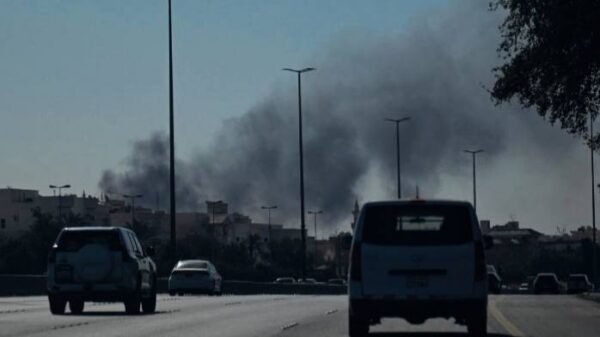













United States President Donald Trump on Sunday ordered the naval blockade of the Strait of Hormuz after peace talks with Iran in Islamabad, Pakistan, failed to yield results.
“The United States to Blockade Ships Entering or Exiting Iranian Ports on April 13 at 10:00 A.M. ET. Thank you for your attention to this matter! President DJT,” Trump said in a post on the Truth Social platform.
The US Central Command, in a statement, said it would begin implementing the blockade “in accordance with the President’s proclamation”.
It said that the blockade would be enforced impartially against vessels of all nations entering or departing Iranian ports and coastal areas, including all Iranian ports on the Persian Gulf and Gulf of Oman.
“CENTCOM forces will not impede freedom of navigation for vessels transiting the Strait of Hormuz to and from non-Iranian ports. Additional information will be provided to commercial mariners through a formal notice prior to the start of the blockade,” CENTCOM said.
“All mariners are advised to monitor Notice to Mariners broadcasts and contact US naval forces on bridge-to-bridge channel 16 when operating in the Gulf of Oman and Strait of Hormuz approaches,” it added.
According to the unified command of the Iranian armed forces, ports in the Gulf and the Sea of Oman are “either for everyone or for no one”, Al Jazeera reported, citing Iranian state broadcaster Islamic Republic of Iran Broadcasting.
“Enemy-affiliated vessels” will not have the right to pass through the Strait of Hormuz, while other vessels will be allowed passage, subject to regulations by Tehran, the Iranian statement was quoted as saying, adding that Washington’s imposition of restrictions on the movement of vessels in international waters “is an illegal act and amounts to piracy”.
Even as Trump announced his latest threat, he also claimed that the two-week ceasefire with Iran meant to stay in effect until April 22 “is holding well” while also saying he does “not care” if Iran returns to the negotiating table.
Rasha Al Joundy, a senior researcher at the Dubai Public Policy Research Centre, noted that the US blockade excludes vessels moving from non-Iranian ports.
“Therefore, the aim is, first, tactical pressure related to the negotiations, which stalled after 21 hours,” Joundy said. Second, the aim is a position to prevent Iran from attacking Gulf Cooperation Council countries, she said.
Abdolreza Alami, a senior lecturer at the faculty of communication and media studies at Universiti Teknologi Mara in Malaysia, told China Daily that the US administration’s simultaneous declaration of a naval blockade and insistence that the ceasefire “is holding well” is a “fundamental contradiction”.
“Under UNCLOS (the United Nations Convention on the Law of the Sea), a blockade is an act of coercion — incompatible with any active ceasefire. This is a dual-audience strategy that risks destroying (the US’) own credibility,” said Alami.
“When Trump says he ‘doesn’t care’ whether Iran returns to the table — that is precisely when you know he desperately needs it. Tehran reads this immediately as a negotiating signal, not policy. Iran’s strategic patience has outlasted far greater pressures. Time, in this configuration, favors Tehran,” he added.
Iranian Foreign Minister Seyed Abbas Araghchi said intensive talks had been at their “highest level in 47 years” as Iran “engaged with US in good faith to end war”.
“But when just inches away from Islamabad MoU, we encountered maximalism, shifting goalposts, and blockade. Zero lessons earned,” Araghchi said in a post on X, adding that goodwill begets goodwill while enmity begets enmity.
After holding the second special Association of the Southeast Asian Nations Foreign Ministers’ Meeting on the Situation in the Middle East on April 10, the grouping said last week it welcomed the two-week ceasefire between the US and Iran.
Following the online meeting, the ministers reaffirmed the importance of maintaining maritime safety and security and urged the US and Iran “to continue negotiations that will lead to the permanent end of the conflict and lasting peace and stability in the region”, as they commended the efforts of Pakistan and all parties involved.
“In this regard, we call for the restoration of the safe, unimpeded, and continuous transit passage of vessels and aircraft in the Strait of Hormuz in line with the 1982 UNCLOS, as well as for all parties to ensure the safety of seafarers and ships in accordance with the International Convention for the Safety of Life at Sea (SOLAS),” they said in a statement released on April 13.