










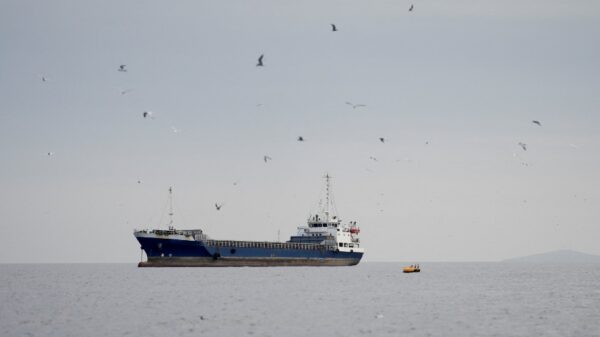




ISLAMABAD, Apr 17 – Iran has announced the reopening of the strategic Strait of Hormuz for commercial shipping during the ongoing ceasefire with the United States.
In a statement posted on X, Iranian Foreign Minister Abbas Araghchi said the waterway is now “completely open” for all commercial vessels for the remaining period of the truce.
The Strait of Hormuz is one of the world’s most critical oil transit routes and had been effectively closed for weeks following escalating tensions.
The closure came after a US-Israeli attack on Iran in February, prompting Tehran to restrict maritime access in the region.
Earlier this week, the United States Navy announced plans to begin a naval blockade of the strait, further raising concerns over global energy supplies.
However, there has been no immediate response from Washington following Iran’s latest announcement.
The current Iran-US ceasefire is expected to expire on April 22nd.
The Strait of Hormuz is a critical shipping route through which roughly 20% of the world’s oil and natural liquefied gas is transported.
The strait’s geography has allowed Iran to use it as leverage throughout this war, selectively preventing vessels from passing through the narrow waterway and spiking oil prices in the process.
Bounded to the north by Iran and to the south by Oman and the United Arab Emirates (UAE), the corridor – only about 50km (31 miles) wide at its entrance and exit, and about 33km wide at its narrowest point – connects the Gulf with the Arabian Sea.
The strait is deep enough for the world’s biggest crude oil tankers, and is used by major Middle Eastern oil and LNG producers, as well as their customers.
In 2025, about 20 million barrels of oil and oil products passed through the Strait of Hormuz per day, according to estimates from the US Energy Information Administration (EIA). That is nearly $600bn (£447bn) worth of energy trade per year.
The oil comes not only from Iran but other Gulf states such as Iraq, Kuwait, Qatar, Saudi Arabia and the UAE.