







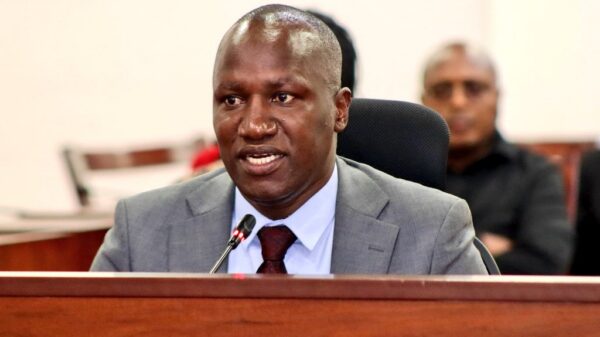


NAIROBI, Kenya Mar 4 – National Assembly Majority Leader Kimani Ichung’wah has defended the proposed National Infrastructure Fund, describing it as a long-planned strategy to overhaul Kenya’s development financing model and reduce reliance on debt.
Moving the National Infrastructure Fund Bill at Second Reading, Ichung’wah dismissed claims that the proposal was an afterthought, telling the National Assembly that the Bill is firmly rooted in the Kenya Kwanza manifesto and subsequent legislative reforms.
“This Bill did not just find itself on the floor of this House,” he said. “It has a clear genesis and strategic thinking behind it.”
According to the Majority Leader, the President made it clear that such capital-intensive projects cannot be sustainably financed through borrowing or increased taxation.
“We cannot continue funding essential infrastructure through unsustainable borrowing or additional taxation,” Ichung’wah said, quoting from the address. “But neither can we postpone these imperatives without risking our future.”
A central feature of the Bill is the ring-fencing of proceeds from privatisation and partial divestiture of government-owned assets.
Ichung’wah said that, unlike in the past when such proceeds were absorbed into the national budget the new Fund would preserve and reinvest these resources strictly in infrastructure and wealth-creating projects.
He cited past privatisations of entities such as Safaricom and Kenya Power, arguing that private sector participation improved efficiency, expanded employment, and increased tax contributions.
“Many of these privatisation proceeds have always gone into financing our budget, paying salaries or servicing debt,” he said. “This Fund will break that cycle.”
Under the proposal, proceeds from future initial public offerings and partial sales of government stakes in state corporations will be channelled directly into the Fund rather than used for recurrent expenditure.
Addressing governance concerns, Ichung’wah said the Fund would be managed by a competitively recruited board and secretariat operating under strict performance contracts and evaluation mechanisms.
The Bill bars individuals who have held political office or been affiliated with political parties within the last five years from serving on the board, a provision he said was intended to insulate the Fund from political patronage.
“This Fund must serve the national interest, not political interests,” he said.
The board will be required to develop an investment policy subject to approval by the National Treasury Cabinet Secretary outlining priority sectors, asset allocation, portfolio limits, and expected rates of return.
The policy will also require prioritisation of incomplete projects before new ones are initiated.
Ichung’wah said Kenya was following proven global models, pointing to Australia’s Future Fund, Temasek, and Mubadala.
“These are tested instruments,” he said, adding that Kenya must adopt similar approaches to transition from a developing to a developed economy.
Ichung’wah urged lawmakers to consider the fiscal realities imposed by the 2010 Constitution, including mandatory and substantial annual allocations to county governments.
He cautioned against simplistic comparisons with previous administrations, arguing that the current fiscal environment requires innovative financing mechanisms.
“These national imperatives are not for one leader or one Parliament,” he said. “They are for this generation and generations to come.”