











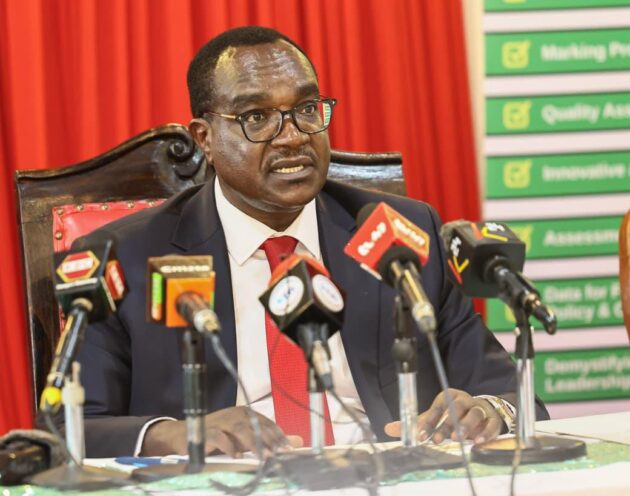

NAIROBI, Kenya Jan 9 – A total of 1,932 candidates scored a straight Grade A in the 2025 Kenya Certificate of Secondary Education (KCSE) examinations, marking a slight but significant improvement from last year, Education Cabinet Secretary Julius Migos announced on Friday during the official release of the results.
The number represents 0.19 percent of the 993,226 candidates who sat the examination, up from 1,693 candidates (0.18 percent) in 2024, signaling steady gains in top-end performance even as the country prepares to fully transition from the 8-4-4 system to the Competency-Based Curriculum (CBC).
The CS congratulated the Class of 2025, describing the results as encouraging and reflective of reforms being undertaken in the education sector.
“The results are good, and I want to take this opportunity to congratulate the Class of 2025 KCSE. The state of competency-based education is strong, and the future of education in this country is bright,” Migos said.
National schools dominate
According to the results breakdown, national schools produced the highest number of candidates with a mean grade of A, accounting for 1,526 students. They were followed by extra-county schools with 197 A grades, while private schools recorded 185 candidates with straight As.
The CS noted that while elite institutions continue to dominate top grades, sub-county schools performed strongly in the middle bands, producing 72,699 candidates with C+ and above, compared to 36,600 from county schools, underscoring the impact of expanded access and targeted interventions at the grassroots level.
More candidates qualify for university
Overall performance improved across key thresholds. The number of candidates who attained the minimum university entry grade of C+ and above rose to 270,715, representing 27.1 per cent of the candidature. This was an increase from 246,319 candidates (25.53 per cent) in 2024.
Those scoring C– and above, who qualify for various tertiary education pathways, stood at 507,131 candidates (50.92 per cent), up from 49.41 per cent the previous year. Candidates attaining a pass grade of D+ and above also increased to 634,082 (63.67 per cent).
“These gains reflect the investments we have made in teachers, infrastructure and learner support,” Migos said.
Candidate numbers and gender trends
A total of 993,226 candidates sat the 2025 KCSE examinations, an increase of 30,714 candidates (3.19 per cent) compared to 2024. Of these, 492,012 were male and 501,214 female, meaning girls outnumbered boys for the second consecutive year since the inception of KCSE.
The highest proportion of candidates 716,048 learners (72.02 per cent) — fell within the expected age bracket of 17 to 19 years, while the number of under-16 candidates increased slightly to 26,391 (2.65 per cent).
Performance by subject
The CS reported that 17 subjects recorded significant improvement in performance, while 11 subjects registered a decline compared to 2024.
Female candidates outperformed their male counterparts in subjects including English, Kiswahili, Kenyan Sign Language, Home Science, Christian Religious Education, and Art and Design. Male candidates, however, recorded stronger performance in Mathematics, Biology, Chemistry, Physics-related sciences, History and Government, Geography, and Business Studies.
Integrity and exam security
Migos reaffirmed the government’s commitment to examination integrity, revealing that 1,180 candidates were found to have engaged in examination irregularities. Their results were cancelled in line with the law.
He credited the smooth administration of the examinations to a whole-of-government approach involving the Ministry of Education, Ministry of Interior, DCI, ICT Ministry, and security agencies.
Transition to CBC
The CS said the 2025 KCSE cohort is the third-last group under the 8-4-4 system, as the country accelerates the rollout of CBC. He highlighted the placement of 1.1 million learners from junior to senior school and the introduction of flexible revision and pathway review options.
He also announced the scaling up of the Kenya Education Management Information System (KEMIS), which will eventually place the entire education ecosystem on a single digital platform.
“Competency-based education is the system that will transform this country from Third World to First World. It is real, and it is coming very soon,” Migos said.
Candidates can access their individual results online via the KNEC portal immediately after the release.