












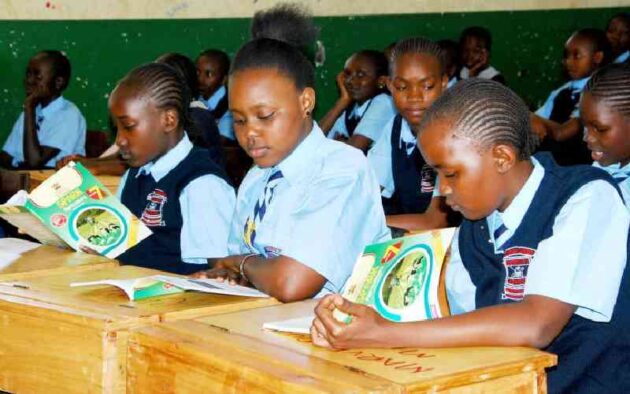

NAIROBI, Kenya Dec 11 – Girls have outperformed boys in 10 out of 12 subjects in the 2025 Kenya Junior School Education Assessment (KJSEA), marking one of the strongest gender gaps recorded under the Competency-Based Curriculum.
Education Cabinet Secretary Julius Migos Ogamba announced the results on Thursday at New Mitihani House, saying the performance trend shows that girls continue to excel in most subjects, especially languages and humanities.
“Female learners out-performed male learners in ten of the twelve subjects. This is an important insight for educators and parents,” Ogamba said.
According to the Ministry, the widest performance gaps were seen in Kiswahili, Christian Religious Education, English, and Social Studies, where girls scored significantly higher in the “meeting expectations” and “exceeding expectations” bands.
About 64.86 percent of girls met or passed the expected level, compared to 51.41 percent of boys.
The same pattern appeared in Christian Religious Education, where 59.77 percent of girls did well against 48.39 percent of boys.
In English, 52.86 percent of girls reached the expected standard, slightly ahead of 48.45 percent of boys, while in Social Studies, girls again topped the boys with 62.98 percent compared to 54.35 percent.
Overall, seven subjects had more than half of all learners meeting or exceeding expectations, with Hindu Religious Education recording the highest performance at 84.62 percent.
However, the Education Cabinet Secretary raised concerns over Mathematics and Kenyan Sign Language, where both boys and girls struggled.
The 2025 Kenya Junior School Education Assessment (KJSEA) was taken by 1,130,459 learners, according to official data.
Of these, 578,630 were boys, while 551,829 were girls, marking one of the highest national candidature counts in recent years.
The counties with the highest candidate numbers were Nairobi, Kakamega and Nakuru.
Most learners (56.84 percent) were aged 14–15, the expected age for Grade 9.
The assessment further revealed that 59.09 per cent of learners qualify for the STEM pathway, while 46.52 per cent are suited for Social Sciences and 48.73 per cent for the Arts and Sports pathway.
According to the Ministry, placement to Senior Schools will start next week and run until December 20, 2025, with Grade 10 learners expected to report on January 12, 2025.
Ogamba assured parents that the 9,540 Senior Schools across the country can comfortably absorb all candidates.
The government he said will continue offering capitation at Sh22,244 per learner per year, and no changes have been made to boarding school fees.
Learners can access their results online through kjsea.knec.ac.ke using their Assessment Number.