
















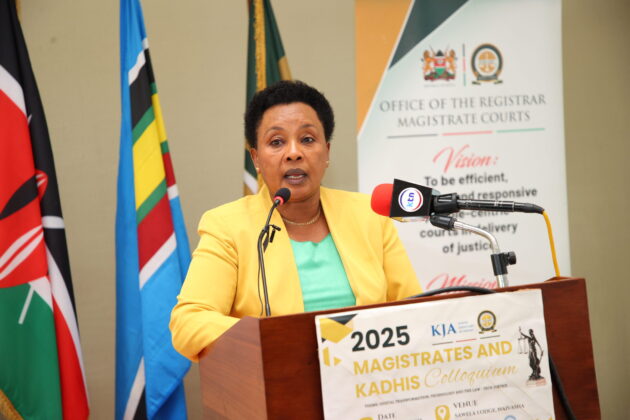

NAIROBI, Kenya, Apr 12 – Deputy Chief Justice Philomena Mwilu has urged judicial officers to uphold fairness, independence, competence and integrity in delivery of justice.
The DCJ called on Magistrates and Kadhis to abide by their oath of office that mandates them to dispense justice without any fear, favour, bias, affection, ill-will, prejudice or any political, religious or other influence.
Speaking at the conclusion of the Magistrates’ and Kadhis’ Colloquium in Naivasha, the Deputy Chief Justice emphasized the enduring foundational principles enshrined in the oath of office, which all judicial officers must uphold with the utmost fidelity.
In line with this year’s colloquium theme, “Digital Transformation, Technology and The Law – Tech Justice,” the Deputy Chief Justice underscored the critical role of digitization in the Judiciary’s operations. She highlighted that the environment for judicial practice is evolving at a rapid pace, making it essential for judicial officers to continually enhance their skills and deepen their knowledge to ensure effective and timely delivery of justice.
“Our experience over the past six years has proven that digitization offers immense benefits to the Judiciary. However, it also presents challenges that require careful management,” she said.
Justice Mwilu, however, noted several concerns, including issues related to data privacy and the integrity of digital evidence; unequal access to technology and a widening digital divide driven by limited digital literacy and accessibility barriers; and inappropriate legal frameworks including outdated laws and the failure of legislation and jurisprudence to keep up with the fast-evolving digital environment.
The DCJ also highlighted culture change challenges and a lack of resources or will to train and build the capacity of Judiciary personnel; virtual hearings and the attendant fair trial concerns; and the significant challenges of digital evidence.
The judicial officers also delved into the Digital Revolution, Emerging Technologies and their Legal Implications including on AI, the ethical and human rights considerations in adopting new technologies, and the local and global regulatory frameworks. They also delved into the Legal Framework Governing Data Privacy and Data Protection and discussed the Judiciary’s own automation experience.
“I have no doubt you have gained considerably in this emerging and fast evolving area of legal and judicial practice. I urge you to continue to deepen your knowledge in these areas; the future is digital and you must be prepared for it,” said the DCJ.
She urged the officers to manage court process by using all the tools at their disposal to ensure that the courts function efficiently and effectively. Key amongst these tools is the Court User Committee.
“During this colloquium you also had opportunity to engage on the CUC Monitoring Reporting and Analysis System (MORAS) for automation of receipt of minutes. Without a vibrant and active CUC, there can be no effective or efficient dispensation of justice at any Court Station.”
The Deputy CJ noted that 181,439 matters were filed between July and December 2024 in Magistrates’ Courts across the country with 179,377 of these matters being resolved.
“That is a remarkable 99% case clearance rate. This is not a statistic – it is a symbol of dedication, resilience, and unwavering commitment by our magistrates and court staff.
She observed that the average workload per magistrate is about 1,332 cases, a figure that raises a flag on wellbeing, efficiency, and sustainability.
“We cannot pour from an empty cup and your workplace well-being is of critical significance. Recognizing the immense workload often undertaken in a difficult working environment, I nevertheless ask you, please do the right thing. Recognize the onerous task, and solemn duty you undertake in exercising judicial authority. Which authority is the delegated sovereignty of the people of Kenya, in service to the people of Kenya under the Constitution.”