














NAIROBI, Kenya November 7 – Meat stakeholders have decried the increased supply-demand gap in the sector as well as duplicated government policies as some of the hindrances facing them.
The stakeholders from the Kenya Markets Trust, Kenya Meat, Livestock Exporters Council of Kenya (KEMLEIC) said poor government policies, high taxation, unnecessary duplicated bureaucratic policies, and lack of experts in the sector are among challenges facing them.
Kenya is a high net importer of meat despite boasting of the second largest reserves of livestock in Africa with the Arid and Semi Arid Lands occupying 80 percent of Kenya’s region
As of 2016, KMT notes that the country had a meat deficit of 300,000 tonnes and is expected to rise due to a growing population expected to hit 95.5 million by 2050.
Failure to leverage on important factors that give the country a strong comparative advantage, the stakeholders noted has been a huge failure foreseen by successive regimes.
Wario Bonaya, the Programmes Manager at KMT highlighted several advantages that pit Kenya against other meat producers including easy access to ports unlike her competitors (Ethiopia, Uganda, Botswana).
Bonaya further noted that Kenya’s traditional livestock rearing skills are ideal and have been used to build similar sectors in neighbouring countries.
Meat alone contributes to 15 percent of the Agricultural GDP with 12 percent of Kenyans heavily depending on meat farming.
Eighty-six percent of the meat market is informal with only 2 percent of the meat sold undergoing cold chain processing and another 50 percent mortality losses from birth to sale.
With a higher percentage missing out the cold chain processing, there is high wastage, lack of processing skill, lack of policy formulation, compliance with food safety standards and limited private investment.
Need to Consolidate Policies
Nicholas Ngahu of the Meat and Livestock Exporters Industry Council of Kenya said that in order to unlock the potential of the meat industry in the country, there is also the need to consolidate policies in the country which has too many duplicated bureaucratic policies.
“There are approximately 20 different laws that touch on meat production stifling the business and thus creating a huge barrier to those willing to venture in the business,” Ngahu said.
John Wamahiu, intervention specialist, livestock at the Kenya Markets Trust highlighted that another challenge faced in the sector is high mortality losses in the subsistence-oriented sector.
“High mortality losses has been encouraged by limited access to animal health inputs, services, fractured land governance, and high informal cross border trade and Climate risks putting pressure on the sector leading to forage scarcity and land degradation,” he said.
Food Safety Concerns
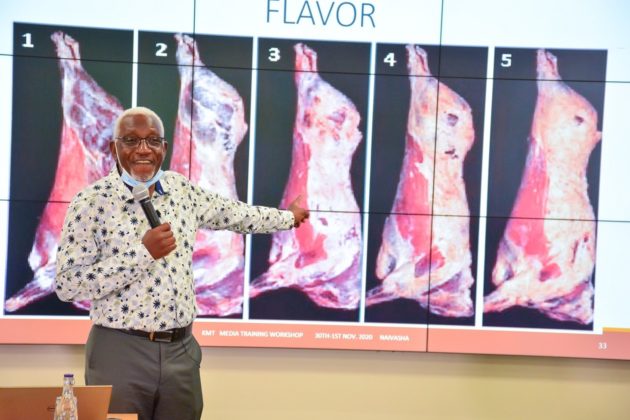
In the wake of increased concern over the safety of sold meat products, food safety expert Prof Kangethe Kiambi highlighted the need to harmonise and have one agency that looks at the safety of meat and other food from the production to food safety.
He said that despite the presence of high expertise, there is a gap of those who look at the quality of meat from the farm highlighting the need to liaise with local-level stakeholders.
As part of the proposed game-changers for the sector raised by the experts are viable and traceable production, processing capacity, policy framework and need for large-scale investment.