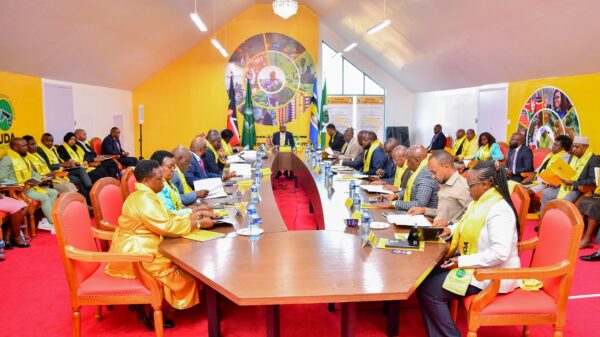




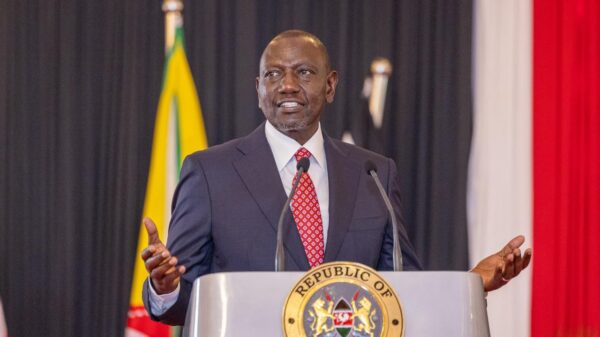












NAIROBI, Kenya, Dec 2 – President William Ruto on Tuesday launched the Jukwaa La Usalama Report at State House, Nairobi, during a meeting with chiefs and assistant chiefs from across the country, outlining a comprehensive plan to strengthen Kenya’s security operations and improve service delivery at the grassroots.
The report calls for intensified, intelligence-led multi-agency operations targeting bandits, militant groups, extremist elements, narcotics traffickers, and organized criminal gangs.
It also emphasizes deeper cooperation between security agencies and community policing structures, noting that local organized groups will now be formally incorporated into national security management systems to improve information flow and public participation.
The government will deploy more specialized security units to areas facing unique threats and finalize the National Police Reservists policy to ensure accountable recruitment, training, and operational control of the NPRs while enhancing collaboration with other agencies.
The strategy further seeks to strengthen judicial follow-up on criminal cases, improve rapid response teams, and dismantle drug trafficking networks.
In addition, the Ministry will expedite the National Correctional Services Bill, draft a new National Correctional Services Policy, and develop a dedicated policy on Small Arms and Light Weapons.
To address security risks linked to marginalization, the government will fast-track targeted development projects—particularly roads, water, health, and education infrastructure—in historically neglected regions.
A central pillar of the report is community engagement and conflict resolution. The government will operationalize the National Government Village Administration Policy to formally recognize Village Elders in governance, conflict mediation, peacebuilding, and security support.
It will also scale up community sensitization and socio-economic empowerment programs to address the root causes of crime, including drug abuse prevention and rehabilitation.
Community reporting mechanisms will be strengthened to curb land encroachment, illegal arms possession, defilement, and incidents of sexual and gender-based violence.
Additionally, counties will enhance surveillance of religious organizations and expand psychosocial support, youth empowerment, and counter-radicalization initiatives to prevent the spread of extremist doctrines similar to those witnessed in the Shakahola tragedy.
The Ministry of Interior said that it has established a sustainable framework to institutionalize the Jukwaa La Usalama initiative, ensuring continuous engagement between government leaders and the public.
The town hall–style forums, now integrated into the Ministry’s work plan, will be held bi-annually at the grassroots and nationally once every five years, serving as an important feedback mechanism for policy and service delivery.
Since independence, Kenya has adopted numerous strategies to promote development, alleviate poverty, and enhance citizen welfare.
Under the Kenya Kwanza Administration’s Bottom-Up Economic Transformation Agenda (BETA), the government has prioritized inclusive governance, equitable resource distribution, and greater citizen involvement in decision-making.
In line with Article 10 of the Constitution, which anchors public participation as a national value, Murkomen said that the Minsitry conducted the nationwide Jukwaa La Usalama consultations between April and October 2025 across all 47 counties.
These forums brought together a wide range of stakeholders—NGAOs, security officers, county governments, youth and student representatives, women’s groups, religious leaders, business associations, elected leaders, and civil society.
They served both as a problem-solving platform and as a mid-term review of BETA within the security and administration sector. Participants discussed issues such as criminal activities, drug abuse, banditry, sexual and gender-based violence, land disputes, service delivery challenges, human resource concerns, human–wildlife conflict, and mining-related problems.
The forums revealed a number of recurring threats, including corruption, drug and alcohol abuse, undocumented foreign nationals, criminal gangs, and rampant land disputes.
Officers cited delays in promotions and training, inadequate tools, logistical challenges, unreliable network connectivity, and budget constraints as key obstacles to effective service delivery.
From these engagements, participants recommended strengthening multi-agency security operations, enhancing community participation, improving cybersecurity and digital governance, deepening small arms control initiatives, increasing operational capacity for officers, improving infrastructure and mobility, strengthening national registration systems, and consolidating identity and civil registration policies.
They also called for the decentralization of passport services and enhanced vetting of foreign nationals.
The Ministry acknowledges that Kenya’s security framework has evolved significantly since the 2010 Constitution introduced a more decentralized and community-centered governance model.
The Jukwaa La Usalama initiative was developed to bridge gaps in this system by creating open, consultative spaces where citizens, leaders, and security officials can jointly address emerging threats and provide real-time feedback.
The Ministry called on all Kenyans to embrace collaboration and shared responsibility, affirming that a safer, cohesive, and prosperous nation can only be achieved when citizens and security agencies work together.