



















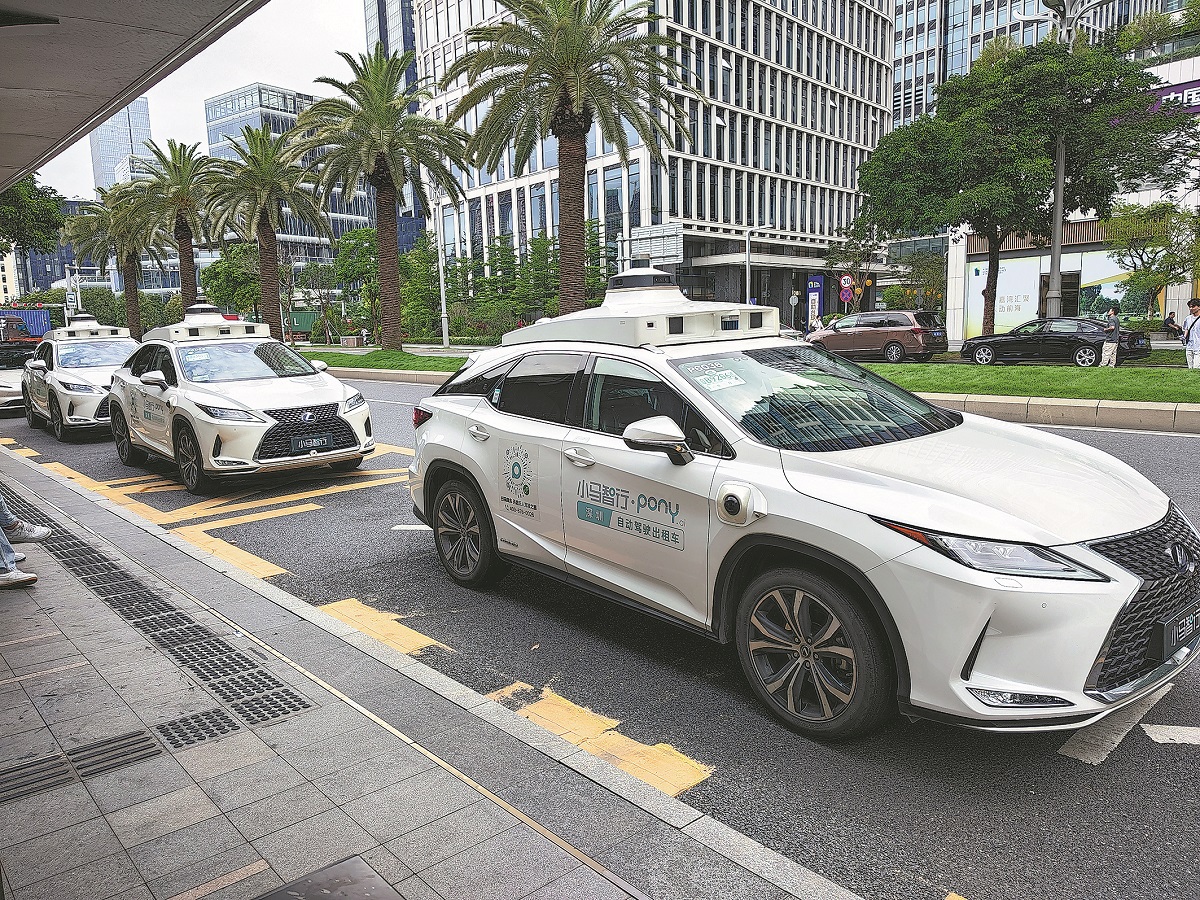


Rapid replication
Zhang from Pony.ai said the current technological readiness of autonomous driving enables rapid replication and deployment, forming the foundation for commercial exploration in overseas markets. Many countries outside China and the US are actively promoting autonomous driving to address challenges such as aging populations, creating new opportunities for technology deployment abroad, he said.
Pony.ai emphasizes that international expansion is driven by commercial opportunity, not for the sake of expansion itself, Zhang said. “Expanding internationally at this stage allows technology to reach more users and regions, generating social and economic impact,” he said.
Pony.ai prioritizes countries with a strong willingness to develop the autonomous driving technology and open policies that embrace innovation, he said. Other considerations include well-developed road infrastructure and existing automotive and electronics supply chains.
Countries facing aging populations or driver shortages also present significant market and transformation opportunities, said Zhang.
“Selected overseas markets — including the Middle East, Europe, Singapore and South Korea — share characteristics such as economic development, open policies and well-maintained infrastructure,” he said.
Markets such as the Middle East and Southeast Asia are particularly attractive.
In Abu Dhabi, regulators have rolled out “green channel” policies to fast-track approvals, enabling WeRide and Pony.ai to launch pilot fleets of robotaxis and driverless buses.
Singapore, with its well-established tech ecosystem and controlled urban environment, has positioned itself as a laboratory for next-generation mobility.
By gaining a foothold in these regions, Chinese companies can showcase their technology in real-world settings, while also building brand recognition far beyond their home base.
Sharing risks
The strategy also reflects pressure from investors. For venture-backed companies in a capital-intensive industry, “going global” serves as a compelling narrative to demonstrate growth potential and resilience.
International expansion is not just about new roads to drive on — it is about staying in the race for relevance and survival in a sector where timelines are long and costs are enormous.
WeRide, in a written reply to China Daily, acknowledged that expanding internationally provides “rich opportunities for financing and business development”. It echoed Pony.ai’s Zhang’s answer that “international expansion is driven by commercial opportunity”.
That also explains in part why Chinese autonomous driving companies are partnering with global mobility giants like Uber, which is seen as a win-win and risk-sharing solution, to make inroads into overseas ride-hailing markets.
According to the McKinsey Center for Future Mobility, robotaxis are expected to become commercially available on a large scale by 2030.
For Uber, which has wound down its own in-house autonomous driving unit, the partnerships represent a strategic bet on outsourcing core technology while focusing on network scale and user engagement, said analysts.
“First, it must be affordable for consumers, but at the same time, it also needs to be profitable for service providers,” said Philipp Kampshoff, a senior partner at McKinsey.
Southeast Asian super-app Grab, which offers ride-hailing and food delivery services, announced in August that it will invest tens of millions of dollars in WeRide, in a deal aimed at speeding up the rollout of Level 4 robotaxis and other self-driving vehicles across Southeast Asia.