














Kisilu Musya who is credited for transforming the sleepy village of Mutomo. /MOSES MUOKI.
KITUI, Kenya Feb 28- He took a deep breath, faced up in the sky where the unforgiving sunshine was releasing scorching heat and cried.
After regaining composure, he wiped the tears using his arm and mumbled something in his Kamba dialect; “Ngai Nowe wisi” (Only God knows).
You see, his first African name- Kisilu- means the dark one; a man who hails from a neglected village in Mutomo sub-location.
Kisilu Musya never imagined that his small actions would bring the world to his village- a sparsely populated area with no proper roads, where farms have been encroached by wild weed and high poverty levels among locals.
While the sun is always punctual in rising to heat up Ndatani village, as if on a mission to dry off the remaining green vegetation, it is Kisilu who is shining light of hope to the area.
His is a story of perseverance and determination, all in real life for the hundreds of Ngatani village.
“It is God,” Kisilu said, two minutes after I posed the question, on what he did.
But why is the 49- year-old father of nine a man of interest?
Unaware that his actions will one day come to help him and fellow villages, for five years from 2011 to 2015, Kisilu used his camcorder to record videos of his farming efforts.
He learned the skills at a ‘Farmers Field School’ “since I wanted to tell my story and that of my community and how climate change has adversely affected our lives.”
All his efforts would spectacularly fail due to the unpredictable weather.
“I never knew anything about climate change and its effects. Neither did I know I was confronting a menace of such magnitude (the global warming),” Kisilu said.
When he left his casual job of 9 years and returned home in 2002, his idea was to become a farmer; like father like son, he told himself.

Farmers in Mutomo never lack water for their livestock and farms due to this dam. /MOSES MUOKI.
“When we were growing up, the weather was stable. We would have a bumper harvest. I still remember,” he narrated.
But he was now confronting a different thing.
The weather was so bad that Mutomo area would go for even more than two seasons without receiving a drop of rainfall. Not that it has changed.
“I was documenting small moments. I did not know they would mean anything or even change my life and that of my people,” the Kenya Certificate of Secondary Education (KCSE) holder said.
-Thank you for the rain-
From a distance, the Capital FM crew could see a dog halfway submerged in water, in an attempt to cool off from the scorching heat.
On the other end, a herd of cattle was drinking water from the same dam.
It is the only remaining evidence that the area recently received rainfall, a rare phenomenon in the sleepy Ngatani village.
How did a neglected village get a dam?
In 2011, a Norwegian filmmaker, Julia Dahr visited Kisilu’s village with one mission- to film how farmers in the area had been affected by climate change.
Kisilu was a co-creator of the film, which captured the devastating consequences of climate change.
“I filmed the floods and droughts, and even a storm that blew the whole roof of my family’s house away. I also filmed my own story of becoming a local climate activist,” he said.
The film which was dubbed “Thank You for The Rain” was launched in 2017, to a global reception.
It opened the window of opportunities with various stakeholders coming to his rescue and that of his people.
They have financed the construction of a life-changing earth dam, a move that has become a beacon of hope to the entire village. It is a lifeline to souls that had retired to the fate of climate change.
The 30,540 cubic meter earth dam is set to serve at least 300 households. It will also be used to irrigate farms around it and act as a source of water for their domestic animals.
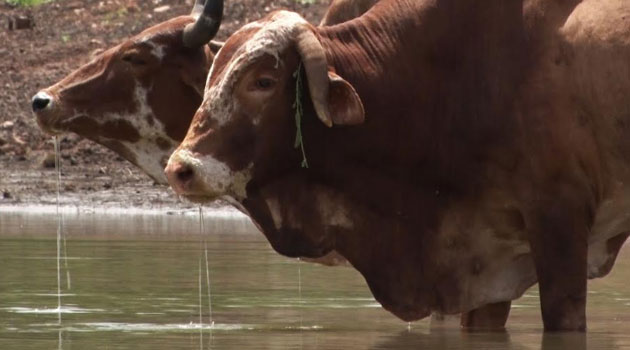
Cows at the dam in Mutomo village that has given locals a lifeline. /MOSES MUOKI.
Before, the nearest source of water was a seasonal river that is more than 5 kilometers away.
The film, Kisilu said, “has now received recognition as a tool to strengthen the resilience work in my community and beyond. By screening the film at farmers’ meetings, schools and churches, I created new arenas for discussions on climate change and how to build climate-resilient communities.”
His story is an example of the important solutions that already exist within farming communities, and he said, it is another reason, “why we must be involved in decision-making. Seeing how more and more farmers are becoming climate-resilient is encouraging, but we cannot fight climate change alone.”
In 2015, he was among global players at the United Nations Climate Change Conference, COP 21 held in Paris, France.
The partners include Docubox, an East African based documentary fund, supporting filmmakers with important and unique stories.
Emily Wanja, the Docubox Impact Campaign Manager said Kisilu’s story confirms that a film “is such a powerful tool of storytelling, to drive social change.”
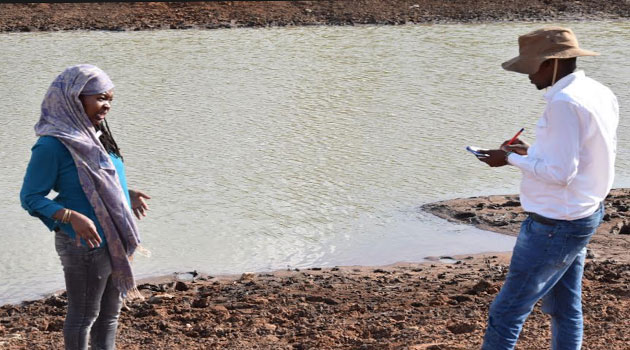
Emily Wanja, the Docubox Impact Campaign Manager speaking to Capital FM’s Joseph Muraya. /MOSES MUOKI.
Through the film, she said the world sees, “what climate means on a personal level. You see Kisilu rise from just being an ordinary farmer to a climate change activist to a community leader.”
Once the project is fully completed, they hope to ensure there are irrigation farms around the dam and a resource centre.
“Some of the things we have learnt is about the power of film and storytelling to convene. When we seat on a table and we are watching an amazing story, it does not matter where we come from or our level of education, we are bound by empathy, which is a language of humanity. We are compelled to do something,” she asserted.
She described their partnership with Kisilu as “a power of unlikely alliances.” Other partners include Doc Society, Good Pitch, and Sahelian Solutions Foundation.
Kisilu’s hope and that of his village mates is that there will be enough rainfall in the coming season, for the dam to have enough water, through which their dream will be achieved.