














NAIROBI, Kenya, Apr 2 -The country is experiencing a new wave of refugee arrivals from South Sudan as the crisis in the neighboring country worsens, with an estimated 20 refugees crossing the border daily.
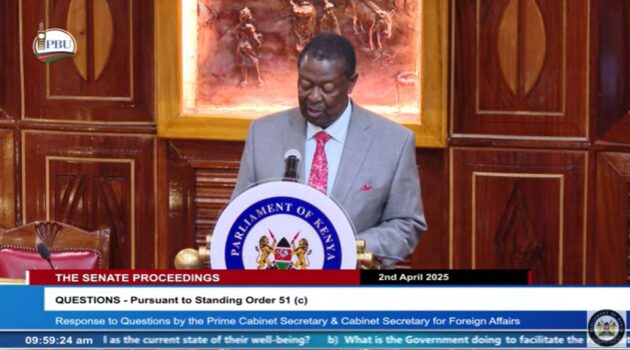
Prime Cabinet Secretary Musalia Mudavadi has warned that the influx, coupled with ongoing security concerns along the Ethiopia and Somalia borders, presents a major challenge to Kenya’s refugee management policies.
“It should be on record that the situation of south sudan is getting worse and we are beginning to see another inflow at the rate of 20 refugees per day and we are beginning to see certain cirmstances that are beginning to give us challenge,” Mudavadi said.
Recent clashes between forces loyal to President Salva Kiir and First Vice President Riek Machar have raised fears that South Sudan is on the brink of renewed war.
The arrest of Machar last week was seen by some observers as the spark that could reignite the civil war that the rivals fought between 2013 and 2018 that killed some 400,000 people.
Security concerns remain high, with the government also monitoring the situation along the Marsabit-Ethiopia border, where sporadic tensions threaten to escalate. Additionally, the resurgence of Al-Shabaab activities in Somalia continues to pose a risk.
“We are also having the issue of Al-Shabaab and the conflict on the Somali side and sporadic tension on the Marsabit-Ethiopia border. There’s a serious security issue that needs to be relooked at both locally and regionally,” Mudavadi warned.
He was responding to questions raised by Marsabit Senator Mohammed Chute on the number of Kenyan refugees in Magatho and Dilo towns in Ethiopia, and provide information on the timeline and circumstances of their displacement to Ethiopia.
The country is grappling with the reintegration of thousands of Kenyan refugees who had fled to Ethiopia due to inter-ethnic conflicts in Marsabit County.
“The majority of the refugees were not willing to move to areas that are inhabited largely by the Borana community. The Kenyans refugees in Ethiopia still retained their identity cards and are now willing to return home to Kenya voluntarily,”Mudavadi asserted.
On the floor of the Senate,Mudavadi emphasized the need for a careful approach to refugee integration, ensuring that those entering the country not only receive humanitarian support but also contribute to Kenya’s economic growth.
“The integration of refugees has to be done carefully.We must transition from a situation where refugees are just drawing from Kenyan resources to one where they help grow the wealth of this country,”he said.
A recent government verification exercise found that 4,993 individuals are ready to return home. However, the process is complicated by security concerns, lack of resources, and the need to provide proper housing and land for returnees.
Mudavadi outlined key concerns that must be addressed before large-scale repatriation can occur including the return destination, accommodation and humanitarian support.
“Safety and security measures must be in place to ensure their safety in the settlement areas. Formal reception a well-organized reception process should be established. Legal assurance and property repossession refugees need guarantees of legal protection and the right to reclaim their property, including ancestral lands,” he explained.
Mudavadi noted that the government is already working systematically to address the issue of Ethiopian refugees in Kenya, particularly in Kakuma and Dadaab refugee camps.
Mudavadi assured lawmakers that refugee repatriation efforts would be conducted in a voluntary and lawful manner, rejecting any form of forced deportation.
“Consultations and negotiations are ongoing because when dealing with refugees, it has to be voluntary. Forced repatriations cannot happen,” he stated.
On the question of compensation, Mudavadi clarified that the government only facilitates the return and reintegration of Kenyan refugees but does not offer financial compensation.
“Regarding compensation, the government only facilitates the return and reintegration of Kenyan refugees who have been granted asylum in another country. However, no compensation is provided to any returning Kenyan,” he stated.