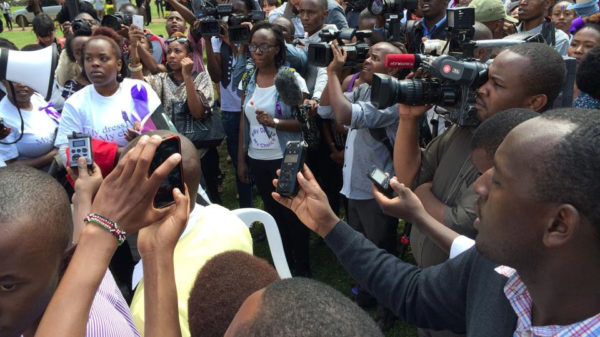
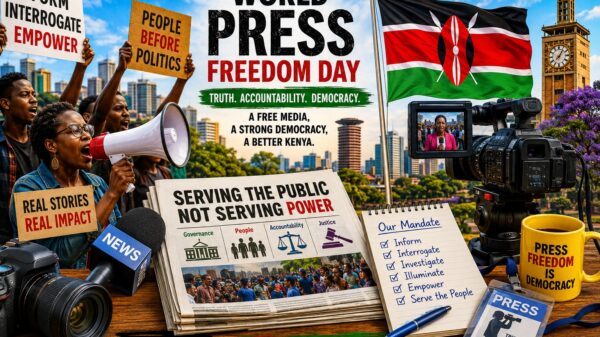












As the country continues to mark World Press Freedom Day, there is every reason to celebrate Kenya’s relatively vibrant and resilient media landscape. Compared to many countries in the region, Kenya enjoys a fairly robust media ecosystem, one that has historically played a significant role in defending democratic space, exposing corruption and amplifying public voices. Yet this moment should also serve as a time for reflection. At a particularly turbulent period for both the media and Kenya’s fledgling democracy, the question is not only whether the media is free, but whether it is fully exercising its democratic responsibility.
Kenya’s political discourse is increasingly shaped not by the realities confronting ordinary citizens, but by the strategic calculations of a small political elite that has mastered the art of controlling narratives. Politicians dominating public conversation is not unusual. They are public actors, elected leaders and naturally central to news cycles. The deeper concern is that the logic determining what becomes the national conversation is overwhelmingly political, driven by competition for power, survival and influence rather than by the lived experiences of wananchi.
When this political logic goes unchallenged, it distorts public understanding and ultimately shifts national priorities away from citizens’ real concerns. Ideally, the media exists to counterbalance this tendency. Society grants the media a social contract not merely to inform, but also to interrogate power, provide context and mediate political discourse in ways that protect public interest.
Communication scholars describe this as the mediatisation role of the media — the ability not only to report politics, but to shape the conditions under which politics is discussed. In healthy democracies, politicians respond to issues elevated by the media on behalf of citizens. Increasingly in Kenya, however, the opposite is happening. Too often, media platforms simply amplify political statements without sufficient scrutiny, even when those statements are clearly designed to manipulate public perception or undermine wananchi interests.
This is not mediation. It is abdication.
Take the now common use of the word “goons” in Kenya’s political discourse. Senior political figures deploy the term casually to describe unnamed groups blamed for insecurity, protests or unrest. Recently, a Cabinet Secretary described Kisumu as a “hotbed of goons” while speaking in Parliament. Such remarks are not harmless political rhetoric. They are framing devices. They shape public perception by associating entire communities and regions with criminality and disorder.
Yet such statements often move through media cycles with minimal interrogation. They are reported, repeated and normalised.
But who exactly are these so-called goons? Where do they come from? Are they an organic social force emerging naturally from certain communities, or are they politically mobilised actors, often young and economically vulnerable Kenyans, recruited and manipulated by political actors seeking to advance their own interests?
Kenya’s political history provides the answer.
During election periods and moments of political tension, groups of young men suddenly emerge in informal settlements and urban centres — in Nairobi, Kisumu, Nakuru, Eldoret and elsewhere — coordinated, emboldened and ready for confrontation. Yet outside these moments, these same young people are boda boda riders, casual labourers, hustlers and unemployed youth struggling to survive within a deeply unequal economy. They are not inherently violent. They are structurally abandoned.
Violence in Kenya is rarely spontaneous. In many instances, it is organised, financed and politically engineered.
Peaceful demonstrations are frequently infiltrated by individuals whose actions quickly shift public focus from legitimate civic grievances to scenes of chaos and destruction. Once this happens, the narrative changes immediately: “goons have taken over.” Rarely do we follow the money. Rarely do we ask who benefits when protests are delegitimised. Rarely do we interrogate the possibility that some of the same political actors publicly condemning violence may privately facilitate or benefit from it.
The uncomfortable truth is that Kenya’s “goonism” is often not born in the streets. It is conceived in political boardrooms, strategy meetings and elite negotiations where power remains the overriding currency. It is reflected in the calculated exploitation of economically vulnerable youth for political gain.
Yet public blame is conveniently redirected.
The young man in Kibera, Mathare, Kondele or Mukuru becomes the face of disorder, while the structural realities shaping his vulnerability — unemployment, exclusion, hopelessness and lack of opportunity — are ignored. The political elites who mobilise and benefit from these conditions remain respectable figures occupying high office, issuing statements and defining the very narratives that shield them from accountability.
This is precisely where the media must do better.
Reporting what politicians say is part of journalism’s surveillance function and remains important. But it is insufficient on its own. The correlational function of the media — providing interpretation, context and deeper analysis — is equally critical in a functioning democracy. Journalism must go beyond asking what happened to examining why it happened, who benefits and what realities are being deliberately obscured.
When politicians describe regions as hubs of “goons,” the media should interrogate those claims using data, community voices and historical context. Coverage of violent protests should not end with burning tyres and running battles. It should examine the political and economic structures that make such mobilisation possible. When young people are arrested, injured or killed during unrest, their stories should not end at the point of conflict. Journalism should trace the deeper systemic failures that left them vulnerable in the first place.
The reality most Kenyans experience daily is far less sensational than political narratives often suggest. Communities across Kisumu, Nyeri, Eldoret, Migori and Nairobi coexist peacefully, trade together and go about their lives without incident. Violence is not Kenya’s default condition. More often than not, it is triggered and sustained by political contestation.
The myth of permanently violent regions populated by faceless “goons” is not only inaccurate; it is politically convenient.
Kenya’s problem is not an amorphous class of violent youth. The deeper problem is a political culture built on manipulation, exploitation and elite impunity. It is sustained by leaders willing to weaponise poverty and frustration for political advantage while publicly condemning the very disorder they help create.
Kenya’s media has both the capacity and influence to shift this narrative. It remains one of the country’s strongest democratic institutions. But doing so requires moving from amplification to interrogation, from repetition to analysis and from elite-driven framing to citizen-centred storytelling.
The stories of young Kenyans must not be reduced to caricatures of criminality and disorder. They are citizens navigating economic hardship, exclusion and uncertainty within a political environment that too often treats them as disposable instruments.
The stakes are too high for the media to remain passive.
A generation of young Kenyans is coming of age in an environment defined by shrinking opportunities and growing political manipulation. If their experiences continue to be framed solely through the language of “goonism,” the country risks not only misrepresenting them, but abandoning them altogether.
Reclaiming the public narrative is therefore urgent. Kenya’s media must centre the people, interrogate power more rigorously and expose the real architects of disorder — the real goons.