


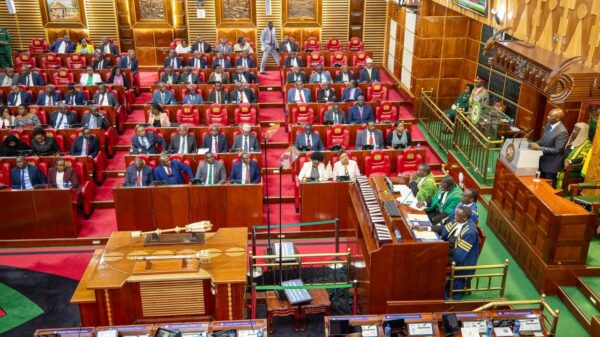











Chief Administrative Secretary, Ministry of Public Service and Gender Rachael Shebesh at an FGM forum in Isiolo. /COURTESY.
NAIROBI, Kenya, Feb 7th – When Tabitha was growing up in rural Kenya, most of her 16-year-old peers were subjected to Female Genital Mutilation (FGM)– a human rights violation that more than 4 million girls worldwide are at risk of this year. Yet Tabitha remains unharmed, thanks to the unwavering support of her parents, who, in spite of enormous social pressure, saved their daughter from the same fate.
On the International Day of Zero Tolerance for FGM, Tabitha and young people around the world are engaging their peers, families, communities, and governments with a plea to end this harmful act of gender-based violence once and for all, as promised by the international community in the 2030 Agenda for Sustainable Development.
“Today’s young people can play a critical role in ending the practice. Unleashing the power of youth means investing in youth-led movements to champion gender equality, an end to violence against women and girls and the elimination of harmful practices,” Chief Administrative Secretary, Ministry of Public Service and Gender Rachael Shebesh stated.
“The government is going to strictly implement the law against FGM in realization of President Uhuru Kenyatta’s commitment to ending FGM by 2022,” Shebesh added, on the occasion of the International Day of Zero Tolerance for Female Genital Mutilation in Isiolo.
President Uhuru Kenyatta made the personal commitment in the fight against FGM in the country, during the International Conference on Population and Development 25th anniversary (ICPD25) at KICC last year, pledging to provide the necessary leadership needed to fight the vice and eliminate the practice which remains one of the most serious violations of rights of women and girls.
“FGM is a retrogressive practice whose continued existence in our country in actual fact assaults our individual and our national consciousness. The practice is inimical to our shared fundamental values as enshrined in our very own constitution that we as Kenyans passed,” Kenyatta said.
Kenyan community elders and religious leaders drawn from 22 counties most affected by FGM also resolved to end FGM in the country by 2022.
The President acknowledges the religious and cultural leaders for leading the onslaught against the retrogressive practice and assured them of the government’s backing.
He further tasked government officials in the ministries of Gender, Education and Health to take the lead in championing government efforts aimed to end FGM in the country.
Kenya, Uganda, Tanzania, Somalia and Ethiopia also made a landmark declaration to address cross border FGM practices.
While significant progress in eliminating the practice has been made in the last 30 years, approximately 200 million girls and women alive today have had their genitals mutilated. This can lead to long-term physical, psychological and social consequences.
“Support for the practice is dwindling. Adolescent girls aged 15 to 19 in countries where female genital mutilation is prevalent are less supportive of continuing the practice than are women aged 45 to 49,” said UNFPA Executive Director Dr. Natalia Kanem.
“In many countries, young girls are at much lower risk of being subjected to female genital mutilation than their mothers and grandmothers were. However, rapid youth population growth in countries where female genital mutilation is prevalent could lead to a significant rise in the number of girls at risk by 2030,” UNICEF Executive Director Henrietta Fore noted.
This requires including young people as partners when designing and implementing national action plans, building relationships with youth-led organizations and networks that work to end female genital mutilation and recognize it as a form of violence against women and girls, empowering young people to lead community campaigns that challenge social norms and myths, and engaging men and boys as allies.
UNICEF, UNFPA and WHO stated that in the course of the year, they will announce the creation of a new –“Generation Equality” to drive further investment and results for gender equality.
“Now is the time to invest, translating the political commitments already made into concrete action. Now is the time to do more and do it better and faster to end the practice once and for all. Now is the time to keep our promise to Tabitha and all girls of reaching zero female genital mutilation by 2030,” WHO Director-General Dr. TedrosAdhanom Ghebreyesus.
-Fact sheet on FGM in Kenya-
Globally, 200 million girls and women alive today have undergone female genital mutilation and 68 million girls are at risk of female genital mutilation by 2030.
In 2020 alone, 4.1 million girls around the world are at risk of undergoing female genital mutilation.
Rapid youth population growth in countries where female genital mutilation is prevalent could lead to a significant rise in the number of girls at risk by 2030.
Female genital mutilation endangers the health of women and girls and can lead to long-term physical, psychological and social consequences.
The practice is rooted in gender inequalities, limiting girls and women from realizing their rights and potential in health, education and income.
Ending female genital mutilation means empowering women and girls to be healthy, stay in school, make choices and contribute to the economy. Achieving this means achieving gender equality.
With only a decade remaining for achieving SDG Target 5.3 – the elimination of harmful practices including female genital mutilation by 2030 – we need to galvanize the global movement to accelerate efforts to eliminate female genital mutilation.
In many countries where female genital mutilation is prevalent, young girls have a dramatically increased chance of growing up without the risk of undergoing this harmful practice compared to their mothers and grandmothers.
Support for the practice is declining. Adolescent girls’ aged 15 to 19 in countries where female genital mutilation is prevalent are less supportive of continuing the practice than are women aged 45 to 49.
The average cost of preventing one case of female genital mutilation is $95.
Ending female genital mutilation in this decade has a multiplier effect on other SDG targets, especially on health and well-being, quality education, safe motherhood, inclusive societies and economic growth.
6 out of 10 commitments made by governments at ICPD25 address gender-based violence and harmful practices, including the elimination of female genital mutilation.