














A new political blueprint in Hong Kong drastically reduces the number of directly elected seats and controls who can run for office © AFP / Bertha WANG
Hong Kong (AFP), Dec 18 – Hong Kongers snubbed a legislature poll taking place under new “patriots only” rules imposed by China, with the lowest turnout since residents here started electing lawmakers three decades ago, according to official figures released Monday.
Only 30 percent, or 1,350,680 of the 4,472,863 registered voters, cast their ballots for city lawmakers in Sunday’s poll, Hong Kong’s top election official, Barnabas Fung, told reporters.
The new rules which drastically reduce the number of directly elected seats and control who can run for office were dictated by Beijing in response to massive and often violent pro-democracy protests two years ago.
All candidates have been vetted for their patriotism and political loyalty to China and only 20 of the 90 legislature seats are being directly elected.

Graphic showing how the make-up of Hong Kong’s legislature has changed since 2016 © AFP / Laurence CHU, John SAEKI
The largest chunk of seats — 40 — are being picked by a committee of 1,500 staunch Beijing loyalists.
The remaining 30 are chosen by reliably pro-Beijing committees that represent special-interest and industry groups.
Polling stations closed at 10:30 pm (1430 GMT) after 14 hours of voting. Elections officials were working on tallying the numbers and full results were expected later Monday.
Sunday’s was the lowest turnout since Hong Kong’s first ever direct election of its legislature in 1991. Turnout was 58 percent in 2016 and 44 percent in 2000.
Kenneth Chan, a political scientist at Hong Kong’s Baptist University, described Sunday’s turnout as “hugely embarrassing” for the government.
“Most pro-democracy voters decided to stay away, to express their disapproval of this kind of election by not turning up,” he told AFP
Final turnout figures are expected in the coming hours and counting the ballots will go into the night.
– ‘Genuine suffrage’ –
As Hong Kong leader Carrie Lam arrived to cast her vote on Sunday morning, three protesters from the pro-democracy League of Social Democrats party chanted: “I want genuine universal suffrage”.

Hong Kong leader Carrie Lam and her ministers have tried to drum up public enthusiasm for the polls © AFP / Bertha WANG
“(Lam) said this was an improvement of the electoral system, but in reality, it stripped Hong Kongers of their right to vote,” activist Chan Po-ying told reporters.
The government bought up newspaper front pages and billboards, sent flyers to every household, pinged mobile phones with reminders to vote and made public transport free for the day.
Senior Chinese officials also called for Hong Kongers to vote.
But the publicity blitz and appeals appear to have done little to persuade residents in a city where dissent has been criminalised by a sweeping national security law.
An accountant in her 20s, who gave her name as Loy, said she had no plans to use her ballot.
“My vote won’t mean anything because ultimately it’s Beijing’s people winning,” she told AFP.
But Daniel So, a 65-year-old who works in technology, was among the first queuing at a polling centre in the wealthy Mid-Levels district.
“The young people are not so interested in this election because they are misled by foreign politicians and media,” he told AFP. “China is doing so great now.”
– Boycott calls –

All candidates have been vetted for their patriotism and political loyalty to China © AFP / Bertha WANG
Lam has sought to manage expectations, telling state media last week that a low turnout could indicate “the government is doing well and its credibility is high”.
Before voting on Sunday, she told reporters she “had not set any target” for turnout.
Independent polling placed her public approval rating at around 36 percent.
Multiple Hong Kong media outlets reported Lam would travel to Beijing on Monday, citing sources.
Sunday’s election has received vocal backing from Beijing, which sees the new system as a way to root out “anti-China” elements and restore order in a legislature freed from a disruptive opposition.
Hong Kong chief secretary John Lee said Sunday that people who were excluded from the poll “are those traitors who will not be acting for the overall good of Hong Kong”.
Critics counter that authoritarian China has all but banned opposition parties in a city that once boasted a rambunctious political scene.
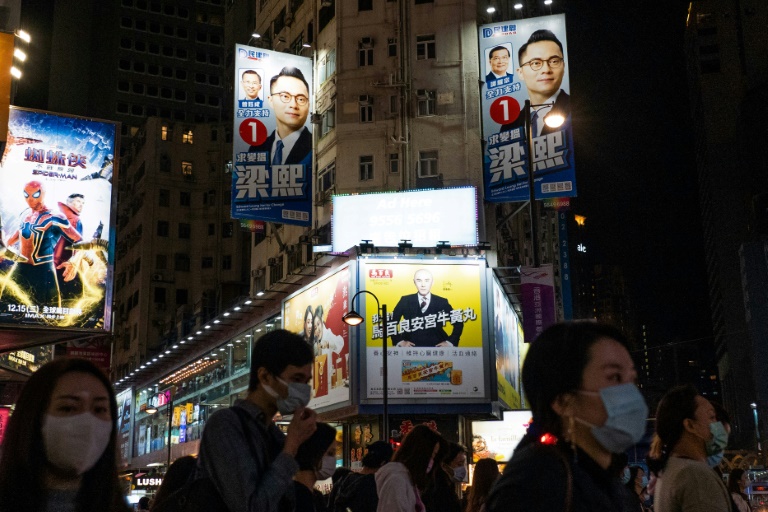
Sunday’s election has received vocal backing from Beijing, which sees the new system as a way to root out ‘anti-China’ elements © AFP / Bertha WANG
Dozens of prominent opposition figures — including many democrats who won seats in the previous election — have been jailed, disqualified or have fled overseas.
The city’s biggest pro-democracy parties put forward no candidates and a growing number of Hong Kong activists abroad openly advocated a boycott.
“People do not want to vote for a rubber-stamp chamber and pretend everything is all right,” Nathan Law, a former lawmaker now living in Britain who is wanted by Hong Kong authorities, tweeted Sunday.
Hong Kongers are allowed to cast blank ballots or not vote.
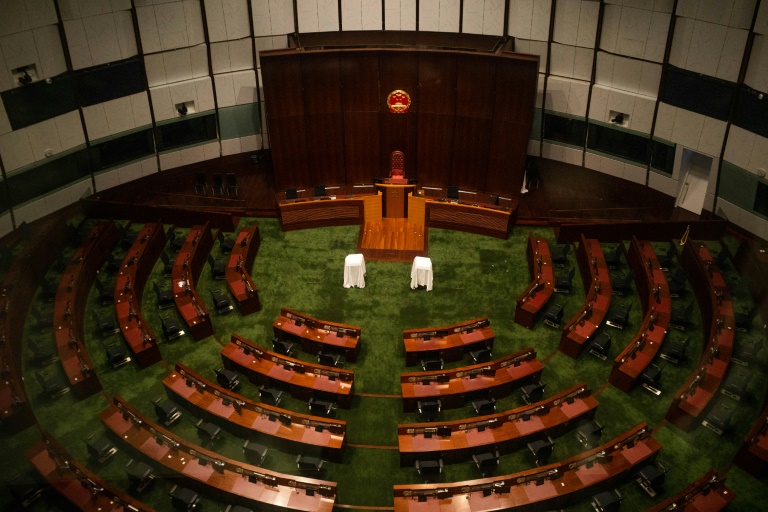
Hong Kong’s official seal was replaced by China’s national emblem in the city’s legislature ahead of the legislature poll © AFP / Bertha WANG
But earlier this year, authorities made it a crime to “incite” others to boycott elections or cast blank or spoiled ballots.
Authorities have arrested 10 people under this law so far, mostly for social media posts.
They have also issued arrest warrants for activists overseas who have called for a boycott.