
















NAIROBI, Kenya, Jan 16 – The Electoral Commission (EC) in Uganda is expected to release the second batch of preliminary results for the 2026 presidential election at 9 a.m. as vote tallying continues across various parts of the country.
Initial results released last night gave President Yoweri Museveni of the National Resistance Movement (NRM) an early lead from 133 polling stations, with 23,845 votes counted.
Of the valid votes tallied so far, President Museveni leads with 14,232 votes (61.7%), followed by National Unity Platform (NUP) candidate Robert Kyagulanyi, popularly known as Bobi Wine, with 7,753 votes (33.64%).
Forum for Democratic Change (FDC) candidate Nandala Mafabi has garnered 560 votes (2.43%), while Mugisha Muntu, Mubarak Munyagwa, Frank Bulira, Robert Kasibante, and Joseph Mabirizi trail with smaller percentages, collectively accounting for less than 3% of the votes counted so far.
The EC also reported 796 invalid votes and 37 disputed votes, which will be reviewed before the final results are declared.
Election Commission Chairperson Justice Simon Byabakama said the next president will be announced on Saturday before 5 p.m., in accordance with the law.
“Accordingly, the Electoral Commission will tally all results from Uganda’s districts and cities at this centre and finally declare the elected presidential candidate within 48 hours of the closure of polling,” Justice Byabakama said during a media briefing at the National Tally Centre in Lubowa, Wakiso District.
Article 103(7) of the Constitution states that the Electoral Commission shall ascertain, publish, and declare in writing, under its seal, the results of a presidential election within 48 hours of polling. Clause (6) further stipulates that the candidate who receives the highest number of votes shall be declared President.
Justice Byabakama emphasized that the declaration process will continue until Saturday, January 17, 2026, when the final results are expected to be announced.
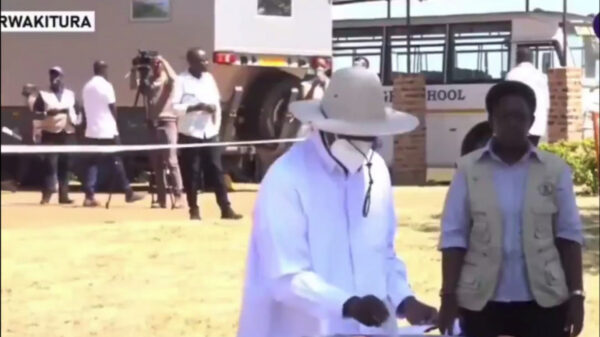
Votes are being counted in parts of Uganda amid an internet shutdown and opposition accusations of rigging in both the presidential and parliamentary elections.
Delays of up to four hours have been blamed on malfunctioning bio-metric machines used to verify voters’ identities.
Election Commission ordered the use of the national voters’ register in areas where bio-metric machines failed to function.