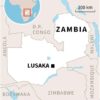













The US has announced that it is cutting $50m (£37m) in aid to Zambia’s health sector, due to the country’s failure to address the “systematic theft” of donated drugs and medical supplies.
This “difficult” decision was taken after repeated warnings to the Zambian government to safeguard vital drugs meant for the country’s most vulnerable patients, said US ambassador to Zambia Michael Gonzales.
“We are no longer willing to underwrite the personal enrichment of fraudsters or the corrupt when patients go without or have to buy life-saving medications that we have provided for free,” he added.
The Zambian government said it had taken measures to tackle the issue.
Health Minister Elijah Muchima thanked the US for its “generous support”, while saying that the problem of theft predated the current government which took office in 2021.
The US cuts are separate to the sweeping foreign aid freeze announced by President Donald Trump in January.
The US accounts for about a third of public health spending in Zambia, according to a statement from the US embassy in the country.
But US officials said they had discovered the “country-wide theft” of medical products that were intended to be distributed for free to the public and were now being sold by private pharmacies.
More than 2,000 pharmacies across Zambia were found selling donated drugs and medical supplies in a year-long investigation conducted by the US embassy.
“Shockingly, across these visits, 95 percent of the pharmacies that were selling the kinds of products that the United States provides, were also selling stolen goods,” the statement said.
Nearly half of the pharmacies visited were found selling medication and supplies donated by the US government, it said.
Other pharmacies were also selling stolen medical stocks purchased by the Zambian government, the Global Fund, and other donor, it added.
The US embassy said it had presented its findings and offered experts to help stop further theft and bring the culprits to justice in April last year but no action was taken.
“I regret that to date, the government’s actions have fallen drastically short of demonstrating a commitment to safeguarding US assistance and the lives we aim to save,” the embassy said.
Zambia’s law enforcement operations have focused on “low-level actors” and have led to the arrest of “only a few mid-level officials” instead of investigating supply sources and pursuing the masterminds behind the theft of medicines, according to the US embassy.
Gonzales said the US “can no longer justify to the American taxpayer continuing to provide such massive levels of assistance”.
He said the cuts would affect drugs to treat malaria, HIV and TB.
“This is not a decision we have taken lightly,” Gonzales said, shedding tears as he explained how the measure would affect Zambian patients.
The aid cuts will take effect January next year to give the Zambian government time to develop alternative arrangements but he said “the decision had been made”.
In response, the Zambian health minister said “an advanced digital stock tracking system” had been set up to help monitor supplies of medicines.
He also reassured Zambians that there were sufficient stocks of all drugs so there was “no immediate risk of shortages”.
Since the Trump administration took office, it has cut billions of dollars in global health programmes, hitting African countries including Zambia, where HIV remains a major threat especially for adolescents and young adults.
Trump announced the aid freeze on his first day in office in January in line with his “America First” foreign policy.
The aid cuts have affected health programmes across Africa, including shipments of critical medical supplies, including HIV drugs.
The majority of the US Agency for International Development’s (USAID) programmes, which provided health and humanitarian assistance to vulnerable nations, have since been terminated.
In March, Zambia’s President Hakainde Hichilema said Trump had “slapped us on both cheeks”, saying it was time for his country to strengthen its treasury to procure its own medicines.