












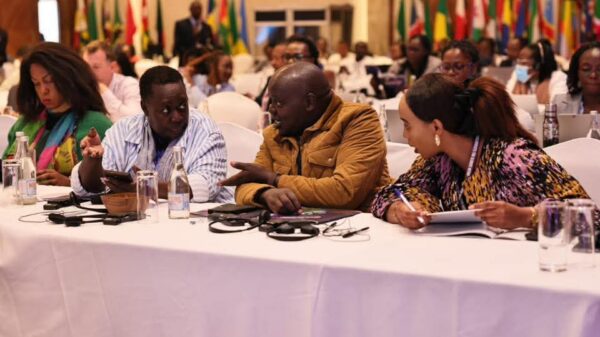










In 2016, a group of six Kenyan scientists from Kilifi County went to China for a two-month exchange program on hybrid rice production. The team which included Gladys Mwafungo, spent their time at the Hunan-based Yuan Longping Agricultural High Tech Institute (LPHT) and learnt about Chinese technologies for producing high-yielding rice varieties. On their return, Mwafungo and her colleagues set out to sensitize and advise both national and county governments as well as farmers on the need to adopt modern rice-growing technologies.
Mwafungo is among hundreds of African scientists who have benefited from hybrid rice training programs in China, thanks to the relentless innovative efforts of the Chinese agronomist Prof. Yuan Longping, well-known as the “father of hybrid rice,” and founder of LPHT. Yuan’s scientific creativity and burning desire to transform the condition of humankind enabled him to break new ground, becoming the first person to successfully cultivate the first high-yielding hybrid rice strain in 1973.
With over half the world population depending on rice as the main food crop, refining its cultivation is an indispensable avenue to improve food security and alleviate poverty. Prof. Yuan’s research has grounded that hybrid rice has over 20% yield advantage compared to inbred varieties. Today, China is estimated to get over 60% of its rice needs from hybrid varieties which with accumulated planting area exceeded 16 million hectares. Replacing half of the world’s rice growing areas with the hybrid varieties would feed up to 500 million more people annually, according to the agronomist.
The agronomist’s connection to Africa can be traced to the 1980s when he began actively promoting cultivation of the high yielding hybrid varieties in the continent. In countries such as Madagascar, Nigeria, Kenya, and Egypt Yuan’s team worked to help local experts muster the modern technologies or rice production. In addition, every year, hundreds of young scientists from dozen African countries are invited to his Hunan research centre to learn about novel agricultural technologies.
The beneficiaries have since become important knowledge persons, driving both policy and actual production of improved rice varieties in the continent. Following a decade of piloting the improved varieties in Madagascar, for instance, the country has achieved an improved production of 7 tons per hectare compared with local varieties that could only fetch 2.5 tons per hectare. Farmers are not only having adequate food but also sell surplus to get other basic needs such as housing.
Because of Prof. Yuan’s distinguished role in promoting food security in the continent through capacity building of local agricultural experts, in 2012 he received the China-Africa Friendship Award. It is this demonstrated commitment to help Africa to be food secure that those familiar with the agronomist’s work were shocked to learn of his death on May 22, 2021, at the age of 91.
Though Prof. Yuan has exited the stage of life, he has left behind a rich legacy of winning traits, technologies and networks that should keep his dreams alive. Kenya and most of Africa continue to experience food shortage, despite being home to arable land. The challenge has only been amplified by the impacts of Covid-19 pandemic, which has seen more Kenyan families get ensnared by extreme poverty. In the unyielding spirit of Prof. Yuan, Kenyan scientists who have trained on rice improvement should continue to leverage their knowledge and amplify the country’s efforts to achieve food security.
Kenya should also make good use of the JKUAT-based Sino-Africa Joint Research Centre, a facility which offers talent cultivation and technology transfer channel from China through agricultural demonstration. Through the Centre, jointly implemented by the Chinese Academy of Sciences, Kenya can acquire the ideas and technologies that have hoisted Beijing’s food sufficiency.
The writer is a scholar of international relations with a focus on China-Africa cooperation. Twitter: @Cavinceworld.