










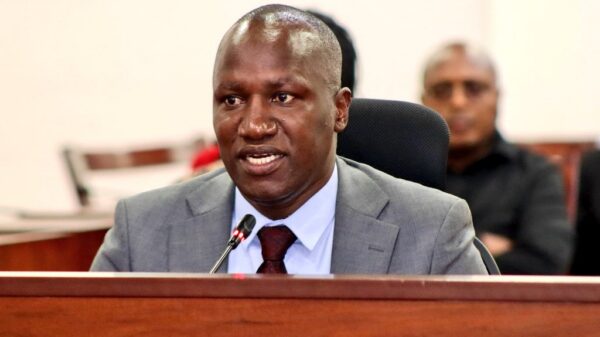


NAIROBI, Kenya, May 15 — Former House Budget Committee Chair Ndindi Nyoro has accused senior government officials of profiteering from the government-to-government (G2G) fuel importation arrangement, arguing that the programme has failed to protect consumers from soaring pump prices.
Nyoro’s remarks came a day after the Energy and Petroleum Regulatory Authority (EPRA) announced steep fuel price increases for the May 15 to June 14 pricing cycle, pushing petrol prices in Nairobi to Sh214.25 per litre and diesel to Sh242.92.
EPRA attributed the increases to rising global petroleum costs even as it said government would apply 8 per cent Value Added Tax (VAT) on fuel products.
However, speaking in Nairobi on Friday, Nyoro dismissed claims that international market dynamics alone were responsible for the record-high prices.
“The G2G arrangement Kenyans can now clearly see is a scam at best,” he declared.
He alleged that politically connected individuals were benefitting directly from the fuel importation framework.
“The G2G arrangement is a kiosk for senior government officials. The same people you see claiming to reduce this or that are the same people who are the owners of G2G,” he said.
Nyoro argued that Kenya’s fuel prices remain disproportionately high compared to neighbouring countries despite global oil prices being lower than they were in 2022.
“Fuel in terms of global prices was lower in 2022, yet Kenyans were paying cheaper at the pump and there was no G2G then,” he said.
Lower regional prices
He cited Uganda, Tanzania, Rwanda and Ethiopia as examples of countries currently selling fuel at lower prices than Kenya, despite some relying on Kenyan transport infrastructure.
“Uganda that uses our port is selling both super petrol and diesel cheaper than Kenya,” he said.
According to Nyoro, taxes, levies, distribution charges and profit margins now account for nearly Sh100 of every litre of petrol and diesel sold in Kenya.
He said the landed cost of super petrol currently stands below Sh120 per litre, leaving substantial room for government intervention.
“We are talking about close to Sh75 in taxes and levies and then the rest around Sh25 in terms of distribution and margins,” he stated.
Nyoro also raised concerns over alleged fuel adulteration, saying motorists had increasingly complained about poor-quality diesel damaging engines.
“Kenyans are crying twice. They are crying for the price of oil and they are crying for their cars to be destroyed because now the fuel in Kenya is of low quality,” he said.
He accused authorities of failing to act despite repeated warnings from stakeholders and legislators over rising fuel costs and the broader cost-of-living crisis.
“Leaders must tame their greed. Kenyans cannot accommodate global supply shocks and also accommodate your greed at the same time,” Nyoro said.
The Kiharu MP has since proposed amendments to scrap the reinstated 8 per cent VAT on fuel and abolish a Sh7 Road Maintenance Levy increment adjustment introduced in 2024, arguing that the measures would immediately lower petrol and diesel prices to below Sh190 per litre.