























NAIROBI, Kenya, Feb 22 – For years, sustainability in Kenya lived in the corporate social responsibility appendix; tree-planting ceremonies, glossy brochures and symbolic pledges. In 2025, it sits firmly in capital expenditure budgets.
Behind climate commitments and ESG dashboards lies a harder economic truth: going green is expensive. And while the long-term case for resilience and efficiency is growing stronger, the short-term financial burden is substantial particularly for firms operating in a high-cost, price-sensitive economy.
From energy self-generation to wastewater treatment systems and ESG compliance frameworks, businesses are being pushed into a structural transition.
The question is no longer whether sustainability matters. It is how much it costs and who ultimately absorbs that cost.
Energy: the competitiveness dilemma
The Kenya Association of Manufacturers (KAM) has consistently warned that high electricity costs undermine the competitiveness of Kenyan producers compared with regional peers such as Tanzania, Uganda and Ethiopia. Rising tariffs, fuel cost adjustments and forex-linked volatility continue to push production costs upward.
For energy-intensive sectors; cement, steel, food processing and textiles; electricity ranks among the largest operational expenses. When tariffs fluctuate unpredictably, planning becomes difficult and margins tighten.
To cushion against these shocks, many firms are turning to renewable self-generation.
Solar photovoltaic systems, often paired with battery storage, are increasingly viewed as a hedge against tariff instability and supply disruptions.
The trade-off is capital.
According to Cherubim Energy Limited, a green energy consortium operating in Kenya, installation costs vary widely by scale.
Small-scale solar farms ranging between 50 kilowatts and 500 kilowatts cost between Sh5 million and Sh50 million.
Medium-scale projects of 500 kilowatts to one megawatt require roughly Sh60 million to Sh80 million.
Large-scale installations above one megawatt typically range from Sh100 million to Sh150 million or more, depending on design complexity and storage integration.
For industrial parks, manufacturing plants or commercial complexes requiring multi-megawatt capacity, the investment quickly enters nine-figure territory.
While the systems can reduce grid electricity dependence and generate savings over time, payback periods may stretch between five and ten years, depending on financing terms.
In a tight credit environment, tying up such capital is not trivial.
Property sector: solar as an operational hedge
The commercial real estate sector illustrates the evolving calculus.
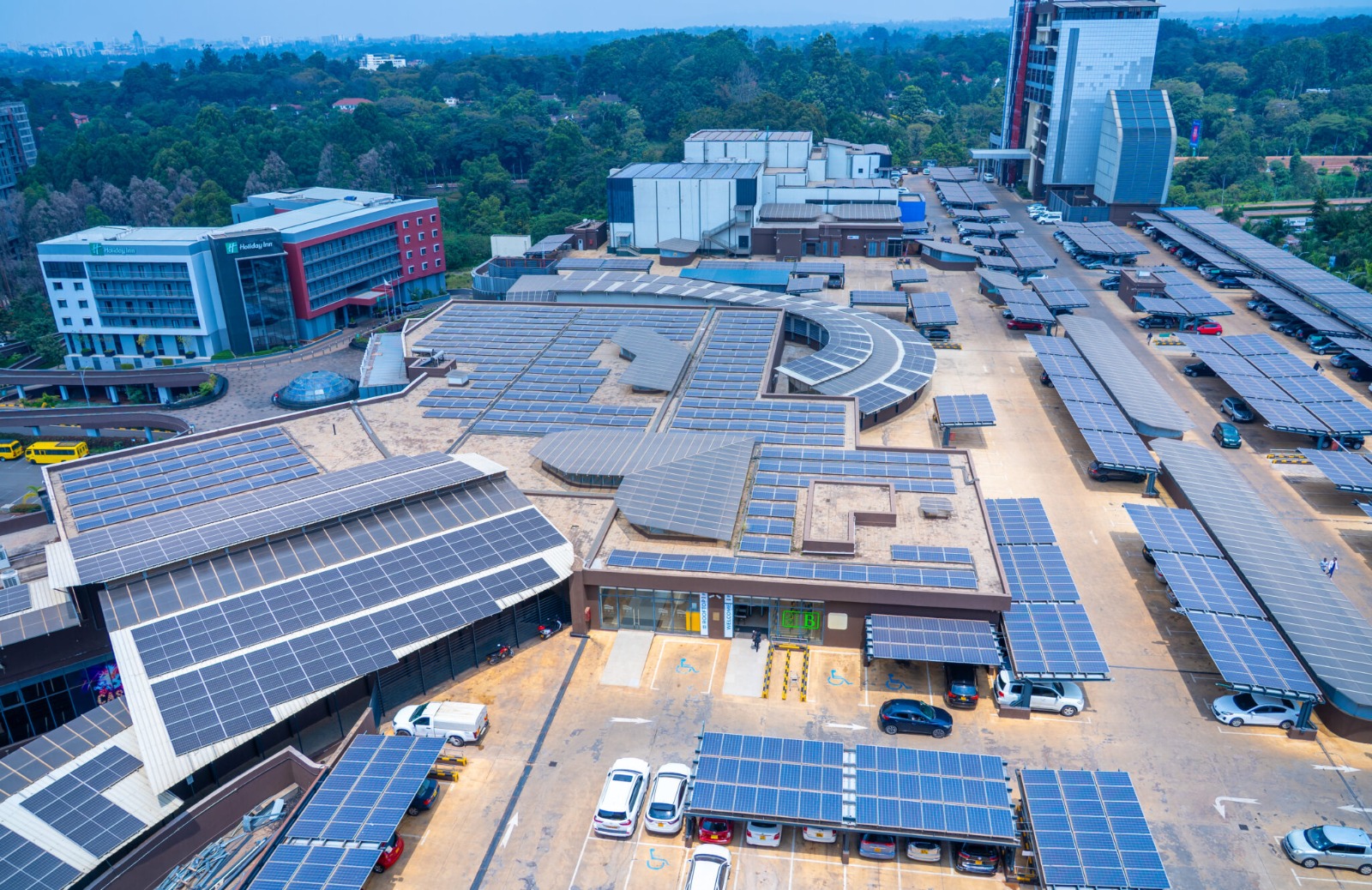
In February 2025, Centum Real Estate and the Two Rivers Mall Special Economic Zone partnered with Distributed Power Africa–Kenya to expand the development’s solar power capacity from 1.2 megawatts to 3.2 megawatts positioning it among the largest rooftop solar installations in East Africa serving commercial and residential tenants.
Centum Real Estate Managing Director Kenneth Mbae told Business Daily that the expansion would “enhance our green credentials as a major property developer and ensure a clean and reliable supply of electricity.”
The economics behind such projects extend beyond branding. Large malls and mixed-use developments operate energy-intensive retail outlets, office towers and residential apartments.
Grid tariff volatility directly affects service charges and tenant satisfaction.
By scaling solar generation, developers aim to stabilize energy costs and reduce reliance on diesel generators.
Yet a 3.2MW installation falls squarely into the large-scale bracket described by Cherubim Energy Limited potentially requiring upwards of Sh100 million to Sh150 million in capital investment.
For major developers with long asset horizons, this can be amortized.
For smaller property owners, similar investments remain financially prohibitive.
The case underscores a broader trend: sustainability solutions are technically viable but capital-intensive, favoring firms with stronger balance sheets.
Financing: the structural bottleneck
Green finance is often presented as the solution. Kenyan banks have expanded sustainability-linked lending portfolios, and climate-aligned loans are increasingly discussed in boardrooms.
However, access is uneven.
Local credit markets remain characterized by relatively high interest rates and shorter repayment expectations than renewable projects typically require.
Solar systems may demand longer tenures to be financially sustainable. Many lenders remain cautious about financing large-scale energy infrastructure without guarantees or concessional support.
Manufacturers have repeatedly called for targeted green financing mechanisms and predictable regulatory frameworks to accelerate adoption.
The persistence of these calls signals that financing remains a constraint rather than a fully developed solution.
For small and medium enterprises, upfront capital remains the single largest barrier to transition.
Beyond electricity: water and compliance costs
Energy may dominate headlines, but sustainability costs extend further.
Industrial water users face tightening discharge requirements and growing scrutiny over wastewater management. Compliance may require investment in treatment plants, recycling systems and environmental monitoring infrastructure.
These upgrades demand engineering redesign and capital expenditure before cost savings materialize.
At the same time, sustainability reporting requirements are expanding.
Listed firms are expected to align with ESG disclosure frameworks, while suppliers increasingly face pressure from multinational partners to demonstrate emissions transparency and environmental compliance.
Carbon accounting tools, software systems, consultant fees and independent assurance processes add layers of administrative cost. For large corporates, these may be manageable.
For SMEs, they represent additional financial pressure.
Consumers and price sensitivity
The final variable in the equation is the consumer.
If businesses invest heavily in renewable systems and compliance upgrades, part of that cost may be embedded in pricing. But Kenya remains a price-sensitive market.
John Oito, an accountant in Nairobi, says affordability remains decisive.
“Only if the price difference is small would most people pay extra for eco-friendly products. Households are already managing tight budgets.”
Joy Okumu, a Nairobi-based nurse, expresses similar caution.
“Eco-friendly products are not cheaper. If prices go up, many people will still choose what they can afford.”
These sentiments illustrate a structural challenge: sustainability cannot succeed if it significantly widens the affordability gap.
Risk management versus immediate returns
From a corporate governance perspective, sustainability spending is increasingly framed as risk mitigation.
Climate variability threatens agricultural supply chains. Water scarcity disrupts manufacturing processes. Financial regulators are integrating climate risk considerations into supervisory frameworks. Investors are scrutinizing environmental disclosures more closely.
In this context, renewable energy systems and environmental compliance measures are tools for long-term resilience. The return on investment may include operational stability, improved investor perception and lower exposure to regulatory penalties.
But those strategic benefits do not eliminate short-term financial strain.
The transition’s uneven burden
Kenya’s green transition is unfolding in an economy balancing industrial growth ambitions with fiscal pressure and cautious consumer demand.
Sustainability investments require capital at a time when firms are also navigating tax adjustments, currency volatility and tight credit conditions.
Large corporates can structure financing and spread costs across diversified revenue streams. Smaller enterprises face more difficult trade-offs between immediate survival and long-term environmental positioning.
Going green in Kenya is no longer optional. Regulatory trends, investor expectations and operational realities make transition inevitable.
What remains unresolved is how the financial burden is distributed across corporate balance sheets, financial institutions and ultimately consumers.
The green economy promises efficiency and resilience. But in 2025, it also carries a clear price tag.