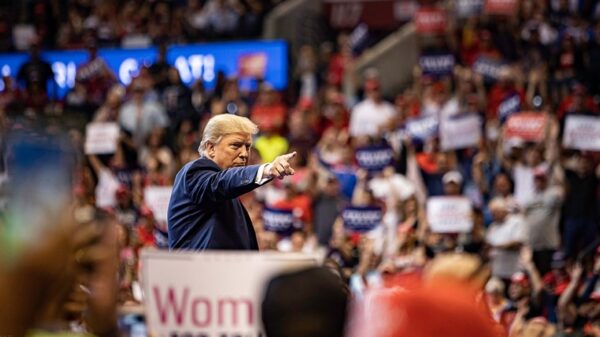
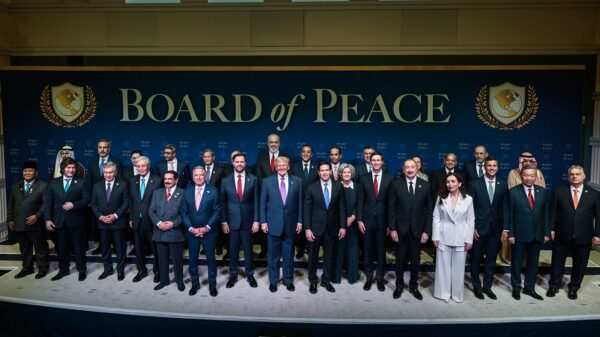













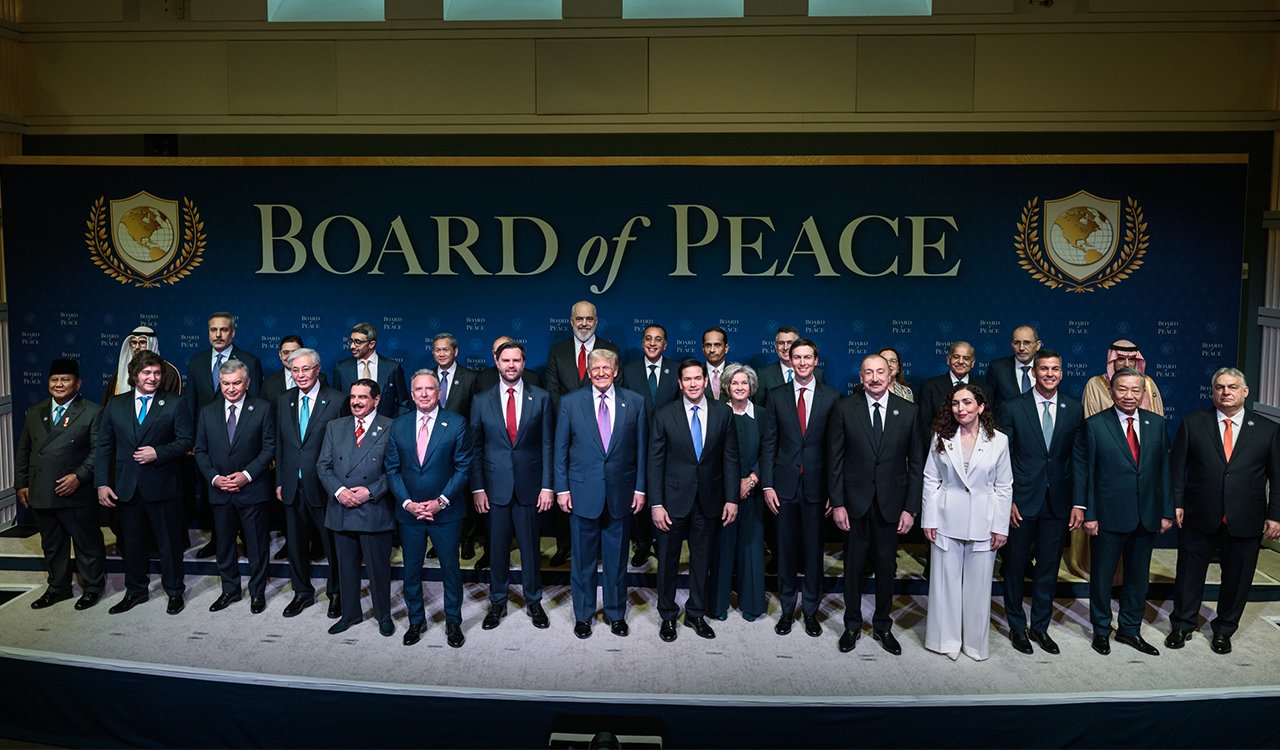

NAIROBI, Kenya, Feb 19 — President Donald Trump on Thursday convened the inaugural meeting of his newly formed Board of Peace in Washington, unveiling an ambitious initiative aimed at spearheading reconstruction in Gaza and expanding American-led diplomatic engagement in global conflicts.
The high-profile session, held at the United States Institute of Peace, comes a day after the Vatican confirmed that Pope Leo XIV would not participate, citing unresolved concerns about the structure and mandate of the initiative.
Originally conceived as a mechanism to coordinate post-war reconstruction in Gaza following the Israel–Hamas conflict, the Board of Peace has since expanded its scope to include broader international conflict resolution efforts.
Trump said the board would eventually include “all world leaders,” positioning it as a central pillar of his administration’s emerging foreign policy framework.
“The cost of peace is very small compared to the cost of war,” Trump said during the meeting, announcing a $10 billion US commitment to support the initiative.
“When you look at that compared to the cost of war, that’s two weeks of fighting. It sounds like a lot, but it’s a very small number.”
Additional USD7bn
He added that an additional $7 billion has already been pledged toward Gaza relief and reconstruction by Kazakhstan, Azerbaijan, the United Arab Emirates, Morocco, Bahrain, Qatar, Saudi Arabia, Uzbekistan, and Kuwait.
Funds earmarked for Gaza will be managed through a reconstruction and development facility housed at the World Bank, according to its president, Ajay Banga.
“This fund is ready to receive the donations that he spoke about just a little while ago,” Banga said, adding that the World Bank would provide financial oversight and transparency mechanisms, including the appointment of a dedicated financial controller.
The Board of Peace was granted a formal mandate by the United Nations Security Council as part of its endorsement of the Trump administration’s 20-point Gaza peace plan. However, Trump has pushed to broaden the body’s mission beyond Gaza to address conflicts worldwide.
Dozens of countries have been invited to join as founding members, with a proposed lifetime membership contribution of $1 billion, though it remains unclear how many governments have formally committed.
Analysts and diplomats have raised concerns that expanding the board’s mandate could dilute its focus on Gaza’s reconstruction and complicate coordination with existing international peace and humanitarian frameworks.
The Vatican’s decision to decline participation underscores growing skepticism among some global institutions.
Vatican Secretary of State Cardinal Pietro Parolin cited unresolved “critical issues,” emphasizing that the United Nations should remain the primary forum for addressing international conflicts.
US officials said Trump intends to run the Board of Peace in a format similar to Cabinet meetings, signaling his intention to personally oversee its strategic direction as part of a broader effort to reshape global peacekeeping and reconstruction efforts.