



















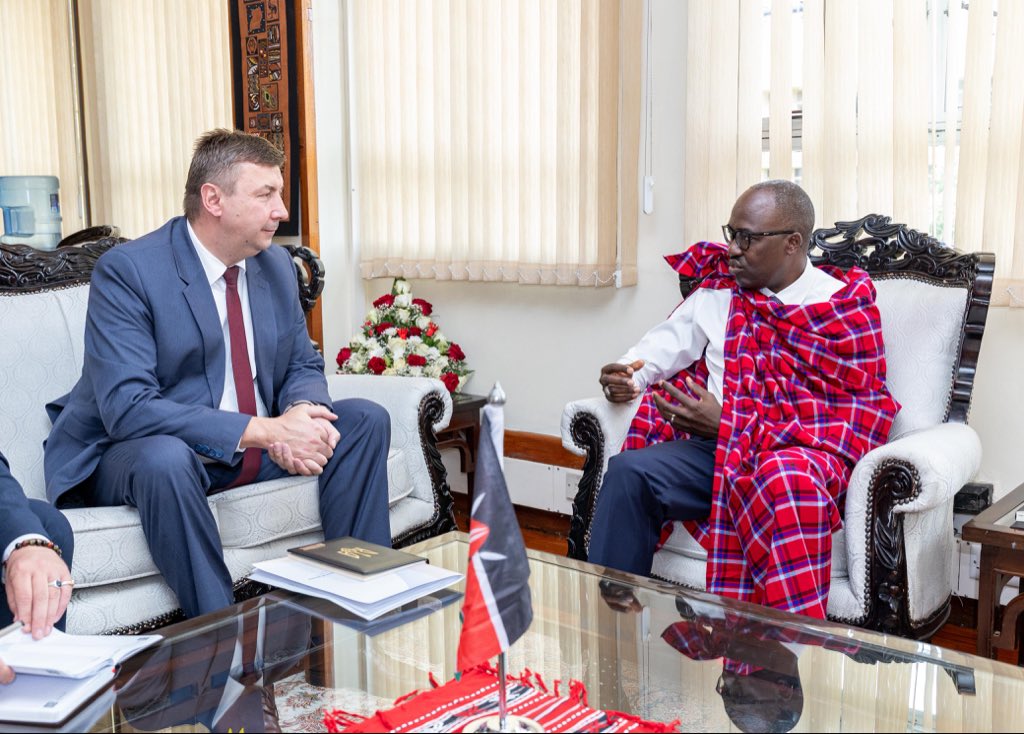

NAIROBI, Kenya, Feb 21 — Foreign Affairs Principal Secretary Korir Sing’Oei has held high-level discussions with Ukraine’s Ambassador to Kenya Yurii Tokar on the safety and possible repatriation of Kenyans captured on the frontlines of the Russia-Ukraine war.
Sing’Oei said in a statement after the meeting that the talks also focused on strengthening strategic cooperation between Kenya and Ukraine, building on agreements reached between President William Ruto and President Volodymyr Zelenskyy, while reaffirming Kenya’s commitment to multilateral efforts that uphold global peace, sovereignty, and territorial integrity.
“Informed by our shared commitment to sovereignty and the UN Charter, I held a productive meeting with Ambassador Tokar,” Sing’Oei said, adding that they discussed the safety of Kenyans captured in the conflict and explored mechanisms for possible repatriation, as well as Kenya’s efforts to combat fraudulent recruitment of its nationals.
The diplomatic engagement comes amid mounting concern following a joint investigation by the National Intelligence Service (NIS) and the Directorate of Criminal Investigations (DCI), which uncovered a network facilitating the recruitment and trafficking of Kenyans to fight in the conflict.
The probe implicated rogue officials across government institutions, including the Directorate of Immigration Services, the DCI, and the National Employment Authority, who allegedly facilitated the movement of recruits through airports without interception.
National Assembly Majority Leader Kimani Ichung’wah, who presented the findings in Parliament, said the ongoing Russia-Ukraine war had triggered the recruitment of foreign fighters through rogue agencies and individuals operating within Kenya, with some officials allegedly facilitating visa processing and travel arrangements.
Investigators revealed that more than 1,000 Kenyans, including former military personnel, police officers, and unemployed civilians, were lured with promises of lucrative pay, bonuses, and foreign citizenship opportunities.
Rogue officials
Many were reportedly offered monthly salaries of up to Sh350,000 and bonuses ranging between Sh900,000 and Sh1.2 million, only to undergo minimal training lasting about three weeks before being deployed to active combat zones.
“They are told they are going to work as guards, only to be taken to military camps with minimal training,” Ichung’wah said, noting that recruits were often handed weapons and deployed directly to the frontlines.
Members of Parliament expressed alarm over the revelations, with Mizighi Haika Mnene pointing to systemic failures that had allowed the exploitation of vulnerable Kenyans, Kipkoros Makilap describing the trafficking as chilling and urging urgent government intervention to repatriate affected nationals, and Chimba Zamzam Mohamed calling for stricter immigration oversight to prevent citizens from being trafficked to foreign war zones.
According to the report, as of February 2026, at least 39 Kenyans were hospitalized, 30 had been repatriated, 28 remained missing, 89 were still on the frontlines, one was detained, and at least one death had been confirmed.
The investigation further revealed that recruits initially departed through Jomo Kenyatta International Airport using tourist visas and transited through countries including Turkey and the United Arab Emirates, before shifting to alternative routes through Uganda, South Africa, and neighboring states as scrutiny increased. Recruitment fees reportedly reached as high as Sh1.6 million per individual.
Authorities have since frozen bank accounts linked to key suspects and recovered passports, contracts, and electronic devices, while several alleged masterminds and brokers remain under active investigation.
Ichung’wah urged Kenyans seeking employment abroad to verify opportunities through licensed recruitment agencies and the National Employment Authority portal to avoid falling victim to trafficking networks.