














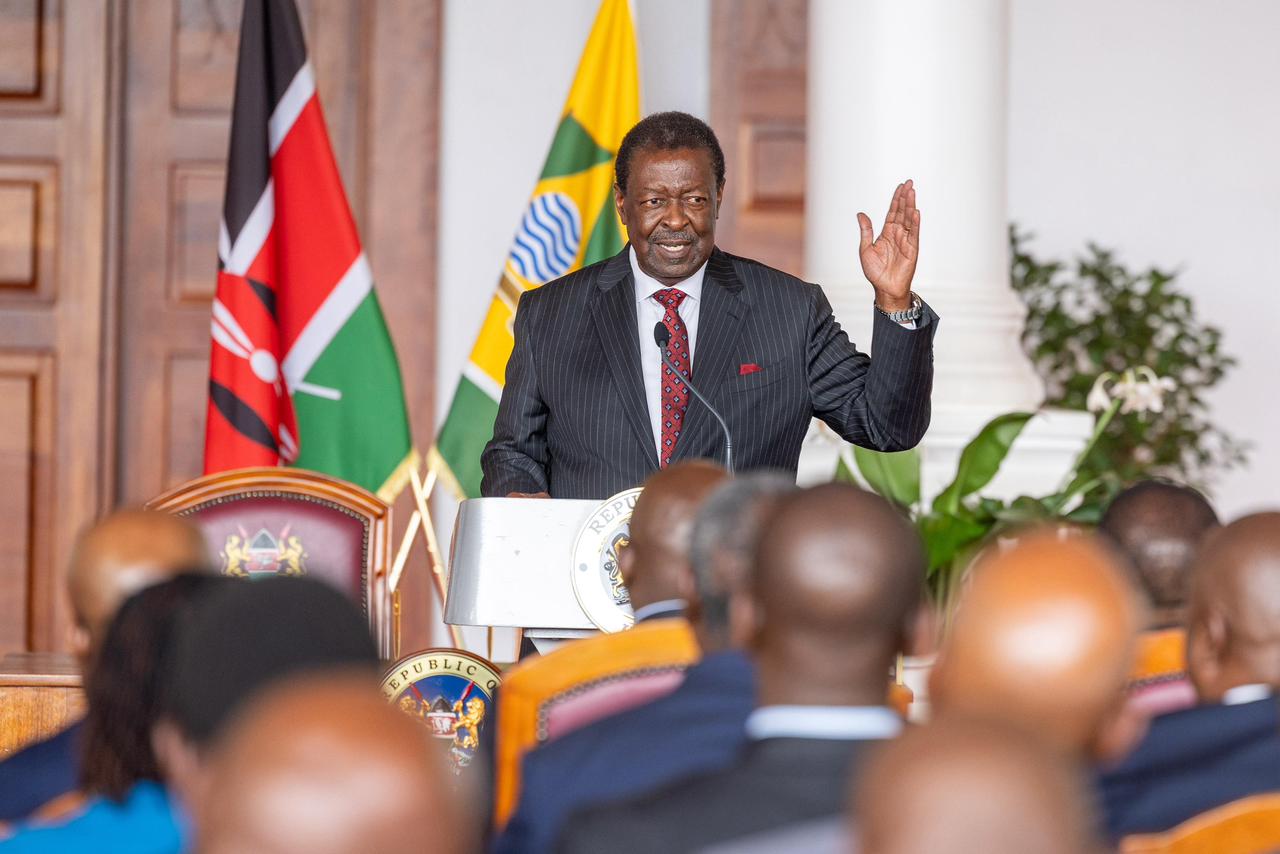

NAIROBI, Kenya, Feb 17 — Prime Cabinet Secretary Musalia Mudavadi on Tuesday defended the newly signed cooperation agreement between the national government and Nairobi City County as a bold and timely move.
Mudavadi said President William Ruto’s intervention will secure the capital’s regional hub status amid rising competition from other African cities.
Speaking at State House during the signing ceremony, Mudavadi praised President Ruto for stepping beyond political comfort zones to pursue what he called “extraordinary” reforms for the capital city, stressing that Nairobi’s leadership role in the region can no longer be taken for granted.
“It takes a lot of courage for a leader to move away from a comfort zone and move to that territory that everybody fears and is worried about,” Mudavadi said.
“The whole idea of you leading and saying that we have to do much more for Nairobi, for this country, for the capital city… is really a serious mark of leadership.”
Mudavadi warned that Nairobi is facing intensifying competition from other African capitals, citing infrastructure and development strides in Addis Ababa, Kampala, Luanda, and Lusaka, and urged leaders to act decisively to retain the city’s status as East Africa’s commercial and diplomatic hub.
“We must break away from the comfort zone. And if we have to retain the hub status that we have always held, then the leadership that we are seeing today is absolutely important,” he said.
‘Long overdue’
He also thanked Nairobi Governor Johnson Sakaja and his administration for embracing the partnership despite anticipated political criticism, arguing that failure to act would leave the city lagging behind regional peers.
“There’ll be mudslingers all over the corners, but at the end of the day, without this initiative, we are in trouble,” Mudavadi said, pointing to environmental degradation and urban planning challenges along the Nairobi River corridor as evidence that reforms were overdue.
Governor Sakaja noted that the agreement was long overdue, emphasizing that the Urban Areas and Cities Act had already provided for special arrangements for Nairobi as the capital city and host to diplomatic missions and the United Nations headquarters in the Global South.
“In the 13 years of devolution, Nairobi City County has not had an opportunity to leverage and benefit from its unique position as a capital city… This agreement is 13 years overdue,” Sakaja said.
He explained that the framework would formalize existing collaborations and expand national support in key sectors including security, infrastructure, water, housing, markets, and mobility, adding that the partnership would help Nairobi prepare for hosting the Africa Cup of Nations (AFCON) 2027.
Sakaja outlined a two-tier governance structure for implementing the agreement: a steering committee chaired by Mudavadi to set policy direction and an implementation committee led by the governor to oversee project execution.
The governor highlighted ongoing and planned projects, including increased water supply through the Northern Collector Tunnel and future projects such as the Maragua Dam and upgrades to water treatment facilities, which could add nearly 200 million litres of water per day to the city.
Nairobi growth
He emphasized that Nairobi’s growing population, estimated at close to seven million residents, requires additional national support beyond the equitable share allocated to counties.
Sakaja was keen to distinguish the agreement from the previous Nairobi Metropolitan Services (NMS) arrangement, which involved a transfer of functions from the county to the national government.
“This is not a transfer of functions… It is not a transfer but a collaboration which is encouraged and which respects the mandate given to both of us by the people of Kenya and the constitution,” he said, describing devolution as a partnership between national and county governments.
Both leaders framed the agreement as part of a broader ambition to transform Nairobi into a world-class city, with Sakaja invoking Singapore as a model for urban transformation.
“We’re on the journey to Singapore and Nairobi will not be left behind,” he said.
“The capital city will remain at the center of the transformation to first-world status.”