




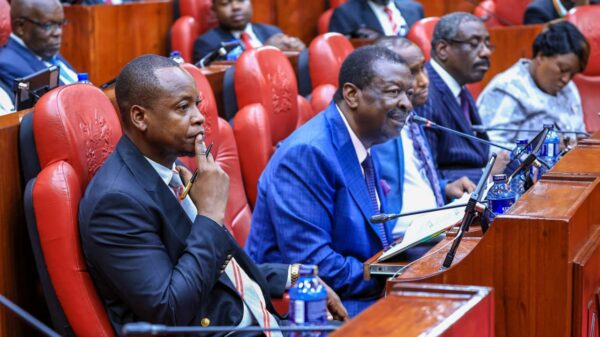


NAIROBI, Kenya, Feb 4 — Internal tensions within the Azimio Coalition Party have escalated after two constituent parties rejected newly announced leadership changes, declared them “illegal, null and void”.
The National Liberal Party (NLP) and the United Democratic Party (UDP) rejected the changes in a letter recived by the Office of the Registrar of Political Parties (ORPP) on Wednesday.
The two outfits threatened court action, deepening an already simmering dispute over the coalition’s legal status, governance and finances.
In the letter, the parties objected to resolutions arising from a February 2 meeting that led to sweeping leadership changes within Azimio, including the removal of House Minority Leader Junet Mohamed as Secretary General and the appointment of Suba South MP Caroli Omondi as his replacement.
The changes, announced by the Azimio Coalition Party Council chaired by former President Uhuru Kenyatta, also saw Wiper Party leader Kalonzo Musyoka named Party Leader, succeeding Raila Odinga following the former Prime Minister’s death in October 2025, and former Nairobi Town Clerk Philip Kisia appointed Executive Director.
Azimio said the decisions were made during a joint session of the Coalition Council and National Executive Committee (NEC), citing “evolving political circumstances” and a need to strengthen internal coordination, operational effectiveness and strategic direction.
However, the NLP and UDP dispute the legality of the meeting and the resolutions, accusing some coalition partners of convening a clandestine and non-procedural NEC session and proceeding to fill vacancies and remove officials without adherence to the coalition’s governing instruments.
“The above actions go against the founding principles of inclusivity, transparency and accountability that Azimio espouses,” the parties said in their letter.
They warned the Registrar against processing the resolutions, stating that failure to halt the changes would prompt legal action.
“We reject in totality the resolutions submitted to your office and caution you from further processing the illegal, null and void resolutions, failure to which we shall seek legal redress in a competent court of law,” the letter states.
The parties also demanded disclosure of key documents, including the Azimio Coalition Deed of Agreement, the coalition’s registered membership as of February 1, 2026, notice and minutes of the February 2 meeting, statutory Form PP7 on the change of officials, and the attendance list.
NLP demands
The latest objection builds on an earlier petition by the NLP to the ORPP, filed a day earlier, seeking clarity on Azimio’s legal status, leadership structure, membership and finances amid what the party described as growing paralysis within the coalition.
In that petition, NLP leader Augustus Muli accused some constituent parties of hoarding coalition-linked funds at the expense of smaller partners, warning that the practice risks weakening and deregistering less resourced parties.
“As parties languish and face deregistration because of the cost of recruitment and running offices, some partner parties are hoarding millions of shillings in banks courtesy of our coalition,” Muli said.
He questioned Azimio’s operational relevance, arguing that the coalition has been largely inactive and paralysed by internal power struggles.
“Azimio’s last meaningful engagement was last year during the selection of the IEBC panel, where an election produced a winner the leadership did not want. That dispute cost the country eight months in court,” he said.
NLP officials also claimed the coalition currently lacks functional leadership and administrative structures, alleging resistance to internal elections by dominant parties fearful of losing control to smaller affiliates.
NLP Secretary General Omondi Koyoo said Azimio, formed under amendments to the Political Parties Act that allow coalition political parties, must demonstrate transparency, accountability and compliance with the law.
“Coalitions are living agreements, not tombstones,” Koyoo said.
A central focus of the petition is coalition financing, with the NLP seeking clarity on funds disbursed from the Political Parties Fund tied to the 6.9 million votes Azimio received in the 2022 presidential election.
The dispute has been compounded by the resignation of Azimio Executive Director Raphael Tuju, which the NLP said exposed leadership gaps within the coalition at a critical moment for the opposition.
At its formation ahead of the 2022 General Election, Azimio brought together twenty-six registered political parties and emerged as the majority coalition in Parliament, but subsequently lost ground following defections by several smaller parties to the ruling Kenya Kwanza alliance.
The unfolding standoff now sets the stage for a potential court battle that could delay or derail Azimio’s leadership restructuring and test the legal durability of Kenya’s coalition party framework under the Political Parties Act.