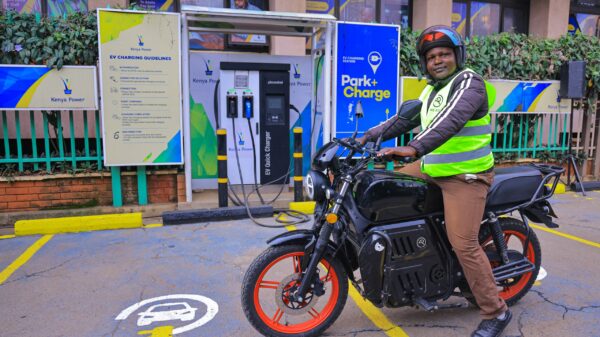





























NAIROBI, Kenya, June 4-Kenya Power has begun a countrywide exercise to identify and migrate all customers using electricity to charge electric vehicles (EVs) onto its dedicated e-mobility tariff, in a move aimed at improving revenue tracking and strengthening planning for the fast-growing sector.
The utility says the transition will target customers currently charging EVs outside the specialized tariff structure, which was introduced in 2023 following approval by the Energy and Petroleum Regulatory Authority (EPRA).
The tariff allows EV users to access discounted electricity at Sh 16 per unit during peak hours and Sh 8 per unit during off-peak hours, a structure Kenya Power says is intended to support adoption while providing better visibility of demand patterns in the mobility sector.
“Three years ago, Kenya Power successfully lobbied for a special electricity tariff to serve the Emobility industry. Our commitment is to create awareness, support the market and drive the adoption of e-mobility in the country,”said Kenya Power’s Managing Director Joseph Siror.
“The transition must serve not only private car owners, but also public transport, two and three wheelers, logistics operators, county transport systems, small businesses and ordinary Kenyans who need cleaner, cheaper and more reliable mobility options.”
Since the tariff’s rollout in July 2023, Kenya Power reports cumulative EV charging revenues of Sh382 million between July 2023 and April 2026, alongside a sharp rise in electricity consumption linked to EVs.
Monthly revenues have increased significantly over the period, rising from Sh 873,907 in July 2023 to a peak of Sh35.25 million in February 2026.
The utility says electricity sales to the e-mobility segment have grown by 113 per cent in the 34-month period, rising from 13,500 kWh to 1.5 million kWh.
November 2025 marked a key milestone after consumption crossed the one-million-kilowatt-hour mark in a single month for the first time, a level Kenya Power says has since been sustained.
Data from Kenya Power shows Nairobi remains the dominant hub for EV charging demand, contributing Sh 271.9 million in revenues.
Other regions lag significantly behind, with the Coast region generating Sh 55 million, North Eastern Sh 35 million, and West Kenya Shs11.5 million.
The concentration underscores the early-stage nature of EV adoption in the country, with uptake largely driven by urban infrastructure and commercial fleets.
Kenya Power is projecting that electricity sales to the e-mobility sector could reach Sh 5.9 billion by 2030, supported by expanding EV adoption and grid integration.
Industry estimates from the Electric Mobility Association of Kenya (Electric Mobility Association of Kenya) place potential revenues slightly lower at Sh 5.79 billion over the same period, with annual grid demand expected to reach 121 GWh.
The number of customers under the dedicated tariff currently stands at 331, up from a negligible base three years ago. Kenya Power expects this to rise to 1,000 customers by the end of the current financial year as more EV users are identified and onboarded.
The growth in EV-related electricity demand has been supported by policy incentives, including duty exemptions on the first 100,000 imported EVs, zero-rating of VAT on EVs and lithium-ion batteries, and reduced excise duties on electric bicycles, motorcycles and battery systems.
Kenya had registered more than 35,000 electric vehicles by the end of 2025, up sharply from 796 units three years earlier, reflecting accelerating adoption, particularly in two- and three-wheeler segments.
While the outlook remains positive, the scale-up also raises planning and infrastructure considerations for utilities and regulators, including grid capacity, charging network distribution, and tariff sustainability as adoption expands beyond urban centres.
Kenya Power says the ongoing metering exercise is intended to ensure the sector’s growth is properly integrated into national energy planning as the market matures.