










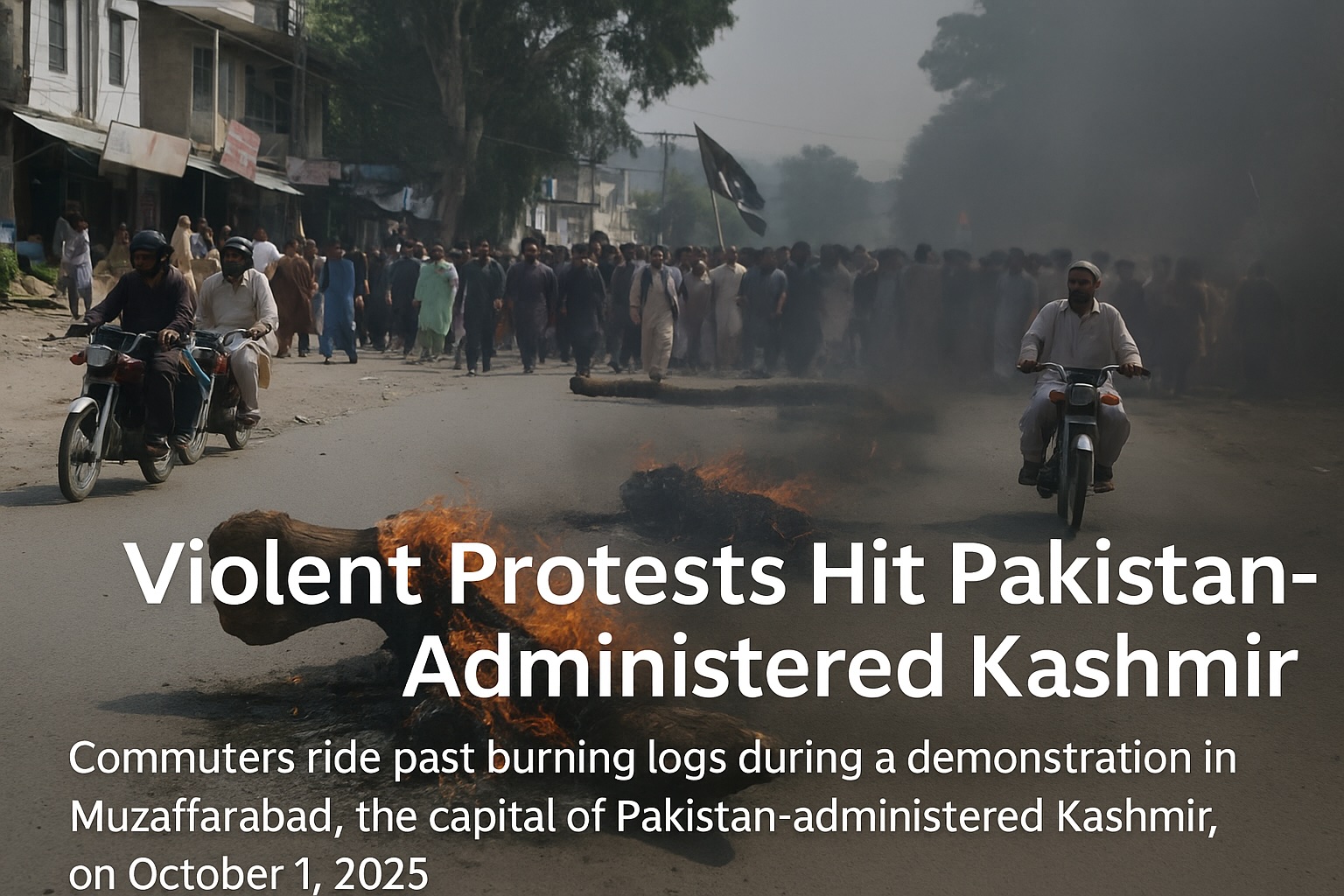

Pakistan-administered Kashmir, Oct 4 — An uneasy calm hangs over Pakistan-administered Kashmir, where a region-wide shutdown entered its fourth day on Thursday following violent clashes between protesters and security forces that left at least nine people dead, including three police officers.
Dozens more have been injured on both sides as the standoff continues.
A high-level government committee arrived in Muzaffarabad, the region’s capital, on Thursday to hold emergency talks with the Jammu Kashmir Joint Awami Action Committee (JAAC) — a powerful coalition of traders and civil society groups leading the protests.
The demonstrations, spearheaded by activist Shaukat Nawaz Mir, began on September 29 and have paralysed life across the territory, locally known as Azad Jammu and Kashmir (AJK).
Authorities have responded with a full communications blackout, cutting off mobile and internet services since September 28.
In Muzaffarabad, markets remain shuttered, public transport off the roads, and the normally bustling streets deserted. The paralysis has left the region’s roughly four million residents in uncertainty and growing frustration.
The government said efforts were underway to restore calm, urging residents not to be misled by what it termed “fake news and propaganda” on social media.
The ongoing protests mark the third major mobilisation by the JAAC in two years — a culmination of public anger over governance, corruption, and inequality in the semi-autonomous region.
Initially triggered by soaring electricity bills and wheat shortages in 2023, the movement quickly gained momentum, uniting residents across AJK’s districts.
The JAAC was formally launched in September 2023 and organised a massive march to Muzaffarabad in May 2024. That protest turned deadly, claiming at least five lives, before Pakistan’s federal government intervened, offering subsidies to cut flour and power costs.
However, discontent has since resurfaced. The latest wave of demonstrations expands the focus beyond economic hardship, calling for structural reforms and political accountability.
The JAAC’s latest 38-point charter of demands calls for sweeping reforms — from free education and healthcare to infrastructure development and greater political autonomy.
Its top priorities include abolition of “elite privileges” for government ministers and senior officials, including the use of state vehicles, fuel allowances, and personal staff; elimination of 12 reserved refugee seats in the regional assembly, which the group claims unfairly benefits a powerful political bloc descended from 1947 refugees; withdrawal of legal cases against protesters arrested during previous demonstrations; and tax relief and job creation, alongside major public works such as bridges, tunnels, and a fully operational international airport in Muzaffarabad.
Prime Minister Shehbaz Sharif earlier this year ordered feasibility studies to revive the Muzaffarabad airport and construct a new one in Mirpur, but progress has been slow.
The AJK administration has shut down schools indefinitely and requested reinforcements from federal paramilitary units — a move strongly opposed by protesters.
Finance Minister Abdul Majid Khan confirmed that negotiations were ongoing, noting that while the government had accepted most of the JAAC’s demands, talks had reached a stalemate over the reserved seats and official privileges.
“Initially, their protests were about electricity and flour prices, and we agreed on those,” Khan said. “But reforms take time. They must also understand that things cannot change overnight.”
The government places the death toll from the clashes at nine, though local officials and activists claim it is higher, with some reports putting the figure at 15.
JAAC leader Shaukat Nawaz Mir accused the authorities of using excessive force and said the protesters would not back down until their core demands were met.
Pakistan-administered Kashmir, with a population of over four million, operates under a semi-autonomous system with its own prime minister and legislature. The territory has long been a flashpoint between Pakistan and India, both of which claim the entire Kashmir region in full.
As the government committee begins negotiations in Muzaffarabad, many residents fear that the region’s deep-seated grievances — economic inequality, lack of development, and political disenfranchisement — will once again be papered over with temporary fixes.
For now, an uneasy calm prevails — but the tension on the streets suggests that the crisis is far from over.