






















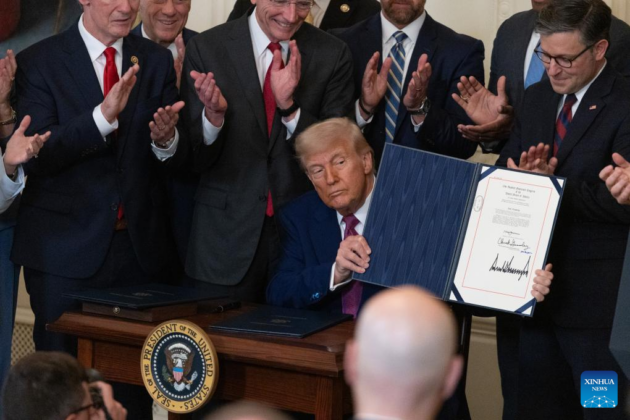

SEPT 4 – President Donald Trump has asked the US Supreme Court to overturn a lower court decision that found many of his sweeping tariffs were illegal.
In a petition filed late on Wednesday, the administration asked the justices to quickly intervene to rule that the president has the power to impose such import taxes on foreign nations.
A divided US Court of Appeals for the Federal Circuit last week ruled 7-4 that the tariffs Trump brought in through an emergency economic powers act did not fall within the president’s mandate and that setting levies was “a core Congressional power”.
The case could upend Trump’s economic and foreign policy agenda and force the US to refund billions in tariffs.
Trump had justified the tariffs under the International Emergency Economic Powers Act (IEEPA), which gives the president the power to act against “unusual and extraordinary” threats.
In April, Trump declared an economic emergency, arguing that a trade imbalance had undermined domestic manufacturing and was harmful to national security.
While the appellate court ruled against the president, it postponed its decision from taking effect, allowing the Trump administration time to file an appeal.
In Wednesday’s night’s filing, Solicitor General John Sauer wrote that the lower court’s “erroneous decision has disrupted highly impactful, sensitive, ongoing diplomatic trade negotiations, and cast a pall of legal uncertainty over the President’s efforts to protect our country by preventing an unprecedented economic and foreign policy crisis”.
If the Supreme Court justices deny the review, the ruling could take effect on 14 October.
In May, the New York-based Court of International Trade declared the tariffs were unlawful. That decision was also put on hold during the appeal process.
The rulings came in response to lawsuits filed by small businesses and a coalition of US states opposing the tariffs.
In April, Trump signed executive orders imposing a baseline 10% tariff as well as “reciprocal” tariffs intended to correct trade imbalances on more than 90 countries.
In addition to those tariffs, the appellate court ruling also strikes down levies on Canada, Mexico and China, which Trump argues are necessary to stop the importation of drugs.
The decision does not apply to some other US duties, like those imposed on steel and aluminium, which were brought in under a different presidential authority.
By BBC