



























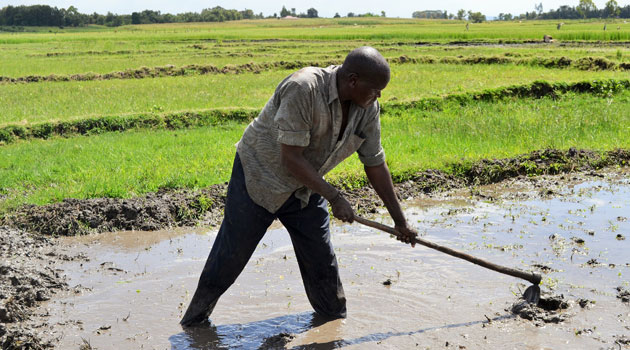

NAIROBI, Kenya, May 29 – The government has directed state agencies to purchase unsold stocks from Mwea, in a bid to stabilize prices and support farmers facing a weak market, even as structural production gaps continue to push Kenya to rely heavily on rice imports.
The directive, issued by Agriculture Principal Secretary Paul Rono to the Kenya National Trading Corporation and the National Cereals and Produce Board, comes against a long-running tension in the sector where domestic surplus at harvest contrasts with national dependence on imports to meet consumption needs.
Kenya produces only about a fifth of its rice demand, with imports covering the remainder of consumption needs, according to government data and sector estimates.
While production has gradually increased in key schemes such as the Mwea Irrigation Scheme which accounts for roughly 60–65 percent of local output national output still falls far below annual demand, estimated at around 400,000 tonnes, forcing sustained importation to bridge the gap.
This structural imbalance has created a recurring policy dilemma with farmers often facing oversupply and falling prices during harvest seasons, while the country simultaneously imports rice to stabilize retail markets.
Recent government interventions have attempted to manage both sides of the equation.
State procurement agencies have in past seasons been instructed to absorb local harvests through structured marketing systems, with assurances that farmers would be paid promptly and that no stock would remain uncollected.
In early 2026, officials confirmed that most locally produced rice had been fully taken up and payments cleared.
However, farmers continue to raise concerns that timing and volumes of imports often coincide with peak harvest periods, contributing to price suppression at the farm level.
Traders and millers, on the other hand, argue that imports remain essential to avoid shortages and manage retail inflation, particularly in urban centres where rice is a key staple.
Speaking during the launch of a certified seed facility in Mwea, PS Rono defended the import strategy while acknowledging the need for stronger domestic absorption systems.
“We must first buy all locally produced rice before importing the deficit, the government has enough funds to purchase farmers’ rice and no farmer should suffer losses because of delayed purchases,” said Rono.
At the same time, he reiterated that Kenya’s production base remains insufficient to meet consumption demand, reinforcing the rationale for continued imports as a stabilization tool.
“Kenya does not produce enough rice to meet local consumption demand. Imports are necessary to stabilize food prices and prevent shortages that could make food unaffordable for ordinary Kenyans,” he added.