

























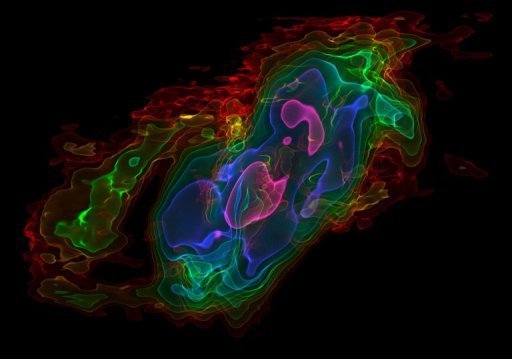
Images from a nearby galaxy may have explained how star factories can bizarrely slow down, astronomers reported on Wednesday.
Astrophysicists have long puzzled why the Universe has very few galaxies with a high mass, even though there are many galaxies that create stars at a phenomenal rate, sometimes a hundred times greater than our own Milky Way.
In theory, these “starburst” galaxies should have become super-sized — but until now, no one has known why.
Using a new telescope perched high above Chile’s Atacama desert, where ultra-dry air makes for great viewing conditions, astronomers have seen billowing clouds of hydrogen and other gases — the fuel for making new stars — fleeing a starburst galaxy called NGC 253.
Located 11.5 million light years away, NGC 253 was discovered in 1783 by Caroline Herschel, sister of William Herschel, who was the first to spot the planet Uranus.
It has been dubbed the “Silver Coin” or “Silver Dollar” galaxy because of its round, shiny form.
In spite of this name, NGC 253 has in fact a slightly askew orientation when viewed from Earth. This gives sky-gazers an excellent chance to pore over super-clusters of stars near its centre.
These clusters are where stars are being formed — and they are also an exit point for massive ejections of gas, according to the investigators.
“We can clearly see for the first time massive concentrations of cold molecular gas being jettisoned by expanding shells of intense pressure, created by young stars,” said Alberto Bolatto of the University of Maryland in College Park.
“The amount of gas we measure gives us very convincing evidence that some growing galaxies blow out more gas than they take in, slowing star formation down to a crawl.”
The pressure on the gas comes from winds of particles disgorged from these bright, brash young stars, the astronomers believe.
The other main theory to explain the dearth of high-mass galaxies is that the precious gas is gobbled up by supermassive black holes at the centre of galaxies.
But there is no indication that NGC 253’s central black hole is currently active, says the paper, published in the journal Nature.
Measurements by the ALMA telescope at the European Southern Observatory in Chile estimate that the galaxy’s stellar fuel is fleeing at between 40 and 250 kilometres (25 to 150 miles) per second.
Despite this great speed, the gas could take millions of years to completely escape the galaxy’s gravitational clutch. It may even get recycled by the galaxy to create new stars, but only further observations can confirm the theory.