






















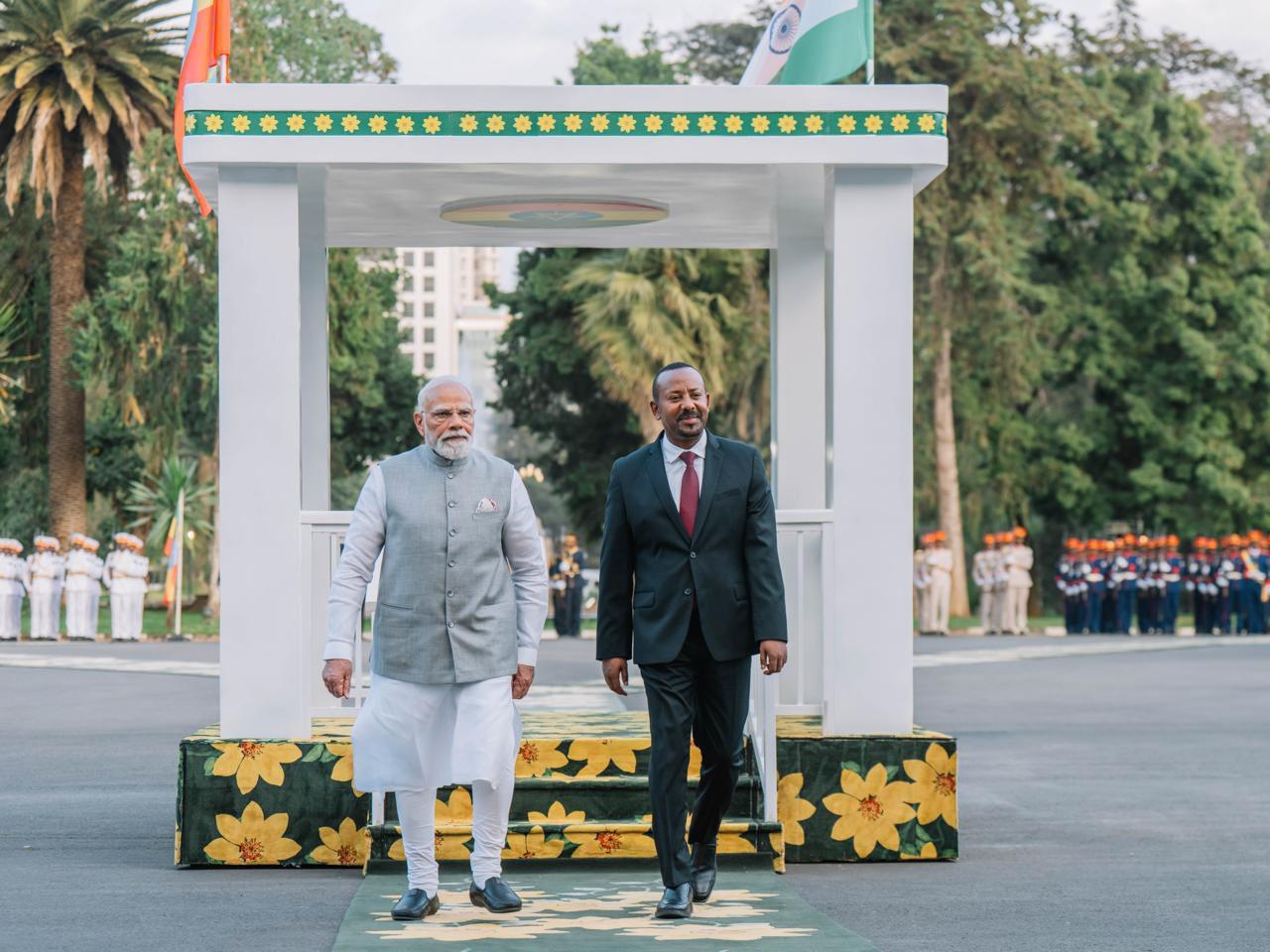

NAIROBI, Kenya, Dec 17 – The visit of Indian Prime Minister Narendra Modi to Addis Ababa this week marks more than a diplomatic milestone.
By elevating India–Ethiopia relations to a strategic partnership, the two governments signalled an intention to move decisively from political goodwill towards deeper economic and institutional cooperation.
Coming at a time when the Global South is reshaping its development pathways, the visit carries significance well beyond protocol.
In a post on X (formerly Twitter) Modi said: “Landed in Addis Ababa a short while ago. Honoured by Prime Minister Abiy Ahmed Ali’s gesture of welcoming me at the airport. Ethiopia is a nation with great history and vibrant culture. India and Ethiopia share deep civilisational ties. I look forward to engaging with the Ethiopian leadership to further strengthen our partnership in diverse areas.”
Modi underlined the importance of the visit, noting that it reflects India’s commitment to deepening partnerships with countries that share age-old civilisational links and robust contemporary relations with New Delhi.
On his first day in Addis Ababa Modi and Dy Abiy Ahmed saw India and Ethiopia sign three memoranda of understanding. Both countries have decided to enhance cooperation in administrative assistance in customs matters, data centre establishment at the embassy of Ethiopia and cooperation in UN peacekeeping.
“We are elevating India and Ethiopia relations to a strategic partnership. This step will provide new energy, new momentum and new depth to our ties,” Prime Minister Modi said during the delegation-level talks.
“Today, we got the opportunity to deliberate on the key aspects of our cooperation, such as economy, innovation, technology, defence, health, capacity-building and multilateral cooperation. I am pleased that today, we have decided to double the student scholarship for Ethiopia in India,” Mr. Modi said.
Mr. Modi said that India and Ethiopia have shared contact, dialogue, and exchange for thousands of years. The two countries, which are rich in languages and traditions, are symbols of unity in diversity, he added.
In a social media post, Prime Minister Abiy noted: “We held a productive tête-à-tête meeting, followed by a bilateral session with our respective delegations, exploring renewed avenues of cooperation that reflect the growing partnership and shared priorities between Ethiopia and India.”
“India has been a longstanding partner of Ethiopia, and today’s meetings underscore our shared commitment to expanding collaboration across multiple sectors for the mutual benefit of our nations,” Prime Minister Abiy stated.
“Today, we meet with a clear focus to shape a modern partnership, grounded in sovereignty, self-reliance and practical cooperation. Our cooperation is rooted in equality and South-South solidarity,” he said.
“Our economy is performing strongly. Last year, we grew 9.2% and this year we are expecting 10.3% GDP growth. Besides GDP growth, our FDI inflow is also rising big time. India is the leading source for our FDI,” he said.
Ethiopia, Africa’s second-most populous country, occupies a central position in the Horn of Africa and has long been viewed as a gateway to the continent. India, for its part, has become one of the most active external partners across Africa, with commercial interests spanning manufacturing, pharmaceuticals, agriculture, technology and infrastructure. The Modi visit reflects a convergence of priorities: Ethiopia seeking capital, trade expansion and foreign-exchange stability; India seeking reliable, long-term partners in fast-growing markets.
The warm welcome extended by Prime Minister Abiy Ahmed underlined the political importance Addis Ababa attaches to the relationship. When the two prime ministers arrived at the Sheraton Addis, members of local and international business and community circles were present to observe and welcome the moment — among them Mr Abdirashid Duale, reflecting the close interest of the private sector and diaspora communities in the visit’s economic implications.
Yet beyond ceremony, the real test will lie in execution — how trade flows are financed, how investments are settled, and how cross-border economic activity is sustained.
This is where financial intermediaries with deep regional roots — and effective public-private partnerships — play an increasingly central role.
Trade and investment partnerships depend not only on government agreements but on the capacity of businesses to move capital efficiently, compliantly and predictably. For Ethiopia, strengthening foreign-exchange inflows, expanding trade finance and integrating diaspora capital into the formal economy are now key policy objectives. Achieving these goals increasingly requires closer coordination between public institutions and private-sector operators.
Institutions such as Dahabshiil Group, one of the Horn of Africa’s largest financial services and investment groups, illustrate how private actors can support public economic objectives. Founded in the region and operating across Africa, the Middle East, Europe and North America, the group has long been associated with remittances. Its role has since broadened to encompass a wider range of financial services, including banking services across the region.
Through entities including East Africa Bank, Dahabshiil Group works with Indian, Ethiopian and global banking and commercial partners, and has expanded into trade-related payments, settlement services and cross-border liquidity support, operating alongside banks and regulators to facilitate formal trade flows.
Dahabshiil Group already facilitates significant trade-related financial flows between India and the region, including Ethiopia, supporting importers and exporters across sectors such as pharmaceuticals, consumer goods, machinery and agricultural inputs. Indian suppliers exporting into the region, and regional traders sourcing from India.
Beyond bilateral corridors, the group supports triangular and multi-market trade linking India with the Horn of Africa, the Gulf, East Africa, Europe and North America. This includes settling payments for regional exporters accessing third markets, supporting Indian firms operating across the Horn of Africa, and channelling diaspora-linked capital into productive trade and investment activity.
The relevance of these developments is further underscored by the presence in Addis Ababa of the Chief Executive Officer of Dahabshiil Group, Abdirashid Duale, who is engaging with stakeholders to assess economic and regulatory developments and to meet diaspora business communities active across Ethiopia and the wider region. Such engagement highlights how public-private partnerships are becoming more important than ever in translating diplomatic momentum into practical outcomes.
Yet the success of this renewed partnership will depend less on summit communiqués than on the plumbing of finance and trade — and on the effectiveness of collaboration between governments and private institutions. As states set direction, organisations such as Dahabshiil Group quietly ensure payments are settled, trade continues and commercial relationships endure.