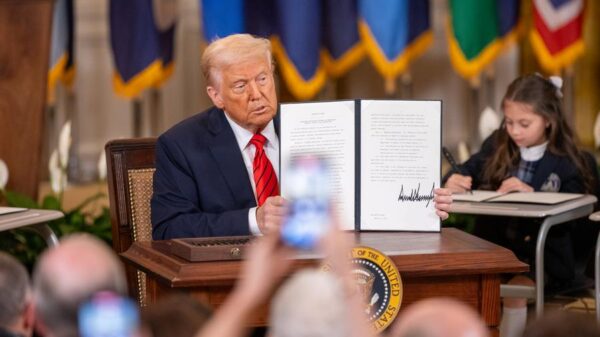



















APRIL 2 – Donald Trump says tariffs are coming. That message from the US president has been consistent.
But what tariffs and when? Import taxes have come so thick and fast since he took office that it can be hard to keep track.
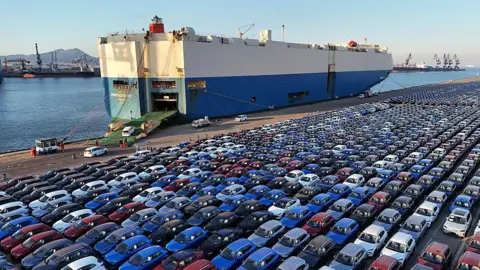
Trump has already raised duties on Chinese imports, as well as steel, aluminium and some goods from Canada and Mexico. Higher levies on cars are due to go into effect this week.
We’re now waiting for Trump to unveil the details of his plan for a wider set of tariffs, which his team has spent the last few weeks developing.
The White House is calling it “Liberation Day”. So what might we learn on Wednesday?
How big are the tariffs?
The White House has not said how high the tariffs could go, although various possible rates have been floated by analysts.
On the campaign trail last year, Trump backed a 10% across-the-board tariff on all imports coming into the US, sometimes suggesting that could be 20% – even 60% on imports from China.
Once in office, he introduced the idea of “reciprocal” tariffs, suggesting the rates could vary country by country.
“Very simply, it’s if they charge us, we charge them,” he said in February, shortly before he ordered officials to develop such a plan.
The White House almost immediately complicated the picture, noting that their recommendations would reflect not just tariffs but also other policies they believe are unfair to US businesses, like Value Added Tax (VAT).
It has a led to a scramble, as businesses and political leaders try to get a sense of how big a new tax their products might be facing; and how whatever is announced on Wednesday will interact with other duties, such as those on steel and aluminium, already put into effect by Trump.
Officials in Europe, for example, are preparing for a double-digit tariff on their exports. Trump earlier this year said he planned to hit goods from the bloc with a 25% import tax.

Which countries could be affected?
The Trump administration has not confirmed which countries will be hit, although it has trailed Wednesday’s announcement as a sweeping one.
On Sunday, the president said the new tariffs could apply to “all countries”, suggesting a possible return to the across-the-board tariff he backed in the campaign.
It dashed hopes in some countries, such as the UK, that thought they might float under the radar, though many are still hoping eventually to work out some sort of deal.
But it is still unclear to what extent the tariffs will be universally applied or more targeted.
Last month, US Treasury Secretary Scott Bessent said efforts were focused on the “Dirty 15” – the 15% of countries that account for the bulk of trade with the US and impose tariffs or other rules that put US firms at a disadvantage.
The Office of the US Trade Representative, as it prepared to craft recommendations, identified the countries in which it was “particularly interested”.
They were Argentina, Australia, Brazil, Canada, China, the European Union, India, Indonesia, Japan, Korea, Malaysia, Mexico, Russia, Saudi Arabia, South Africa, Switzerland, Taiwan, Thailand, Turkey, the UK and Vietnam.
Trump himself has reserved some of his harshest criticism for historic allies and major trade partners, such as Canada and the EU.
“Friend has been, oftentimes, much worse than foe,” he declared last week.
What impact will the tariffs have?
Tariffs are taxes on imports. So the big question is, who will pay?
Technically, there is a simple answer: the US firms bringing in the goods are the companies that will face the bill, especially if the White House starts levying the tariffs “immediately”, as spokeswoman Karoline Leavitt suggested on Tuesday.
But the larger the tariffs are, the more firms will be looking for ways to offset those costs, either by changing suppliers, pushing business partners to share the burden – or by raising prices for Americans.
Many firms have said they are already preparing for that step. But it is a risky game because if companies raise prices too much, buyers will simply stay away.
The dynamics have raised the risks of an economic recession both in the US – and far outside its borders, where many firms rely on US sales.
Trump says companies looking to avoid tariffs can simply do their business in the US, but that’s not an immediate, or easy fix, given the high costs of hiring and setting up factories.
Introduce currency swings and retaliation by other countries into the mix, and the repercussions of Trump’s bid to reset global trade balances are likely to prove hard to predict long after Wednesday’s announcement.
 Getty Images